
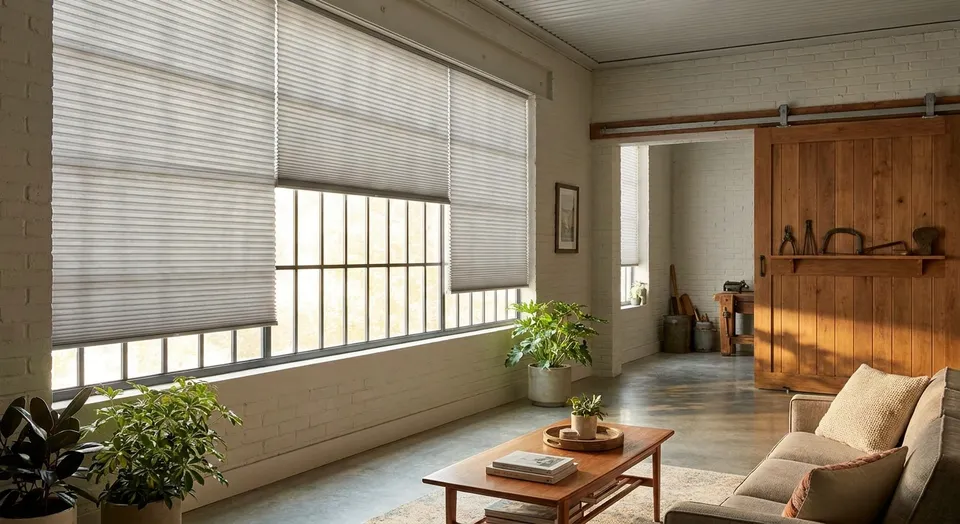
Garage conversions turn drafty storage space into a bedroom, office, or gym, but the windows in that space rarely got upgraded when the walls did, and single-pane or thin-frame windows leak heat fast in a Puget Sound winter. Insulated cellular shades close that gap without a full window replacement.
- Double-cell insulated cellular shades are the strongest pick for garage conversion bedrooms and offices in 2026. Buy them for year-round temperature control.
- Single-cell cellular shades cost less but trap one air layer instead of two, so they're a Consider, not a Buy, for uninsulated garage walls.
- Cordless double-cell blackout shades win for garage-converted nurseries and shift-worker bedrooms where light gaps matter as much as temperature.
- Roller shades alone don't solve the insulation problem in a garage conversion, pair or skip them for this specific use case.
Why this matters
A garage that becomes a bedroom or office keeps the original window openings in most cases, contractors reframe walls, not glass. Those windows were sized and specified for a garage, not a conditioned living space, so they run colder in winter and hotter in summer than the rest of the house. Insulated cellular shades in Auburn, WA and across South King County close a real performance gap for garage conversions, and the honeycomb structure is the reason: air trapped inside the cells acts as a buffer between the glass and the room.
This guide breaks down what to look for, which cellular shade types actually help in a converted garage, what to skip, and how the options stack up side by side.
Who this is for
This guide is for homeowners in Auburn, Kent, Tacoma, Bellevue, or elsewhere in the Greater Seattle Area who converted. Or are converting. A garage into a bedroom, home office, gym, or guest suite and are now dealing with a window that feels ten degrees off from the rest of the house. If the space still has the original garage-era window and no plans for a full replacement, cellular shades are the fastest fix that doesn't involve tearing into the wall.
What to look for in insulated cellular shades for garage conversions
Cell structure: single vs. double
Double-cell shades trap two layers of air instead of one, which is the entire mechanism behind their insulating value. For a garage conversion where the wall cavity and window flashing were never upgraded to living-space standards, that second air layer is doing real work against heat loss. Single-cell shades still help over bare glass, but they're a smaller upgrade.
Cell size
Cell sizes typically run from 3/8" up to 3/4", and larger cells generally hold more air. A garage conversion window that gets direct morning sun or sits on an exterior-facing wall benefits from the larger cell size. It's a bigger air buffer for a bigger temperature swing.
Light control matched to room use
A garage-converted bedroom needs near-total light blockage for anyone working night shifts or wanting to sleep past sunrise; a home office or gym conversion usually wants light filtering instead so the room doesn't feel like a cave. Get this wrong and you'll be re-ordering shades within a year.
Mount type and frame depth
Garage windows often have shallower frames than standard living-room windows, which limits inside-mount options. Getting the correct mount type for a custom shade matters more here than on a typical window because a frame that's too shallow forces an outside mount, which changes the measurements and the look.
Cordless or motorized operation
Garage conversions used as home gyms or offices tend to have furniture pushed close to the window, a cordless or motorized shade avoids a cord catching on equipment. If the room is a nursery or kids' space, cordless is close to mandatory for safety.
Moisture and temperature tolerance
Garages run more humid and temperature-volatile than the rest of the house before conversion, and some of that legacy condensation risk lingers at the window even after insulation and drywall go in. Cellular shade fabrics rated for moisture exposure hold their shape better in that environment than uncoated fabric options.
Get a shade plan for your garage conversion
Rainier Blinds measures and installs across the Greater Seattle Area with an in-house crew.
Top picks for garage conversions
Cellular construction can add an insulating layer at the window. Performance depends on the actual product, fit, glazing, climate, and use; request product-specific data rather than assuming an R-value or a fixed utility-bill saving.
The budget insulator, single-cell light filtering shade. Single-cell shades with a 3/8" cell size still beat bare glass by a wide margin and cost less than double-cell options. They make sense for a garage conversion used seasonally, like a guest room that only sees traffic a few months a year. Verdict: Consider when the room isn't in daily use.
The blackout pick for sleep spaces, cordless double-cell blackout shade. For a garage-converted bedroom, especially one used by a shift worker or a light-sensitive sleeper, blackout fabric paired with double-cell construction handles both the light problem and the temperature problem at once. See how energy-focused cellular shade picks stack up for South King County homes running through cold snaps. Verdict: Buy for any garage conversion used as a bedroom.
The double-duty pick. Motorized double-cell shade. Motorized operation solves the cord-clutter problem in garage gyms and offices where furniture sits close to the window, and it lets you schedule the shade to close automatically during the hottest part of the day. Homeowners converting garages in Lakewood and similar South Sound neighborhoods are landing on this option specifically for energy performance in cellular shades. Verdict: Buy for tech-forward households, Consider if budget is the priority.
Top-down/bottom-up cellular configurations can balance daylight and privacy on some openings. Confirm availability, dimensions, operating method, and the order schedule for the specific product before selecting it.
What to avoid
- A roller shade as your only fix. Roller shades control light and give a clean look, but they don't trap air the way a honeycomb structure does, so they solve none of the temperature problem a garage conversion actually has. The breakdown in roller shades vs. cellular shades for South King County homes covers exactly where this trade-off shows up.
- A shade sized for the rough opening instead of the actual glass. Garage window frames sometimes have uneven trim from the conversion work, and a shade cut to the wrong dimension leaves gaps that undo the insulating benefit entirely.
- Skipping the cordless upgrade in a room with kids, pets, or gym equipment. It looks like a minor upsell until a cord snags on a treadmill handle or a toddler reaches it.
Verdict comparison
| Option | Cell type | Best for | Light control | Verdict |
|---|---|---|---|---|
| Double-cell light filtering | 3/4" double | Year-round offices, bedrooms | Filtered | Buy |
| Single-cell light filtering | 3/8" single | Seasonal guest rooms | Filtered | Consider |
| Cordless double-cell blackout | 3/4" double | Shift-worker bedrooms, nurseries | Full blackout | Buy |
| Motorized double-cell | 3/4" double | Gyms, home offices, smart homes | Filtered or blackout | Buy / Consider |
| Top-down bottom-up cellular | Varies | Awkward window heights | Adjustable | Consider |
FAQ
Do insulated cellular shades actually help a garage conversion stay warm?
Yes, double-cell cellular shades trap two layers of air against the glass, which is the same principle behind double-pane windows, and that matters more in a garage conversion because the original window and frame usually weren't upgraded during the remodel.
What's the best cellular shade for a garage-converted bedroom?
A cordless double-cell blackout shade is the strongest pick for a garage bedroom in 2026 because it handles both light blockage and temperature buffering in one product, which matters most for shift workers or light-sensitive sleepers.
Is single-cell or double-cell better for a garage conversion?
Double-cell is better for daily-use rooms because it traps more air and holds temperature more consistently, while single-cell works fine for seasonal or occasional-use spaces where the budget matters more than peak insulation.
How much do insulated cellular shades cost for a garage conversion window?
Cost depends on window size, cell type, and whether you choose light filtering or blackout fabric, so get an on-site measurement for an accurate number rather than relying on a generic online estimate.
Can cellular shades replace the need for a window upgrade in a garage conversion?
Cellular shades reduce heat loss and gain significantly but don't replace a full window upgrade if the frame itself is failing or single-pane glass is cracked. They're a strong interim or complementary fix, not a structural repair.
Are cordless cellular shades safe for a garage conversion used as a nursery?
Choose a suitable cordless or motorized product to avoid an exposed operating pull cord. Follow all product safety instructions and keep cribs, beds, and climbable furniture away from windows.
Do motorized cellular shades work well in garage conversion home offices?
Motorized double-cell shades work well in garage offices because they eliminate cords near desks and equipment and can be scheduled to close automatically during peak sun hours.
What cell size is best for a garage window with direct sun exposure?
A larger cell size, around 3/4 inch, holds more trapped air and performs better against direct sun exposure than a smaller 3/8 inch cell, which matters most on south- or west-facing garage conversion windows.
One last thing
The detail most homeowners miss on a garage conversion isn't the shade. It's the frame depth. Garage window frames built for a utility space are often shallower than a standard living-room frame, which forces an outside mount and changes your measurements before you order anything. Measure the frame depth first, then pick the cellular shade, not the other way around.