
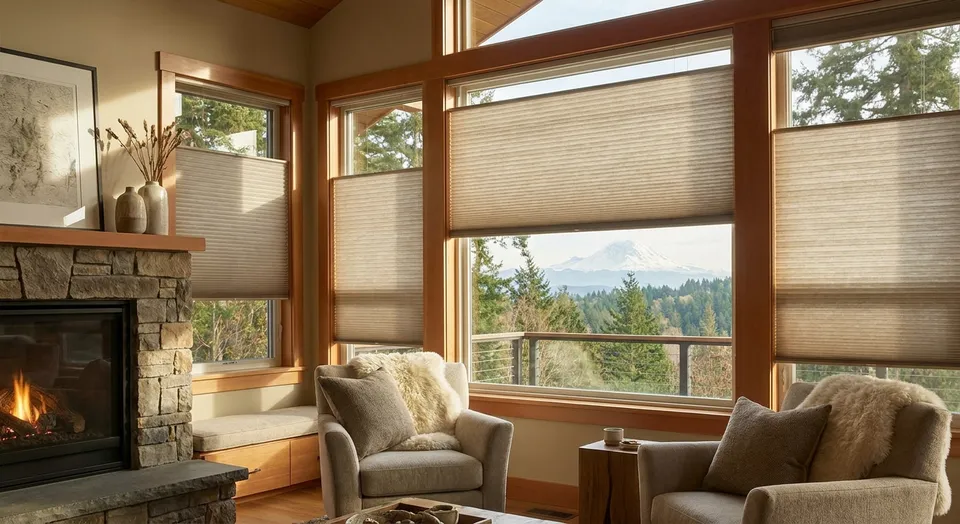
Cellular shades are the single most effective window treatment for cutting heat loss in Puget Sound homes, and not every cell type or size delivers the same payoff. This guide ranks the cellular shade categories that actually move the needle on winter heating bills in Auburn, Bellevue, Tacoma, and Seattle homes in 2026.
- Double-cell honeycomb shades win overall for energy savings in Rainier-area homes in 2026. Buy.
- Single-cell light-filtering shades cost less but insulate less; fine for low-priority rooms.
- Motorized cellular shades add scheduled closing at dusk, which matters more in short Puget Sound winter days.
- Compare the selected cellular product’s thermal data and mounting requirements. Fit matters, but side channels are not available or appropriate for every system.
- best cellular shades energy savings comes down to cell depth and side-track fit, not brand name.
Why this matters
Cellular construction can add an insulating layer at the window. The result depends on the exact product, fit, glazing, climate, and how the shade is used; it does not establish a particular temperature change or utility-bill saving.
The catch: not all cellular shades are built the same. A 3/8-inch single-cell shade from a big-box store insulates far less than a 1-inch double-cell shade with a tight side-channel fit. If you're comparing roller shades vs. cellular shades for a south-facing living room, the cell depth is the number that decides your winter utility bill, not the fabric pattern.
How this list is ranked
This ranking weighs four factors for Rainier-area homes specifically: measured insulating value (cell depth and construction), fit tightness (side channels, top-down/bottom-up hardware), light control needed for Pacific Northwest glare and gray-sky glare, and real installed cost versus a bare-bones single-cell shade. Categories that only look efficient on a spec sheet but leak air around the frame get marked down.
Each entry below is a cellular shade category, not a single SKU, because the construction type drives the energy outcome more than any one manufacturer. Rainier Blinds measures for side-channel and top-down/bottom-up hardware on every installed cellular shade, which is the detail that determines whether the insulating value on the label actually shows up on your energy bill.
The ranked list
1. Double-cell (honeycomb) shades: the safe pick
Cellular construction can add an insulating layer at the window. Performance depends on the actual product, fit, glazing, climate, and use; request product-specific data rather than assuming an R-value or a fixed utility-bill saving.
For a drafty single-pane window in an older Auburn or Federal Way home, this is the category that actually shows up as a lower gas or electric bill by the first full winter. Verdict: Buy for any west- or north-facing window in a home built before 2005.
2. Single-cell light-filtering shades: the budget pick
Single-cell shades run one row of honeycomb pockets, usually in the 3/4-inch to 1-inch range, and cost less installed than double-cell versions. Insulating value lands lower, typically half to two-thirds of a comparable double-cell shade.
They're a reasonable call for rooms with newer double-pane or triple-pane glass where the window itself is already doing most of the insulating work. Verdict: Consider for secondary bedrooms and low-traffic rooms; Skip for any room carrying the bulk of your winter heat loss.
3. Blackout cellular shades: best for bedrooms
Blackout cellular shades add an opaque backing layer to a single- or double-cell base, which blocks light completely and adds a modest insulating bump from the extra layer of material. The energy gain is secondary to the light-blocking job, but it's real.
Homeowners comparing options for a Federal Way primary bedroom often land here for the light control first and the energy savings second. Full details on sizing and fabric choices are in the guide to custom blinds for Federal Way homes. Verdict: Buy for bedrooms and media rooms; Skip for kitchens and living rooms where you want daylight back on demand.
4. Top-down/bottom-up cellular shades: the privacy-plus-efficiency pick
This hardware configuration lets the shade drop from the top of the frame while the bottom stays raised, so a room keeps daylight and privacy without sacrificing the insulating layer at the top of the window where heat rises fastest. It adds cost over a standard cellular shade but closes a gap that fixed shades can't.
For street-facing windows in Auburn and Renton where privacy and glare both matter, this hardware earns its keep. Verdict: Buy for any street-facing window; Consider for interior-facing windows where privacy isn't a factor.
5. Motorized cellular shades: the automation pick
Motorized cellular shades close on a schedule, which matters more in the Pacific Northwest than almost anywhere else in the country because winter daylight runs out by 4:30 to 5:00 p.m. from November through January. A shade that closes automatically at dusk traps the insulating air layer before the room starts losing heat, instead of after someone remembers to pull the cord.
The scheduling feature is the actual energy lever here, not the motor itself. The full rundown on hardware options and control apps is in the motorized shades guide for Kent homes. Verdict: Buy for homes where shades routinely sit open past sunset; Hold if someone in the house already closes shades reliably by hand.
6. Skylight and specialty-shape cellular shades: the situational pick
Skylights and angled windows lose heat fast because warm air rises straight to the glass, and a properly fitted cellular shade on a skylight can meaningfully cut that loss. The catch is fit: an off-the-shelf specialty shape almost never seals the frame the way a shade measured on-site does.
This is a category where a factory-cut shade genuinely underperforms a professionally measured one, because the side gaps on an odd-shaped window are exactly where the insulating air layer escapes. Verdict: Buy only with professional on-site measurement; Skip any pre-cut skylight shade that isn't measured for your exact frame.
Get an on-site measurement
Rainier Blinds measures every window before quoting, so the cell depth actually fits the frame.
Comparison table
| Category | Typical cell size | Insulating value | Best room | Verdict |
|---|---|---|---|---|
| Double-cell honeycomb | 3/4" to 1" | Varies by product | Drafty older windows | Buy |
| Single-cell light-filtering | 3/8" to 3/4" | Lower, roughly half of double-cell | Newer double-pane rooms | Consider |
| Blackout cellular | 3/4" to 1" | Moderate, light-control priority | Bedrooms | Buy |
| Top-down/bottom-up | 3/4" to 1" | Same as base cell, gap at top closed | Street-facing windows | Buy |
| Motorized cellular | 3/4" to 1" | Same as base cell, scheduling adds real-world savings | Whole-house automation | Buy |
| Skylight/specialty | Varies | High if fitted correctly, low if pre-cut | Skylights, angled glass | Buy with measurement only |
Where to buy
- Choose the shade and mounting method together. Accurate measurement helps account for the required deductions, depth, and obstructions; follow the selected product’s installation requirements.
- Cellular construction can add an insulating layer at the window. The result depends on the exact product, fit, glazing, climate, and how the shade is used; it does not establish a particular temperature change or utility-bill saving.
- Confirm the install crew is in-house, not a subcontractor. Rainier Blinds' own crew handles measure-to-install for cellular shades across Auburn, Bellevue, Tacoma, and Seattle, and the same team that measures does the fitting, which matters most on skylights and angled frames. See the full rundown on custom window treatments in Auburn for what a measured install looks like start to finish.
FAQ
What's the best cellular shade for energy savings in 2026?
Cellular construction can add an insulating layer at the window. The result depends on the exact product, fit, glazing, climate, and how the shade is used; it does not establish a particular temperature change or utility-bill saving.
Do cellular shades really lower heating bills?
Cellular construction can add an insulating layer at the window. The result depends on the exact product, fit, glazing, climate, and how the shade is used; it does not establish a particular temperature change or utility-bill saving.
Is a 1-inch cellular shade better than a 3/4-inch one?
A 1-inch cell traps more still air than a 3/4-inch cell, so it insulates better, though the difference is smaller than switching from single-cell to double-cell construction. For maximum insulation, double-cell 1-inch shades outperform both.
Are motorized cellular shades worth it for energy savings?
Motorized cellular shades are worth it if your shades routinely sit open past sunset, since scheduled closing traps the insulating air layer before the room starts losing heat. If someone already closes shades by hand every evening, the energy gain from motorization is minimal.
How much do cellular shades cost installed in 2026?
Installed cost varies by cell type, size, and hardware like top-down/bottom-up or motorization, and pricing is best confirmed with an on-site quote rather than an online estimate. Big-box pre-cut shades often list lower upfront but lose insulating value from poor frame fit.
Do blackout cellular shades save more energy than light-filtering ones?
Blackout cellular shades add a modest energy bump from the extra opaque layer, but the primary benefit is light control, not insulation. For bedrooms where both matter, blackout cellular shades are the stronger pick.
What ruins the energy performance of a cellular shade?
Compare the complete product’s documented thermal performance and mounting details. Accurate measurement and appropriate installation help the shade perform as designed.
Are cellular shades better than roller shades for energy savings?
Cellular construction can add an insulating air layer, while roller fabrics offer different light-control and solar properties. Compare the actual products, care needs, and complete quotes rather than assuming a fixed energy or cost advantage.
One last thing
The thermal result depends on the complete shade, glazing, fit, and use. Follow the product’s mounting requirements and discuss how daily opening and closing will fit your routine. Use product-specific evidence for any savings estimate.