
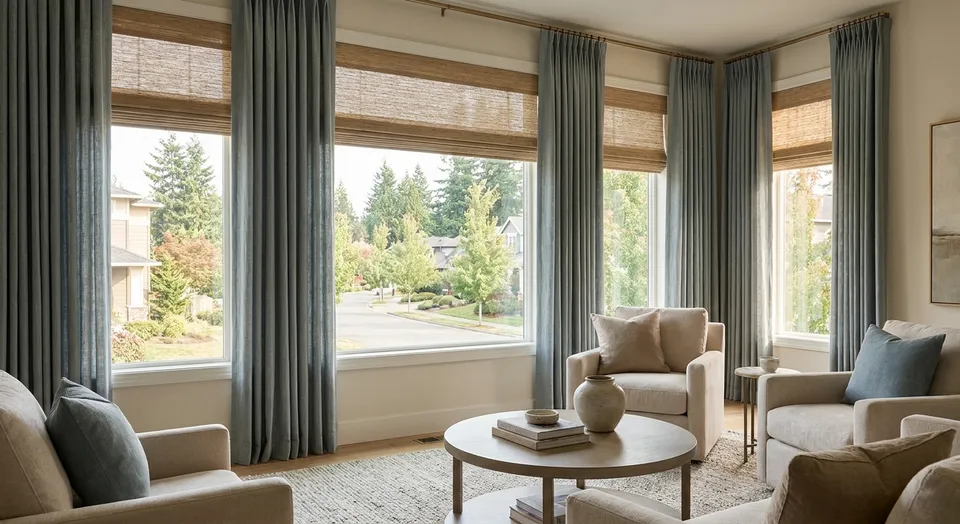
Custom window treatments in Auburn, WA come in more shapes, sizes, and motorization options than ever in 2026. This guide covers what to look for, what to skip, and how the measurement and installation process actually works when you hire a local crew that measures and installs with its own team.
TL;DR
If you're shopping for custom window treatments in Auburn, WA, the three things that matter most are precise in-home measurements, fabric opacity matched to each room, and motorization that fits your smart-home setup. Rainier Blinds measures every window with our own crew, has shades custom-made to your exact measurements, and installs them, no subcontractors, no guesswork. Start with a quote to get real pricing for your windows.
Why this matters
Professional measuring helps account for mounting depth, obstructions, and the selected hardware before ordering. Our Perfect-Fit Promise covers corrections to our team’s measuring or installation errors; compare the complete product and installation scope when reviewing quotes.
Auburn sits in a particular pocket of South King County where the housing stock runs from 1960s ranch homes to new construction. Window sizes vary wildly. A shade that fits a 1980s builder-grade window in a Lakeland Hills new build won't fit a original wood-frame window in an older Auburn neighborhood. Custom measurement handles both, stock sizes handle neither.
Who this is for
Auburn homeowners replacing builder-grade window coverings or outfitting a new home. You want real pricing, a crew that shows up, and shades that fit, not a DIY measuring kit and a return policy. If you're renovating a room, building an addition, or just tired of the blinds that came with the house, this guide applies to you.
What to look for in custom window treatments
In-Home Measurement
A shade that's 1/4 inch too narrow gaps at the edge. Too wide and it binds in the track. Any custom window treatment starts with a measuring tape in your home, not a phone photo and a hope. Rainier Blinds measures every opening on-site, the same crew that installs shows up to measure. That means the person measuring knows exactly how the shade will sit in the frame, accounting for obstructions like window cranks, handles, and molding depth.
Fabric Opacity Per Room
Sheer, light-filtering, room-darkening, and blackout each serve a different room. A south-facing living room in Auburn needs light-filtering to cut glare without killing the view of Mount Rainier. A bedroom needs blackout for summer 5:15 AM sunrises. A bathroom needs moisture-resistant fabric. You're not picking one shade type. You're matching fabric to what each room does.
The four common opacity levels:
- Sheer: Diffuses light, minimal privacy at night. Best for living rooms with no direct sightline from neighbors.
- Light-filtering: Cuts glare, maintains daytime privacy, room still feels bright. The most common choice for main living areas.
- Room-darkening: Blocks most light, some glow at edges. Good for bedrooms where total darkness isn't critical.
- Blackout: reduces light through the fabric. Plan edge coverage for the desired room darkness.
Motorization That Fits Your Home
Compatibility, hub requirements, and available controls depend on the selected motor and your home setup. We confirm those details before ordering.
Warranty Terms
Service life depends on the selected fabric, hardware, exposure, use, and care. Follow the product instructions and confirm the applicable written warranty; no fixed replacement interval is promised.
Local Scheduling and Follow-Up
The biggest difference between a local company and an online retailer is what happens after the shades are ready. A local crew installs on your schedule, and if a shade needs adjusting, the same team comes back. No shipping a 6-foot shade back to a warehouse in another state.
Top picks
The All-Rounder: Light-Filtering Roller Shades
Roller shades offer a simple profile and a range of fabric opacities. Confirm the selected fabric’s care instructions, dimensions, and mounting requirements. Choose each room’s light control and privacy deliberately.
The Bedroom Pick: Blackout Cellular Shades
Cellular construction can add an insulating layer at the window. The result depends on the exact product, fit, glazing, climate, and how the shade is used; it does not establish a particular temperature change or utility-bill saving.
The Smart-Home Pick: Motorized Zebra Shades
The wildcard. Zebra shades (also called transitional shades) alternate sheer and solid fabric bands. Motorize them and you get privacy and light control without pulling a cord, the shade transitions between open and closed by aligning the bands. In 2026, most motorized zebra shades pair with a smartphone app and voice control via Alexa or Google Home. Consider if you're setting up a smart home and want a single shade to cover both privacy and light. The Auburn service area page has more on local installation.
What to avoid
Self-Measure Kits from Online Retailers
The correct measuring method depends on the selected hardware, mounting position, and opening. Professional measuring helps account for obstructions and required clearances. Compare complete product and installation quotes rather than assuming a fixed price gap between local and online options.
One-Size-Fits-All Hardware
Custom measurement helps account for the actual opening and hardware. The required deductions and edge gaps depend on the system; an exact-size order does not guarantee gap-free blackout.
Overlooking the Top Treatment
The top of the shade, headrail, cassette, or fascia, is visible every day. A flush cassette looks finished and hides the roller. An exposed headrail collects dust and looks unfinished. This is a decision to make before ordering, not after installation. Cassettes add cost but are worth it in living spaces where the shade top is at eye level.
Verdict comparison
| Feature | Roller Shades | Cellular Shades | Zebra Shades |
|---|---|---|---|
| Best room | Living, kitchen | Bedroom, media | Mixed-use |
| Light control | Light-filtering to blackout | Light-filtering to blackout | Sheer to room-darkening |
| Insulation | Minimal | High (double-cell) | Moderate |
| Motorization | Available | Available | Common |
| Clean lines | Yes | Yes | Yes |
| Cost range | Moderate | Moderate to high | Higher |
FAQ
What's the best custom window treatment for Auburn homes? Light-filtering roller shades handle most living spaces. Pair them with blackout cellular shades in bedrooms for a complete home solution. The key is matching fabric opacity to each room's use.
How much do custom window treatments cost in Auburn, WA? Pricing varies by product, fabric, and motorization. Rainier Blinds gives a quote for your selected options at your consultation, no showroom visit required. The cost depends on window count, shade type, fabric grade, and whether you add motorization.
How long does installation take? Our team measures the openings, arranges the custom order, and installs the selected treatments. We confirm the production and installation schedule for your project; motor setup and operation checks are included where applicable.
Do I need motorized shades? No. Manual shades work well for most homes. Motorization adds convenience for hard-to-reach windows, tall windows, or smart-home integration. It's an upgrade, not a requirement.
What's the difference between custom and stock window treatments? Custom shades are cut to your exact window measurements. Stock shades come in preset sizes that may gap or bind. Custom also offers more fabric and motorization options.
Can Rainier Blinds install shades I bought elsewhere? Rainier Blinds installs and provides automation services for shades supplied by Rainier. For a shade bought elsewhere, contact its original supplier for installation or retrofit support.
Does Rainier Blinds make the shades? No. Rainier Blinds measures your windows, has custom-made shades produced by established wholesale suppliers, and installs them with our own crew. The measurement and installation are in-house. The manufacturing is not.
One last thing
The most common mistake Auburn homeowners make in 2026 is ordering one shade type for the whole house. Your living room, bedroom, and bathroom have different light, privacy, and moisture needs. Match the shade to the room, not the other way around. A 10-minute conversation about what each room does saves a costly remake.
Related guides
In-home consultations are free within 60 driving miles of Auburn. Farther projects are considered individually; any consultation fee is quoted before booking and credited toward your order.