
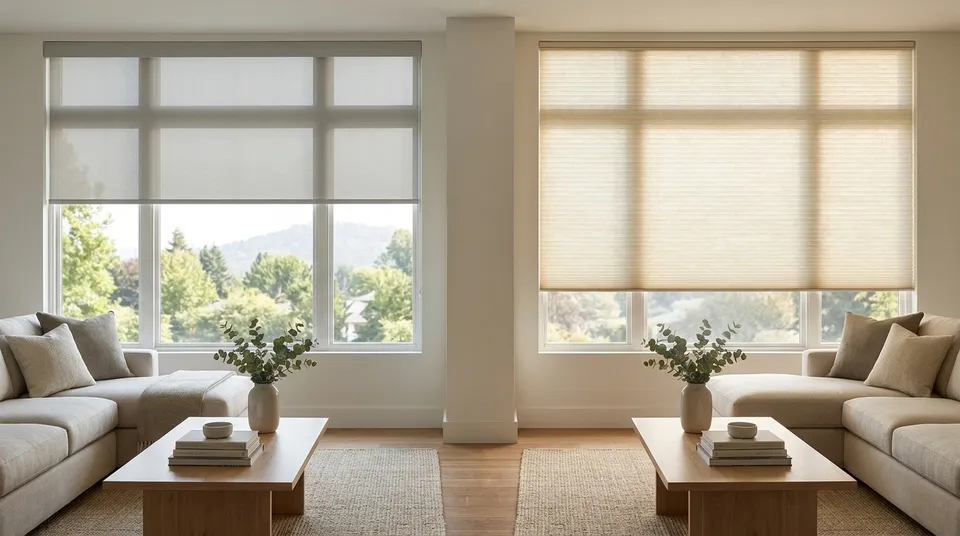
Roller and cellular shades can both provide privacy and light control. The useful difference is how they look, how their fabric is constructed, and which product fits your window and daily routine. You can use either throughout a home or combine them room by room.
Start with the room's main job
A bedroom may need stronger light blocking, a home office may need less glare, and a street-facing living room may need privacy during the day. Decide which of those needs comes first, then compare suitable fabrics in both shade styles.
Roller shades use a sheet of fabric that rolls around a tube above the opening. They create a simple, flat appearance when lowered and can be specified with different fabrics, including light-filtering and blackout options.
Cellular shades use pleated fabric with a honeycomb structure. The folded appearance is different from a roller, and the cells can provide an insulating layer at the window. Cellular fabrics also come in different light-control options.
Light control and privacy
Both roller and cellular shades can be raised partway. Neither is limited to being fully open or fully closed. The fabric determines what light passes through the covered portion; the raised portion leaves the glass exposed.
Some cellular systems also offer top-down/bottom-up operation, allowing coverage at the lower part of the window while light enters above. Availability and control options depend on the selected product, so confirm the configuration before relying on that feature.
Look at a sample with daylight behind it and discuss nighttime privacy as well. A fabric that preserves a daytime view may behave differently when the room is lit after dark. For stronger darkness control, compare dedicated blackout fabrics and the mounting plan together.
Insulation and comfort
Cellular construction is worth considering when adding insulation at the window is a priority. Actual performance depends on the specific product, fit, glazing, climate, and how the shade is used. A shade category does not establish a fixed R-value or a guaranteed reduction in energy bills.
Roller shades can help manage incoming sunlight and glare, depending on the fabric. Pacific Northwest National Laboratory's window attachment guide explains how coverings can affect heat gain and heat loss. Ask for performance information for the actual fabric or system, then compare it against the cellular option you are considering.
Blackout depends on fit as well as fabric
Blackout fabric is designed to block light through the material. Light can still enter around the sides, top, bottom, or between panels. Honeycomb construction does not automatically seal these gaps, and a roller is not automatically the weaker blackout choice.
An outside mount may allow more overlap; an inside mount keeps the treatment within the opening. Suitable edge treatments may be available for particular systems. The bedroom blackout guide explains what to compare when room darkness matters most.
Fit, controls, and care
Required mounting depth and maximum sizes vary by product. Check the measured frame, handle clearance, brackets, and raised stack instead of using a universal depth figure. A shallow opening does not automatically rule out every cellular system.
Both styles can offer motorized options. Motor location, noise, speed, charging, and smart-home compatibility depend on the selected system. Ask to see how it operates and confirm the controls rather than assuming one shade style is always quieter or faster.
Care also varies by fabric. Follow the supplied instructions before wiping, vacuuming, or using a cleaning product. Neither a flat surface nor a honeycomb structure guarantees that a fabric can be washed.
Compare complete quotes
Price depends on dimensions, fabric, hardware, controls, and installation. A roller shade is not always less expensive than a cellular shade. Compare measured options with the same scope, then decide which features are worth the difference for each room.
For a whole-house plan, list the main need beside every opening. Our budgeting guide can help you organize that comparison.
Which should you choose?
Start with roller shades if you prefer a flat fabric surface and simple appearance. Start with cellular shades if you like the pleated look and want to explore an insulating construction. Then check the light-control fabric, mounting, controls, and quote for your actual windows.
Book a in-home consultation to compare samples and measured options for your home.