
Our available controls: Rainier Blinds offers Roman and woven wood shades with motorized operation only. Available controls and power options for other products are confirmed at your consultation.
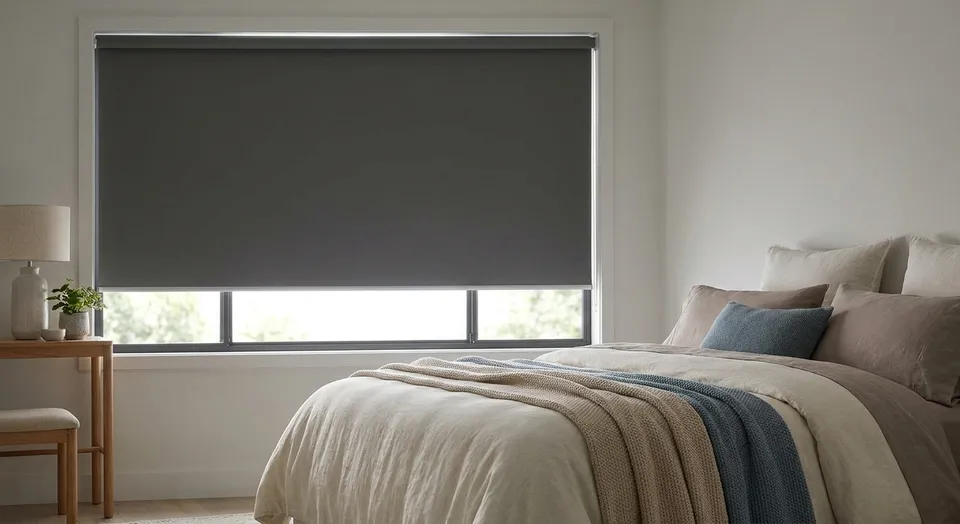
Blackout shades for a bedroom need to do one job well: kill light without turning the room into a cave, and in 2026 the honeycomb and zebra dual-shade categories do that better than the roller blinds most people default to.
- Blackout fabric is designed to block light through the material. Light can still enter around the sides, top, or bottom, so mounting, overlap, and suitable edge treatments determine how dark the room becomes.
- Zebra dual shades cost more but let you dial light from full black to soft filter without swapping panels.
- Blackout roller shades are the budget pick but gap light at the edges unless side channels are added.
- Motorized blackout shades make sense for rooms over 60 inches wide or hard-to-reach windows. Otherwise skip the upgrade.
- Custom-measured shades outperform stock big-box sizes on light gaps around Seattle-area window frames, which run non-standard more often than not.
Why this matters
A gap of even a quarter inch around a shade lets in enough light to wreck deep sleep, and that's the single biggest complaint homeowners in the Auburn and Kent area bring to Rainier Blinds after buying stock blackout shades from a big-box store. Stock sizing doesn't account for the window trim variations common in older South King County homes, so the shade that looked perfect online ships with a half-inch light leak on both sides.
The fix isn't a better shade. It's a correctly measured one, paired with the right fabric category for how dark you actually need the room. That's the distinction this guide ranks against.
How this list is ranked
Compare blackout fabric, edge coverage, mount, ease of use, and care requirements. These are selection considerations, not measured light-blocking scores or a claim of product testing.
The ranked list
1. Cellular (honeycomb) blackout shades: the safest pick
Blackout fabric is designed to block light through the material. Light can still enter around the sides, top, or bottom, so mounting, overlap, and suitable edge treatments determine how dark the room becomes.
They run mid-range on price compared to basic rollers, but the light-blocking-to-cost ratio is the best of any category on this list in 2026. Installation is straightforward on standard double-hung windows and slightly more involved on bay or arched frames. Verdict: Buy. This is the default recommendation for a primary bedroom.
2. Zebra (dual) shades with blackout lining: the wildcard
Zebra shades alternate sheer and solid bands on one roll, letting you slide the fabric to control exactly how much light comes through. Pair that mechanism with a blackout-lined solid band and you get a shade that goes from filtered morning light to full black with one pull.
The tradeoff is mechanical complexity. More moving parts than a single-fabric roller means more that can eventually need adjustment. For a primary bedroom where one partner wakes earlier than the other, this flexibility solves a real problem no other shade type addresses. Verdict: Buy if you need adjustable light levels; Hold if a fully dark room is the only goal, since a simpler cellular shade does that job for less.
3. Blackout roller shades: the budget pick
A blackout roller offers a simple fabric face, but the installed result depends on mounting and edge coverage. Blackout fabric is designed to block light through the material. Light can still enter around the sides, top, or bottom, so mounting, overlap, and suitable edge treatments determine how dark the room becomes.
That's the catch: without side channels or an outside-mount install that overlaps the trim, light leaks in along both edges and across the bottom. For a nursery or a light-sensitive sleeper, that gap matters. Verdict: Consider for guest rooms or secondary bedrooms; Skip for a primary bedroom unless it's installed as an outside mount with overlap.
Comparison guides that break down roller shades against cellular options side by side, like this South King County roller vs. cellular breakdown, are worth reading before choosing between the two. The differences in edge-gap and insulation aren't obvious until you see them measured out.
4. Blackout roman shades: the style pick
Roman shades with a blackout liner sewn behind the front fabric give a bedroom a softer, more tailored look than a roller or cellular shade. The liner does the actual light-blocking; the visible fabric is decorative.
They stack thicker when raised, which eats a bit more window height, and the fold structure means dust collects in the pleats over time. For a primary bedroom that's also a design focal point, the tradeoff is worth it. Verdict: Buy for style-forward bedrooms; Hold if low-maintenance is the priority.
5. Motorized blackout shades: buy only if the window earns it
Motorized versions of any blackout fabric above solve two specific problems: windows wider than 60 inches where a wand or cord becomes awkward, and windows that are physically hard to reach, over a headboard, above a stairwell, in a vaulted bedroom ceiling.
The motor adds cost and a battery or wiring decision, and for a standard 36-inch bedroom window it's solving a problem that doesn't exist. Homes with wide primary suite windows or automated morning routines get real value here, the motorized shades guide for Kent, WA homes walks through when the automation actually pays off versus when it's an unnecessary add. Verdict: Buy for wide or hard-to-reach windows; Skip for standard-size windows where a manual shade does the same job for less.
6. Drapery layered over a blackout shade: additional edge coverage
Even a well-fitted cellular or roller blackout shade can leave a faint light line at 2 a.m. from streetlights or a neighbor's motion light. Layering blackout-lined drapery over the shade closes that last gap completely, since the drapery panel overlaps the entire window frame including trim.
This is the most expensive route because it's two window treatments instead of one, and it only makes sense when a homeowner has already tried a shade alone and still notices light. Verdict: Consider as a second step, not a first purchase.
Comparison table
| Shade type | Light blocked | Edge-gap risk | Best for | Verdict |
|---|---|---|---|---|
| Cellular blackout | Depends on fabric, fit, and edge coverage | Low | Primary bedrooms | Buy |
| Zebra dual w/ blackout | Depends on fabric, fit, and edge coverage | Low | Split sleep schedules | Buy |
| Blackout roller | Depends on fabric, fit, and edge coverage | Medium-High | Budget / secondary rooms | Consider |
| Blackout roman | Depends on fabric, fit, and edge coverage | Low-Medium | Design-focused bedrooms | Buy |
| Motorized blackout | Same as base fabric | Low | Wide or hard-to-reach windows | Buy (situational) |
| Drapery over shade | Depends on fabric, fit, and edge coverage | None | Closing remaining light leaks | Consider |
“A quarter-inch gap around a shade is enough light to wreck deep sleep, and that's the gap stock big-box sizing almost always leaves.”
Where to get them installed
- Skip stock big-box sizing for any window that's more than a few years old. Trim settles, frames shift, and a stock 36x64 shade rarely fits a real 36x64 opening without a gap.
- Get an actual measurement before you buy fabric type. The right blackout category depends on the window's width, mount depth, and whether it's an inside or outside mount. Guessing here is how gaps happen.
- Ask who installs it. A crew that measures and installs shades custom-made to your exact measurements catches sizing problems before they're a returned box sitting in a closet.
Get a real measurement for blackout shades
On-site measuring and installed pricing for bedrooms across the Greater Seattle Area.
FAQ
What are the best blackout shades for a bedroom in 2026?
Blackout fabric is designed to block light through the material. Light can still enter around the sides, top, or bottom, so mounting, overlap, and suitable edge treatments determine how dark the room becomes.
Do blackout roller shades really block all light?
Blackout fabric is designed to block light through the material. Light can still enter around the sides, top, or bottom, so mounting, overlap, and suitable edge treatments determine how dark the room becomes.
Are motorized blackout shades worth it for bedrooms?
Motorized blackout shades are worth it for windows wider than 60 inches or windows that are hard to physically reach, like over a headboard or in a vaulted ceiling. For a standard 36-inch bedroom window, a manual shade does the same job for less money.
Is cellular or roller better for blocking light?
Cellular shades generally block light more consistently than roller shades because the honeycomb cell structure itself stops light rather than relying only on fabric density. Roller shades can match cellular on fabric-level blocking but lose ground on edge gaps.
How much light do blackout roman shades block?
Blackout fabric is designed to block light through the material. Light can still enter around the sides, top, or bottom, so mounting, overlap, and suitable edge treatments determine how dark the room becomes.
Should I layer drapery over a blackout shade?
Blackout fabric is designed to block light through the material. Light can still enter around the sides, top, or bottom, so mounting, overlap, and suitable edge treatments determine how dark the room becomes.
Do stock big-box blackout shades fit older homes well?
Stock sizing frequently leaves light gaps in older homes because window frames and trim shift out of standard dimensions over time. A measured, custom-fit shade closes gaps that stock sizing consistently misses.
What's the difference between blackout and room-darkening shades?
Blackout fabric is designed to block light through the material. Light can still enter around the sides, top, or bottom, so mounting, overlap, and suitable edge treatments determine how dark the room becomes.
One last thing
Blackout fabric is designed to block light through the material. Light can still enter around the sides, top, or bottom, so mounting, overlap, and suitable edge treatments determine how dark the room becomes.