
Our available controls: Rainier Blinds offers Roman and woven wood shades with motorized operation only. Available controls and power options for other products are confirmed at your consultation.
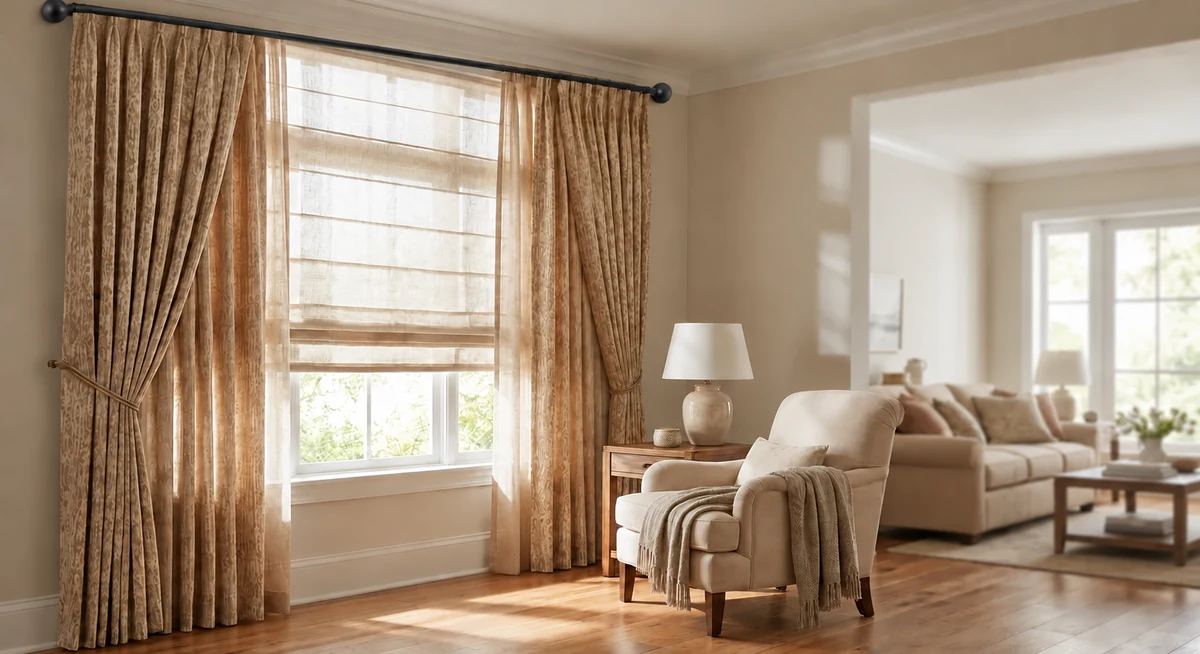
Shades and drapery can share the work of controlling light, creating privacy, and adding texture to a living room. A roller shade might handle everyday glare while drapery softens the wall. A light-filtering shade might pair with closing drapery for more privacy after dark. Decide what each layer needs to do before choosing the fabrics or hardware.
Give each layer a purpose
Look at the room in daylight and after dark. Note when glare reaches the television or seating area and which windows face a street or neighboring home. Privacy depends on the fabric and lighting conditions, so assess samples in the actual room.
Choose whether the drapery will close across the window or remain as stationary side panels. Decorative panels cannot provide full-window privacy on their own. If the room is used for movie nights, consider how both layers will control light, including gaps around the edges.
Two heavier layers can be appropriate when darkness is a priority, while lighter combinations may suit a room used mostly during the day. There is no rule that one layer must be blackout and the other light filtering. Compare the combined effect before deciding.
Compare fabrics together
Place the shade and drapery samples beside each other near the window, then look at them against the paint, flooring, and upholstery. A smooth shade with textured drapery is one useful combination. Two textured fabrics can also work when their colors and patterns feel balanced.
Roman shades add fabric folds, while roller shades present a flatter surface. Rainier Blinds offers Roman and woven wood shades with motorized operation only. If you are considering Roman shades, review fabric choices along with the raised stack and hardware depth.
For striped or patterned treatments, look at the whole wall instead of a small swatch alone. The zebra shade guide can help you consider that layer alongside the drapery.
Plan the shade mount and drapery hardware together
An inside-mounted shade can leave room for drapery in front of the window, provided the frame meets the shade's mounting requirements. An outside mount can also work, but its projection must be included in the drapery plan. Our mounting guide explains the factors to compare.
Use the actual product dimensions to check the headrail, brackets, moving fabric, handles, trim, and drapery folds. Motorized treatments also need suitable access to power connections and charging ports. A rod that clears an empty headrail may still leave too little room once fabric is hanging.
There is no single rod height or clearance measurement that fits every room. Ceiling height, trim, mounting surfaces, bracket projection, panel construction, and fabric weight all affect the layout. Raising a rod alone does not necessarily fix a collision between the two layers.
Leave room for open drapery
Plan where the panels will sit when drawn back. Their stacked width depends on the fabric, lining, fullness, and heading style. A small extension past the window frame will not automatically keep the glass clear.
Check nearby walls, furniture, doors, and heating equipment before choosing the rod or track length and panel drop. Follow the relevant clearance requirements. For panels that will close daily, think about how easily someone can reach and operate them without brushing against the shade.
Test the finished combination
With both layers installed, run the shade through its normal travel and open and close the drapery. Check the fabric and hardware in every position, including the shade's raised stack. If anything catches, stop and identify the contact point before operating it again.
Dress and care for drapery according to its fabric instructions, then recheck the spacing as it settles. Avoid assuming a universal settling time or using heat or steam without confirming the care guidance.
Contact Rainier Blinds to plan the shade, drapery, and hardware together for your living room.
Common questions
How high should I hang drapery above a shade?
Choose the height from the room proportions, mounting surfaces, and actual hardware. Check projection and fabric clearance as well as height; there is no universal measurement.
Can Roman shades be layered with drapery?
Yes. Allow room for the headrail, raised folds, drapery, and charging access. Rainier Blinds offers Roman shades with motorized operation only.
Can I pair blackout shades with blackout drapery?
Yes, when that combination suits the room. Compare the fabrics, panel stack, and remaining light gaps instead of choosing solely from the blackout label.