
Our available controls: Rainier Blinds offers Roman and woven wood shades with motorized operation only. Available controls and power options for other products are confirmed at your consultation.
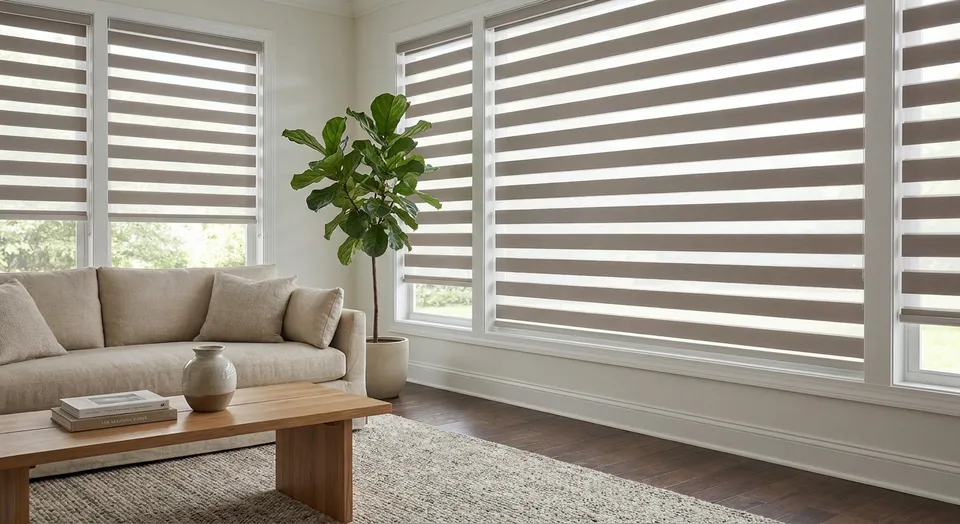
Dual layered zebra shades give Seattle-area living rooms adjustable light control and privacy without the all-or-nothing tradeoff of a solid shade. This guide breaks down which band widths, opacities, and mount styles actually hold up in 2026, and which configurations look right on paper but fail in a real living room.
- Zebra shades living room setups with 3-inch alternating bands fit most standard Seattle windows better than 4-inch bands. Buy.
- Motorized zebra shades solve cord-safety and reach problems on picture windows over 72 inches wide. Consider for wide glass.
- Light-filtering-only fabric skips true blackout; pair with a second layer for media-room use. Skip if you need dark rooms alone.
- Cassette headrails hide the fabric roll better than open-roll systems on street-facing windows. Buy for exposed installs.
- Chain-operated zebra shades fail cordless safety needs in homes with toddlers or pets. Go cordless or motorized instead.
Why This Matters
Living rooms take the heaviest light-control demands in a house. They combine street-facing glass, TV glare, and furniture that fades faster than anywhere else in the home. Dual layered zebra shades solve this by letting you slide alternating sheer and solid bands to filter light in stages instead of flipping between fully open and fully closed.
The wrong band width or opacity means recutting fabric later or living with a shade that never quite blocks the low winter sun angle common across the Puget Sound. Rainier Blinds measures and installs zebra shades for living rooms across Auburn, Bellevue, Tacoma, and Seattle, and the configuration mistakes below show up on nearly every job that started as a DIY online order.
Who This Guide Is For
This is written for homeowners with a living room window facing a street, a west-facing wall catching afternoon sun, or a TV wall that fights glare every evening. It's also for anyone weighing zebra shades against roman shades or drapery and unsure whether the dual-layer fabric actually earns its higher price over a plain roller shade. If your living room has kids under six or a dog that treats the window as a lookout post, the cordless and motorized sections below matter more than the fabric color chart.
What to Look For in Dual Layered Zebra Shades for Living Rooms
Band Width
Most zebra shades ship in 2-inch, 3-inch, or 4-inch alternating bands. Narrower bands give you finer light control in small steps; wider bands look bolder but create more visible gaps when the shade is half-open. A 3-inch band is the safe default for living room windows under 60 inches wide in 2026. It balances light staging without the horizontal-blind look that 4-inch bands can drift toward.
Opacity Ratio
The sheer-to-solid ratio inside each band determines how much daytime privacy you actually get. A sheer-heavy fabric brightens a room but leaves silhouettes visible after dark, which matters on ground-floor living rooms facing a sidewalk. A balanced or privacy-leaning weave costs a little more light but holds up better for street-facing rooms.
Headrail and Cassette Style
An open-roll headrail exposes the fabric tube at the top of the window. A cassette headrail wraps that tube in a fabric-covered box. On a living room window that's visible from the main seating area, the cassette version looks finished; the open-roll version looks unfinished within a year of dust buildup.
Motorization vs. Manual Operation
A manual cordless lift works fine on windows under 60 inches wide that you can reach easily. Anything wider, higher, or behind furniture is a candidate for motorization, battery-powered or hardwired. Because a manual system on a wide zebra shade needs more force to lift evenly and tends to bind after a season of daily use.
Mount Type
Inside mount sits the shade inside the window frame and shows more of the trim. Outside mount covers the frame and blocks more light around the edges, which matters on older Seattle-area homes with uneven or non-square window openings. Getting this wrong on a bay window or a window with deep trim is one of the most common measurement errors homeowners make ordering online.
Top Picks for Living Room Zebra Shades in 2026
The Standard Workhorse: 3-Inch Cordless, Balanced Opacity
This is the default configuration for a living room window between 36 and 60 inches wide with moderate sun exposure. It uses a cordless lift, a 3-inch band, and a balanced sheer-to-solid ratio that filters light without going full blackout. Zebra shades installed in Auburn in this configuration handle both morning glare and evening privacy without a second layer. Buy.
The Picture-Window Solve: Motorized, Wide-Format
For living room windows over 72 inches wide, common in newer South King County construction, a manual chain or cordless system struggles to lift evenly across the full span. Motorization spreads the lift force across the width and adds smart-home scheduling if the room gets direct afternoon sun. It costs more upfront than a manual version, but it's the configuration that actually gets used daily instead of left half-open out of frustration. Buy for windows over 6 feet wide.
The Light-Filtering Compromise: Sheer-Heavy Fabric
A sheer-heavy dual layered zebra shade brightens a north-facing or shaded living room nicely, but it does not deliver true blackout even fully closed. Fine for a daytime-use living room; not fine if the same room doubles as a home theater at night. Consider only if blackout isn't the priority.
The Layering Play: Zebra Shade Behind Drapery
Pairing a 3-inch zebra shade with drapery panels adds texture and softens the horizontal-band look some homeowners find too modern for a traditional living room. Custom drapery panels for living rooms work as the outer layer while the zebra shade handles daily light adjustment underneath. Buy if you want a layered, less banded look.
The Skip: 4-Inch Chain-Operated Band
Do not choose band width or operating control from a photo alone. Compare the actual zebra fabric and its light gaps, and select controls suitable for the household. Follow the product safety instructions.
What to Avoid
- Ordering the same band width for a narrow and a wide window on the same order. A 3-inch band that looks proportional on a 40-inch window looks chunky on a 90-inch one.
- Skipping the cassette headrail on a fully exposed living room window. The open-roll tube sags visibly within a year of daily use and collects dust faster than a covered one.
- Cordless controls avoid exposed operating pull cords. Follow the product safety instructions and keep beds, furniture, and other climbing objects away from windows.
“If the sheer stripe covers more than half the window, you've bought a curtain, not a shade.”
Verdict Comparison
| Configuration | Band Width | Opacity | Operation | Best For | Verdict |
|---|---|---|---|---|---|
| Standard cordless | 3" | Balanced | Manual, cordless | Windows up to 60" | Buy |
| Motorized wide-window | 3" | Balanced | Motorized | Windows 60"+ | Buy |
| Sheer-heavy light-filtering | 3" | Sheer-leaning | Manual | Daytime brightness, no blackout need | Consider |
| 4" chain-operated | 4" | High-contrast | Chain | Adults-only homes | Skip for family homes |
Get zebra shades measured for your living room
Book an in-home consultation to compare samples and get a measured quote.
FAQ
What are zebra shades and how do they work in a living room?
Zebra shades use alternating horizontal bands of sheer and solid fabric on a single roll. Sliding the fabric adjusts how much sheer or solid material sits over the window, letting you stage light instead of choosing only open or closed.
Are zebra shades good for living rooms with lots of sun?
Yes, a balanced-opacity dual layered zebra shade handles direct sun well by letting you dial in coverage gradually. West-facing living rooms in 2026 typically do better with a privacy-leaning weave than a sheer-heavy one.
Do zebra shades block light completely?
Not fully, even closed, unless you choose a blackout-lined version. Standard dual layered zebra fabric filters and reduces light rather than blocking it entirely, which is why media rooms often pair them with a second blackout layer.
How much do dual layered zebra shades cost installed?
Cost depends on window width, fabric opacity, and whether the shade is motorized. Getting an exact number requires an on-site measurement, since living room windows vary widely across Auburn, Bellevue, Tacoma, and Seattle homes.
Are zebra shades safe for homes with kids and pets?
Cordless controls avoid exposed operating pull cords. Follow the product safety instructions and keep beds, furniture, and other climbing objects away from windows.
Can zebra shades be motorized?
Yes, motorization is a standard option on dual layered zebra shades and is the better choice for living room windows over 6 feet wide or windows mounted high or behind furniture.
What's the difference between zebra shades and roller shades for a living room?
A roller shade uses one continuous fabric panel with a single opacity, while a zebra shade uses alternating sheer and solid bands you can adjust in stages. Zebra shades give more light-staging flexibility; roller shades are simpler and often less expensive.
How wide can a single zebra shade panel go before you need two?
Most manufacturers cap a single zebra shade panel around 96 to 108 inches wide depending on fabric weight and motor capacity. Wider living room windows typically split into two panels for even lift and a cleaner light gap at the center.
One Last Thing
Most glare complaints on living room zebra shades trace back to west-facing windows, not south-facing ones. A 3-inch or wider band on a west wall can create a hot-spot glare line through the sheer stripe even with the shade half-closed, which is why homes with strong afternoon sun on the living room usually do better with a privacy-leaning opacity rather than the sheer-heavy option that looks brightest in a showroom.