
Our available controls: Rainier Blinds offers Roman and woven wood shades with motorized operation only. Available controls and power options for other products are confirmed at your consultation.
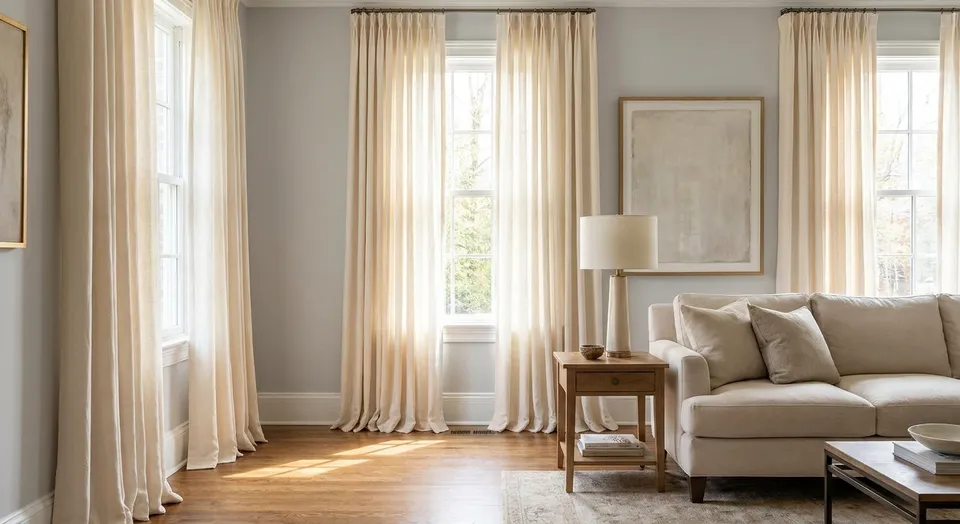
Custom drapery panels for a living room need to solve for Seattle's low winter light and long summer glare at the same time, not just look good in a photo. A roll of stock panels from a big-box store rarely fits the width, length, or light-control job a Puget Sound living room actually needs.
- Linen-blend custom drapery panels for living rooms at 2.5x fullness are the safe 2026 pick. Buy.
- Blackout-lined panels beat sheer-only setups for west-facing Seattle-area living rooms with afternoon glare. Buy.
- Skip stock 84-inch panels. Most Auburn and Bellevue ceilings need 96 or 108-inch custom lengths.
- Production and installation timing depend on the selected fabric, hardware, supplier availability, and project scope. We confirm the current estimate for your order before you plan around a completion date. Start planning early if you have a holiday, move, or renovation deadline.
Why this matters
Drapery is the one window treatment where fit is visible from across the room. A panel that's 6 inches too short reads as a mistake, not a style choice, and a panel with no lining leaves west-facing living rooms glowing orange at 6pm every summer evening.
Homeowners across Auburn, Bellevue, and Tacoma keep making the same three mistakes: buying stock lengths, skipping the fullness math, and picking fabric before checking what the window actually faces. Fix those three and the rest of the decision gets easy.
Who this is for
This guide is for homeowners in the Greater Seattle area replacing rental-grade curtains, mismatched big-box panels, or bare windows in a living room they actually use every day, not a formal room nobody sits in. If you're comparing custom drapery against ordering online sight-unseen, the difference shows up in fullness, hem weight, and whether the panel actually reaches the floor.
What to look for in custom drapery panels for a living room
Fabric weight and light control
A living room facing west or south needs weight behind the color choice, not just the color. Light-filtering linen looks great on a north-facing wall and looks washed out by 4pm on a west-facing one, so match the fabric weight to the exposure before the swatch.
Fullness ratio
Fullness is the ratio of fabric width to rod width, and it's the single biggest reason custom panels look better than stock ones. Most designers target 2 to 2.5 times the rod width; anything under 2x reads flat and thin once it's hung, no matter how good the fabric felt on the sample.
Mount type and hardware
Ceiling mount, wall mount, and traverse rod each change how a panel stacks and how much wall space it eats when open. Get the mount type wrong and a panel that measured perfectly on paper crowds the window when it's pulled back.
Length and hem style
Floor-length panels break just above the floor, puddle panels pool 1 to 2 inches on the ground, and both look intentional only when the length is custom-ordered for the actual ceiling height. Standard 84-inch retail panels stop short of most 9 and 10-foot Seattle-area ceilings, which is why so many living rooms end up with an awkward gap of exposed wall above the rod.
Budget and lead time
Custom drapery costs more per panel than a stock two-pack, but it's the only route that gets the fullness, length, and lining right on the first try. Lock in the budget before falling for a fabric that blows past it, since lining and motorization both add to the per-panel cost.
Motorization readiness
Our automation service is for Rainier-supplied shades. We confirm whether the exact product supports the requested controls; we do not promise motor or cordless conversions for customer-owned shades.
Top picks for living room drapery
Linen-blend panels. The safe pick. Linen-blend fabric holds a 2.5x fullness ratio without sagging and takes light-filtering or blackout lining equally well. One spec that matters: weight per yard, anything under 4 ounces droops at full length. Buy.
A blackout lining can reduce light through a decorative drapery face. The thermal and privacy result depends on the fabric, lining, coverage, glazing, and use; we do not promise a fixed temperature reduction.
Layered sheer plus drapery, the designer pick. A sheer panel on an inner rod with a heavier drapery panel on an outer traverse rod gives daytime privacy without blocking light, then full blackout at night when both layers close. It's two rods and two fabric orders instead of one, so it costs more and takes longer to install. Consider.
Motorized drapery track, the smart-home pick. A motorized traverse track opens and closes wide living room panels on a schedule or a phone app, which matters most on windows over 8 feet wide where manually pulling a cord gets old fast. It needs an outlet or battery pack near the track, so plan the electrical before the fabric arrives. Consider.
Roman shade paired with side drapery, the hybrid pick. A roman shade for the living room handles daily light control while stationary drapery panels frame the window for width and softness. This works well on a single large window where full-width traverse drapery would look bulky. Consider.
Get living room drapery measured right
In-house measure and install across Auburn, Bellevue, Tacoma, and Seattle.
What to avoid
- Stock panels under 96 inches for anything but an 8-foot ceiling. They stop 6 to 12 inches short of the floor on most 9 and 10-foot Seattle-area rooms.
- Unlined sheers as the only layer on street-facing or west-facing living room windows, no privacy after dark and no heat control during the day.
- Mismatched hardware finishes: pairing a satin nickel rod with brass curtain rings looks like an afterthought even when the fabric is right.
Verdict comparison
| Style | Fullness needed | Light control | Verdict |
|---|---|---|---|
| Linen-blend panel | 2.5x | Medium (light-filtering) | Buy |
| Blackout-lined panel | 2.5x | High | Buy |
| Layered sheer + drapery | 2x sheer, 2.5x drapery | High (layered) | Consider |
| Motorized traverse track | 2.5x | Depends on liner | Consider |
| Roman shade + side drapery | N/A (shade) + 2x panels | High | Consider |
FAQ
What's the best fullness ratio for living room drapery panels?
2 to 2.5 times the rod width is standard for living room drapery panels in 2026. Anything under 2x looks flat and thin once it's hung, even in good fabric.
How long should drapery panels be for a living room?
Panels should be custom-measured to reach the floor or break just above it, which usually means 96 or 108 inches for 9 to 10-foot ceilings. Standard 84-inch retail panels come up short on most of these rooms.
Is custom drapery better than stock panels from a store?
Custom drapery fits the exact width, length, and fullness a room needs, while stock panels are cut to generic sizes that rarely match Seattle-area ceiling heights. The difference shows up most in fullness and hem length.
How much does custom drapery cost for a living room in 2026?
Cost depends on fabric, lining, width, and whether the track is motorized, so get a specific quote for the room's measurements rather than relying on a national average. Lining and motorization both add to the per-panel price.
Do blackout-lined drapery panels work for west-facing living rooms?
Yes, blackout lining behind a decorative face fabric cuts afternoon heat gain and glare on west-facing windows without switching to a heavy, dark-looking fabric. It's one of the more requested upgrades for Seattle-area living rooms with strong summer sun.
Can drapery panels be motorized?
Yes, a motorized traverse track opens and closes drapery panels on a schedule or app, which matters most on windows wider than 8 feet. It needs an outlet or battery pack near the track, so plan the electrical before ordering fabric.
How long does it take to get custom drapery installed?
Production and installation timing depend on the selected fabric, hardware, supplier availability, and project scope. We confirm the current estimate for your order before you plan around a completion date. Start planning early if you have a holiday, move, or renovation deadline.
Should I pair drapery with blinds or shades underneath?
Pairing drapery with a roman shade or roller shade underneath gives daily light control while the drapery panels frame the window for width. This combination works best on a single large window rather than a wall of smaller ones.
One last thing
Most homeowners pick fabric first and fullness last, which is backwards, a gorgeous pattern at 1.5x fullness looks cheaper than a plain linen at 2.5x. Settle the fullness ratio and hardware before falling in love with a bolt of fabric, and the rest of the decision gets a lot easier.