
Our available controls: Rainier Blinds offers Roman and woven wood shades with motorized operation only. Available controls and power options for other products are confirmed at your consultation.
Consultations are free within 60 driving miles of Auburn. Farther projects are considered individually; any consultation or travel fee is quoted before booking and credited toward your order if you proceed.
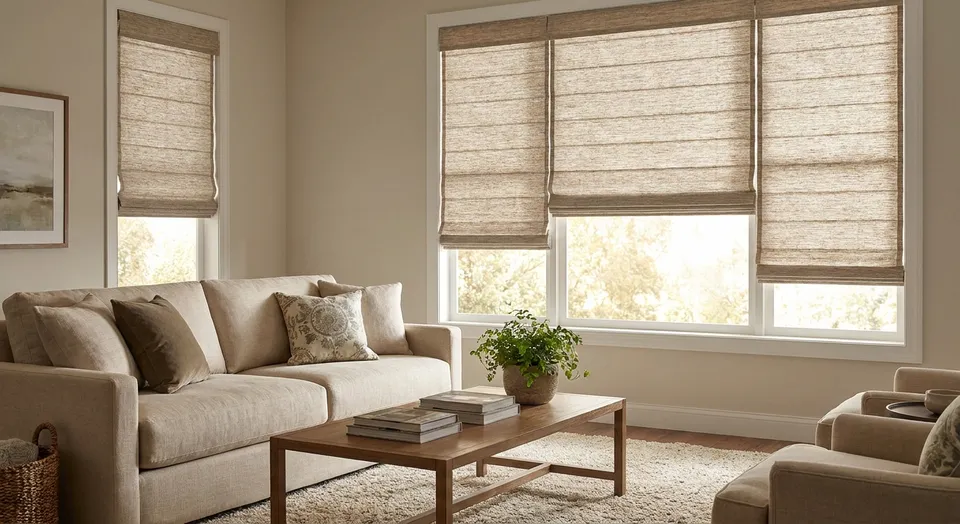
Roman shades pull a living room together the way a good rug does: soft folds, clean lines, and no dangling cord sitting next to the coffee table. This ranks the roman shade styles that actually hold their shape in Pacific Northwest living rooms in 2026, not the ones that only look good in a showroom photo.
- Flat roman shades top the list of best roman shades for living rooms in 2026, tailored folds, no bunching. Buy.
- Motorized roman shades win for tall or hard-to-reach living room windows. Buy.
- Relaxed roman shades soften a room but collect more dust. Consider for low-traffic rooms.
- Skip balloon (Austrian) roman shades in a living room, the puffed fold reads dated fast.
Why This Matters
Roman shades have become the default request for living rooms across Auburn, Bellevue, Tacoma, and Seattle in 2026, mostly because homeowners want fabric warmth on a window without the bulk of full drapery panels. A roman shade folds flat against the glass when raised and drops as a clean, unbroken panel when lowered, no rings, no swag, no visible hardware competing with furniture.
The catch is that "roman shade" covers at least six different fold structures and three lift types, and not all of them behave the same way in a living room that gets used every day. Rainier Blinds fields this question constantly from homeowners comparing options for custom window treatments in Auburn, and the style that photographs best online is rarely the one that survives a couch full of kids and a west-facing window.
How We Ranked These Roman Shades
For a living room, compare Roman fold style, fabric, lining, stack depth, and care. Rainier Roman shades are motorized only; we confirm their power and controls before ordering. These are practical selection factors, not a laboratory durability ranking.
The Ranked List
1. Flat Roman Shades: The Safe Pick
Flat roman shades use internal dowels that fold the fabric into crisp, stacked pleats, no soft draping, no bunch. They stack into 4-to-6-inch folds when raised, which keeps the headrail clean on windows up to about 54 inches wide before the fabric needs a seam. This is the fold structure that reads tailored rather than fussy, and it pairs with almost any living room style from mid-century to traditional. Verdict: Buy.
2. Relaxed Roman Shades: The Soft Pick
Relaxed romans drop the dowels and let the bottom curve softly instead of folding flat, which is the look most people picture when they say "cottage" or "farmhouse." The folds run 6-to-8-inch, looser and more visible, which means more fabric surface catching dust in a room with a lot of foot traffic. It's the right call in a formal living room that stays closed off most of the day. Verdict: Consider.
3. Motorized controls
Our Roman shades use motorized operation. Choose the fabric and lining for your room, then we confirm the motor, power option, and controls at your consultation.
"If the fold doesn't sit flat within an inch of the headrail at full lift, the shade is decorative, not functional."
4. Motorized Roman Shades: The Smart-Home Pick
Motorized roman shades solve the two biggest living room problems at once: tall windows nobody wants to reach on a ladder, and living rooms where the shade needs to move on a schedule with sunrise, sunset, or a smart-home routine. They pair especially well with the tall picture windows common in motorized shades built for Renton living rooms, where a manual lift would mean a step stool every evening. Verdict: Buy for any window over 6 feet or hard to reach.
5. Blackout-Lined Roman Shades: The Light-Blocking Pick
A blackout liner adds roughly 1/8 inch of thickness per layer, which changes how tightly the shade folds at the top but buys near-total light control for a living room doubling as a media or theater space. Without the liner, a standard roman shade still lets a visible glow through the fabric weave even fully lowered. Skip the liner if the room's main job is daytime reading light; add it if the TV competes with a south-facing window. Verdict: Buy for media-heavy living rooms.
6. Layered Roman Shades With Drapery: The Designer Pick
Layering a flat roman shade under a drapery panel is the move that shows up in every high-end living room photo, the shade handles light control, the drapery handles softness and height at the ceiling line. It costs more in fabric and hardware than a shade alone, but it's the difference between a finished room and a room with a shade on the window. Verdict: Buy if the budget allows both.
7. Balloon (Austrian) Roman Shades: The One To Skip
Balloon romans use continuous scalloped folds instead of flat pleats, giving a puffed, gathered look that reads more 1990s formal dining room than 2026 living room. The fold structure also traps more dust than any other style on this list because of the sheer fabric volume involved. Reserve this for a powder room or skip it in the living room entirely. Verdict: Skip.
Roman Shade Styles Compared
| Style | Fold at Lift | Light Control | Best For | Verdict |
|---|---|---|---|---|
| Flat | 4-6 inches | Moderate | Everyday living rooms | Buy |
| Relaxed | 6-8 inches | Moderate | Low-traffic formal rooms | Consider |
| Motorized controls | 4-6 inches | Moderate | Homes with kids or pets | Buy |
| Motorized | 4-6 inches | Moderate | Tall or hard-to-reach windows | Buy |
| Blackout-lined | 4-7 inches | High | Media rooms | Buy |
| Layered with drapery | 4-6 inches | High | Design-focused living rooms | Buy |
| Balloon | Continuous | Low | Rooms outside the living space | Skip |
Where To Source Roman Shades For Your Living Room
Stock roman shades sold off a rack come in a handful of fixed widths, and any living room window past 60 inches will need a seam that most stock panels aren't cut to handle cleanly. Custom measurement matters more for roman shades than almost any other window treatment because the fold structure depends on exact width, a shade that's even an inch too wide won't stack evenly at the headrail.
- Measure the window in place, not from a listing, width tolerances of even a half inch throw off the fold pattern.
- Match the lift type to the room's actual traffic before matching it to a photo; Rainier Roman shades are motorized only; confirm power and compatible controls for the selected product, relaxed folds solve none that a flat fold doesn't also solve.
- Compare against other shade categories before locking in fabric, the roller shades vs cellular shades breakdown covers when a flat panel beats a folded fabric shade entirely.
Rainier Blinds measures and installs roman shades with its own crew across the four-city service area, Auburn, Bellevue, Tacoma, and Seattle, rather than subcontracting the install out. Our crew handles the measurement and installation process to ensure proper fold alignment. For a living room with a motorization plan already in mind, the motorized shades guide for Kent homes walks through what to check before adding power to the lift.
Get living room roman shades measured right
Book an in-home consultation to compare samples and get a measured quote.
FAQ
What's the best roman shade style for a living room?
Flat roman shades are the best all-around choice for most living rooms in 2026 because they fold cleanly and suit almost any decor style. Motorized versions are the better pick for tall or hard-to-reach windows.
Are roman shades better than curtains for a living room?
Roman shades give tighter light control and a cleaner look at the window than curtains alone, since they fold flat against the glass instead of hanging loose. Many living rooms layer both, using the shade for light control and drapery for height and softness.
How much light do roman shades block?
A standard roman shade fabric still lets some glow through the weave even fully lowered. A blackout-lined roman shade blocks close to all direct light, which matters in a living room used as a media space.
Are cordless roman shades safe for kids and pets?
Our Roman shades use motorized operation. Choose the fabric and lining for your room, then we confirm the motor, power option, and controls at your consultation.
Can roman shades be motorized?
Yes, roman shades motorize well and are a strong fit for tall living room windows where a manual lift means climbing on furniture. Motorized lifts also work into smart-home schedules tied to sunrise and sunset.
Do roman shades work on wide living room windows?
They work, but any window wider than about 60 inches needs seamed fabric panels rather than a single stock width. A single fabric width tops out around 54 inches before the pattern has to repeat awkwardly.
What's the difference between roman shades and roller shades?
Roman shades fold in fabric pleats when raised, giving a soft, layered look, while roller shades wrap around a single tube for a flatter, more minimal profile. The choice usually comes down to whether the room wants texture or a clean, low-profile line.
One Last Thing
The detail most homeowners miss in 2026 isn't the fold style. It's the headrail depth. A flat roman shade with a shallow headrail can look identical to one with a deep headrail in a photo, but the deep version hides the folded fabric completely when raised, while the shallow one leaves a visible bump at the top of the window. Ask about headrail depth before fabric color; it's the difference between a shade that disappears when open and one that never quite does.