
Our available controls: Rainier Blinds offers Roman and woven wood shades with motorized operation only. Available controls and power options for other products are confirmed at your consultation.
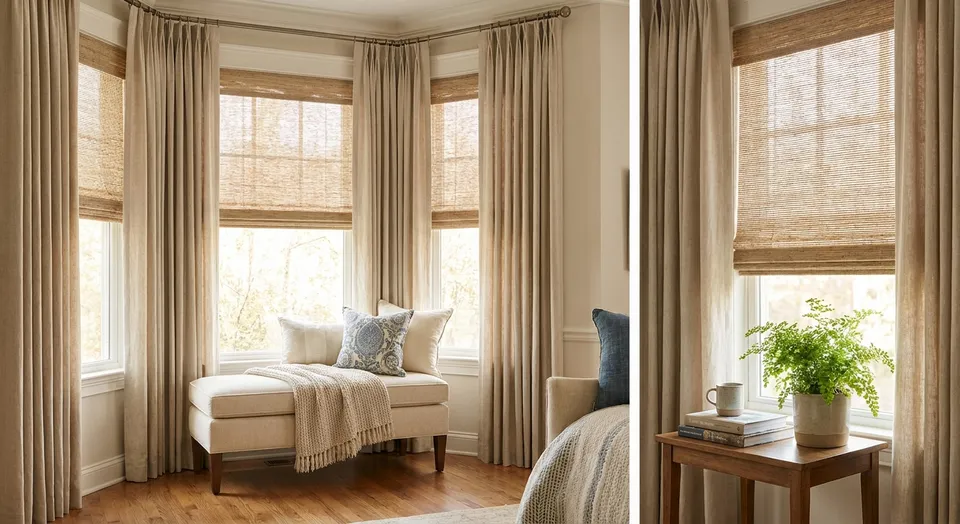
Bay windows are three (sometimes five) angled panes meeting at a corner, and that geometry breaks most off-the-shelf window treatments before you even get to the fabric choice. This guide covers what actually works for bay window configurations in 2026, what fails, and which specific product types solve the reach, light-gap, and mounting problems unique to a three-pane corner.
- Cellular shades win for bay windows in 2026 because honeycomb pleats close light gaps at the corner seams. Buy.
- Motorized shades solve the center-pane reach problem on deep bay setups. Buy if the middle window is over 30 inches from the nearest wall.
- Continuous curtain rods across a bay window block corner light and read as a fix, not a solution. Skip.
- Stock flat shades sized for single windows create visual clutter and installation problems on angled bay corners. Consider only if budget is the primary constraint.
- Custom window treatments for bay windows in 2026 typically require angle-specific mounting brackets, not standard hardware.
Why this matters
A bay window is the focal point of most living rooms and dining nooks in Auburn, Bellevue, and Tacoma homes, and it's also the window that gets treated wrong most often. Standard rod-and-panel curtains hung across a bay flatten the architecture and choke off the light the bay was built to capture. The wrong mount depth on angled brackets leaves gaps you can see daylight through from six feet away. Getting window treatments for bay windows right means matching the product to the angle, the reach, and the light gap problem, not just picking a fabric you like.
Who this is for
This guide is for homeowners with a genuine bay configuration, three or more window panes set at an angle off the main wall, usually in a living room, dining area, or primary bedroom. If you've got a single flat picture window flanked by two smaller ones on the same wall plane, that's a different setup with different rules. Bay windows specifically create three separate mounting angles, a hard-to-reach center pane, and corner seams where light leaks through unless the treatment is built for the geometry.
What to look for in window treatments for bay windows
Angle-specific mounting brackets
Standard blind brackets are built for a flat wall, and forcing them onto a 30-45 degree bay angle leaves the headrail crooked or the shade hanging at a slight tilt. Custom-measured brackets account for each pane's angle individually, so all three shades sit level and close flush. This is the single most common failure point in bay window installs done with stock big-box hardware.
Individual pane control vs. uniform look
Each pane in a bay window faces a slightly different direction, which means sun exposure hits the side panes earlier or later than the center one. Independent controls on each shade let you close the west-facing pane at 4pm without blacking out the other two. A single continuous treatment sacrifices that control for a cleaner sightline, decide which one matters more before you order.
Motorization for the center pane
The center window in a deep bay is often set back far enough that a pull cord or wand is awkward to reach, especially over a window seat or radiator. Motorized shades solve this with a remote or app control instead of leaning across furniture twice a day. If the center pane sits more than 30 inches back from the side walls, motorization stops being a convenience upgrade and starts being the only practical option.
Light gap control at the corners
Where two bay panes meet at a corner, flat-profile shades can leave a sliver of light bleeding through even when fully closed. Cellular and honeycomb constructions compress tighter at the seam because the pleats flex slightly to follow the angle. Roller shades with rigid tubes are more prone to a visible gap at the same corner.
Cord-free operation
Choose a suitable cordless or motorized product to avoid an exposed operating pull cord. Follow all product safety instructions and keep cribs, beds, and climbable furniture away from windows. For a bay window, check the clearance and interaction of every adjacent shade.
Fabric weight and stack height
Heavier fabrics like room-darkening drapery stack up thicker when raised, and in a bay window that stack eats into the narrow space between panes. Lighter cellular or roller fabrics stack flatter, which keeps the corner sightlines clean when the shades are open.
Top picks for bay windows
Cellular shades, the light-gap fix. Honeycomb construction closes tighter against the angled corner brackets than rigid roller tubes, cutting the visible light gap most homeowners complain about after a DIY install. Insulating cell shades also help with the draft that's common on older bay window frames in South King County homes built before double-pane glass was standard. Verdict: Buy for anyone prioritizing a clean, light-tight close across all three panes. See the full breakdown in roller shades vs. cellular shades for South King County homes.
Motorized shades, the reach problem solver. For a bay with a center pane set back 30+ inches, a remote-controlled lift beats climbing over a window seat twice a day for the life of the product. Motorized shades in 2026 also integrate with existing smart home hubs in most Bellevue and Renton installs, so the bay window syncs with the rest of the house schedule. Verdict: Buy if the center pane is hard to reach, details in the motorized shades guide for Kent, WA homes.
Zebra/roller shades. The clean modern pick. Roller shades give the flattest stack and the most minimal sightline of any option here, which works well in a bay window where you want the architecture to stay visible even with shades installed. They're less forgiving on the corner light gap than cellular shades, so measure twice on angle-cut brackets. Verdict: Consider for a modern look where light-tight closure isn't the top priority.
Roman shades and drapery. The decorative layer. Roman shades add a tailored, fabric-forward look that reads more finished than a flat shade, and drapery panels flanking the outer two panes can frame a bay without covering the center view. Neither solves the light-gap or reach problem on their own, they're a style layer, best paired with a functional shade underneath. Verdict: Consider as a second layer, not a standalone fix; for a real-world example of pairing them, see custom window treatments for Auburn, WA homes.
Continuous single-rod curtains, the shortcut that doesn't work. Running one curtain rod straight across all three panes is the fastest fix to install and the worst one to live with. It flattens the bay's angle, blocks the corner light the architecture is built to catch, and bunches unevenly when you try to pull the curtain back over an angled corner. Verdict: Skip.
What to avoid
- Stock flat shades sized for single windows. They're built for a single plane and will hang crooked or gap at every bay corner once installed.
- One giant valance across all three panes. It hides the architectural detail of the bay and traps heat against the glass in summer.
- Choose a suitable cordless or motorized product to avoid an exposed operating pull cord. Follow all product safety instructions and keep cribs, beds, and climbable furniture away from windows. For a bay window, check the clearance and interaction of every adjacent shade.
Verdict comparison
| Treatment | Corner light gap | Reach solution | Cord-free | Verdict |
|---|---|---|---|---|
| Cellular shades | Tightest seal | Manual lift | Cordless available | Buy |
| Motorized shades | Good | Best (remote/app) | Yes | Buy |
| Zebra/roller shades | Moderate gap | Manual | Cordless available | Consider |
| Roman shades/drapery | Poor alone | Manual | No | Consider (layer only) |
| Continuous rod curtains | Blocks corner light entirely | N/A | No | Skip |
For a living-room-specific breakdown of motorized options, motorized window shades for Renton, WA living rooms covers the remote and app setups homeowners ask about most in 2026.
FAQ
What's the best window treatment for bay windows?
Cellular shades are the best window treatment for bay windows in 2026 because their honeycomb pleats close tighter at the angled corner seams than rigid roller shades. Motorized versions solve the added problem of a hard-to-reach center pane.
Should each bay window pane get its own shade or one continuous treatment?
Each pane should get its own shade so you can control light independently as the sun moves across the angled panes throughout the day. A single continuous treatment looks cleaner but sacrifices that per-pane control.
Do bay windows need motorized shades?
Motorized shades aren't required, but they solve a real problem when the center pane sits more than 30 inches back from the side walls and is awkward to reach by hand. For shallower bays, manual cordless lifts work fine.
How much do custom shades for bay windows cost in 2026?
Cost depends on the number of panes, fabric choice, and whether any pane is motorized, since each bay window installation is measured and priced individually. Getting an in-home measurement is the only way to get a real number rather than an online estimate.
Can you use curtains on bay windows?
Curtains work best as an accent layer on the two outer panes rather than as the primary treatment across all three, since a single rod spanning the full bay blocks the corner light and bunches unevenly when pulled back. Pair drapery with a functional shade underneath for the best result.
What's the difference between inside mount and outside mount for bay windows?
Inside mount sits within the window frame and keeps the angled architecture visible, while outside mount covers the frame entirely and is harder to execute cleanly at a bay corner. Most bay window installs in 2026 default to inside mount for this reason.
How long does it take to get custom bay window shades installed?
Timelines vary by order volume and the number of panes being measured, so get a specific timeline during the in-home measurement rather than relying on a generic estimate. A three-pane bay takes longer to fabricate correctly than a single standard window because each angle is cut separately.
Are cordless shades worth it for bay windows?
Cordless shades are worth it in a bay window specifically because three panes in one tight corner multiply the cord-tangling risk compared to a single window. It's a safety upgrade as much as a convenience one.
One last thing
The detail most homeowners miss on a bay window install: the center pane's angle brackets almost never match the two side panes exactly, even in a symmetrical-looking bay. A crew that measures each pane separately catches that; a stock kit ordered online by a single average measurement doesn't, and that's where the light gaps and crooked headrails come from six months later.