
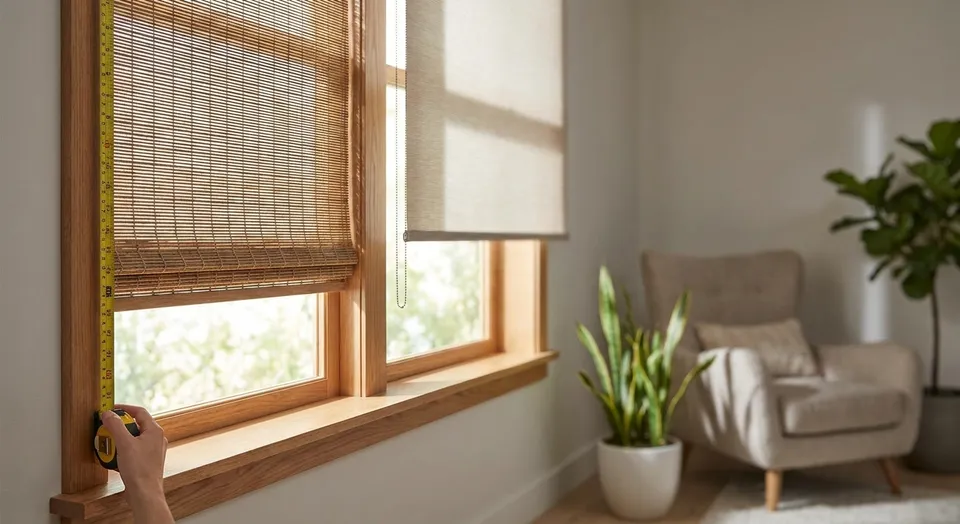
Choosing between inside mount and outside mount is the decision that determines whether your custom blinds fit clean against the window frame or hang like an afterthought on the wall. Get it wrong and you're stuck with light gaps, a shade that won't clear the crank handle, or a bracket screwed into drywall that never should have held it.
- Inside mount needs at least 2 inches of frame depth and clears trim, sills, and cranks. Measure before you buy.
- Outside mount fixes light gaps and works on shallow or uneven frames, but needs 3+ inches of flat wall on each side.
- How to choose blind mount type comes down to frame depth, obstructions, and how much light control you actually want.
- Rainier Blinds measures every window in person before recommending inside or outside mount. Guesswork on this step is the top cause of return visits.
Why this matters
Mount type isn't a style preference. It's a measurement problem first and a look second. An inside-mounted roller shade that's off by a quarter inch will bind on the frame every time you raise it. An outside-mounted cellular shade hung too close to the window will bang against the sash when it opens.
Big-box retailers hand you a tape measure and a diagram and let you decide. That works fine until you hit a window with a shallow frame, a protruding lock, or trim that isn't square, which describes a large share of the older housing stock across Auburn, Kent, and Federal Way. Get the mount type wrong on a $300 shade and you're paying for a remake, not a warranty claim.
What you'll need
- A steel tape measure (cloth tapes stretch and throw off frame-depth readings)
- A pencil and a notepad, or your phone's notes app
- A flashlight, for checking frame depth in shadowed corners
- A step stool for windows above 6 feet
- Photos of each window from straight-on and from the side
- If you're comparing shade types alongside mount type, a look at roller shades vs. cellular shades helps you match the fabric to the mount before you order
The steps
1. Measure your frame depth first
Frame depth decides whether inside mount is even possible. Measure from the front edge of the window frame straight back to the glass or the window stop.
Most blinds and shades need a minimum of 2 inches of usable depth for inside mount; motorized versions with a built-in headrail often need 2.5 to 3 inches. Anything under 1.75 inches rules out inside mount entirely, no amount of custom fabrication changes that.
Common mistake: measuring only at the top of the frame. Depth can shrink near the bottom if there's a sill lip or an added stop molding. Check three points, not one.
2. Check for obstructions inside the frame
Window cranks, locks, sash handles, and interior trim details all eat into the inside-mount space. A casement window crank alone can take up half an inch of clearance an inside-mounted shade needs to operate.
Run your fingers along the frame interior and note anything that protrudes more than a quarter inch. If you find two or more obstructions on a single window, outside mount is usually the cleaner call in 2026 product lines, not a compromise.
Common mistake: ignoring a lock mechanism because it's only in the way sometimes. A shade that catches on a lock once a week is a shade you'll stop using.
3. Decide how much light gap you can live with
Inside mount sits recessed in the frame, which means light will edge around the sides no matter how tight the tolerances are, usually a quarter inch to half an inch per side, depending on the headrail style.
Outside mount solves this by hanging the shade on the wall or trim outside the frame, overlapping the opening by 2 to 3 inches on each side and at the top. If the room is a bedroom or media space where the light gap actually matters, that overlap is the deciding factor, not the look.
4. Confirm you have wall space for outside mount
Outside mount needs flat, unobstructed wall or trim space on both sides of the window and above it, typically 3 inches minimum per side for a clean bracket line. Crown molding, adjacent windows, or corner walls can eliminate that space fast.
Measure the distance from the window frame edge to the nearest obstruction on both sides before you commit. If you've got less than 2 inches on one side, outside mount will look lopsided or simply won't fit the bracket.
Common mistake: assuming there's enough wall without measuring. A hallway window next to a doorframe is the most common spot this goes wrong.
5. Match the mount to how the shade will operate
Motorized shades add hardware, a headrail motor, sometimes a hub or antenna. That needs more inside-mount clearance than manual versions. If you're set on going motorized in a room like a living room or great room, check the motorized window shades guide for Renton living rooms for clearance specifics before locking in inside mount.
For a full motorization rundown across window types, the motorized shades guide for Kent, WA homes covers what depth and power setup each option needs.
6. Look at the window's role in the room
A window you'll open and close daily, a casement or double-hung in a kitchen or bathroom, usually favors outside mount so the shade never interferes with the sash or crank. A picture window that never opens is a better inside-mount candidate since there's no operating hardware to clear.
Common mistake: picking inside mount purely for looks on a window you open every day, then fighting the shade every time you crack it for air.
7. Write down measurements per window, not per room
Every window in the same room can have different frame depth, trim, and obstructions. Even matching windows installed at the same time can vary by an eighth of an inch after decades of settling, which is common in the older homes found across South King County.
Label each measurement by window location (e.g., kitchen, east wall) rather than assuming one number applies to the whole room.
Skip the guesswork on mount type
Rainier Blinds measures every window in person before you order anything.
Troubleshooting
Frame depth is exactly 2 inches, is that enough? It's borderline. Some low-profile roller shade headrails fit at 2 inches, but most cellular and motorized options need closer to 2.5 inches. Measure your specific product's headrail depth against your frame before ordering.
The window has a curved or arched top. Inside mount rarely works on an arch unless the shade is built for it specifically. Outside mount, hung above the arch on flat wall, is the standard fix.
There's a radiator or vent right under the window. That doesn't change mount type directly, but it does affect how low the shade can hang, factor in 2 to 3 inches of clearance above the vent regardless of inside or outside mount.
One window in a set has less depth than the others. Mixed mount types in the same room (inside on the deep windows, outside on the shallow one) is normal and common. Matching the outside shade's fabric and color to the inside-mounted ones keeps the room looking uniform.
The trim is painted shut or warped. Outside mount avoids the frame entirely, which sidesteps warped trim issues that make inside mount unreliable.
You measured for inside mount and it's too tight by 1/8 inch. Don't force it. An eighth of an inch of bind will wear the shade's edge within a year. Reorder for outside mount rather than sanding the frame.
Tools and resources
- Steel tape measure, accurate to 1/16 inch
- Flashlight for shadowed frame corners
- Notepad or phone notes, one entry per window
- Custom window treatments guide for Auburn, WA for a broader look at how mount type interacts with fabric and color choice
- A second person to hold the tape while you read measurements on windows above 6 feet
What to do next
Once you've got frame depth and obstruction notes for every window, the next step is matching mount type to the actual shade style you want. The custom blinds guide for Federal Way, WA homes walks through how different blind styles perform once mount type is locked in.
FAQ
How do I choose between inside mount and outside mount for blinds?
Choose inside mount if your frame depth is at least 2 inches with no protruding locks or cranks; choose outside mount if the frame is shallower, has obstructions, or you want to eliminate light gaps. Measuring frame depth at three points is the first step either way.
What is the minimum frame depth for inside mount blinds?
Most inside-mount blinds and shades need at least 2 inches of frame depth; motorized versions typically need 2.5 to 3 inches for the headrail. Anything under 1.75 inches generally rules out inside mount.
Do outside mount blinds block more light than inside mount?
Yes. Outside mount overlaps the window opening by 2 to 3 inches on each side, cutting the light gaps that inside mount leaves along the frame edges.
Can I mix inside and outside mount in the same room?
Yes, this is common when windows in the same room have different frame depths. Matching fabric and color across both mount types keeps the room looking consistent.
Does mount type affect motorized shade installation?
Yes. Motorized headrails need more clearance than manual ones, so a frame that barely fits a manual inside-mount shade may not fit a motorized version at all.
What causes a shade to bind after inside mount installation?
Binding usually comes from a frame depth or width measurement that was off by an eighth of an inch or more, or from an obstruction like a lock that wasn't accounted for. It shows up as the shade catching every time it's raised or lowered.
Is outside mount better for windows I open often?
Generally yes. Outside mount keeps the shade clear of cranks, sashes, and locks on windows you operate regularly, which is why it's the common choice for casement and double-hung windows used daily.
How much wall space does outside mount need?
Outside mount needs roughly 3 inches of flat, unobstructed wall or trim on each side of the window and above it for the brackets to sit clean. Less than 2 inches on one side usually means the mount will look uneven.
One last thing
The measurement that trips up more DIY orders than any other in 2026 isn't depth. It's checking only one point on the frame. Frames settle unevenly over decades, and a reading taken at the top can be an eighth of an inch off from the bottom on the exact same window. Measure top, middle, and bottom before you order, every time.