
Our available controls: Rainier Blinds offers Roman and woven wood shades with motorized operation only. Available controls and power options for other products are confirmed at your consultation.
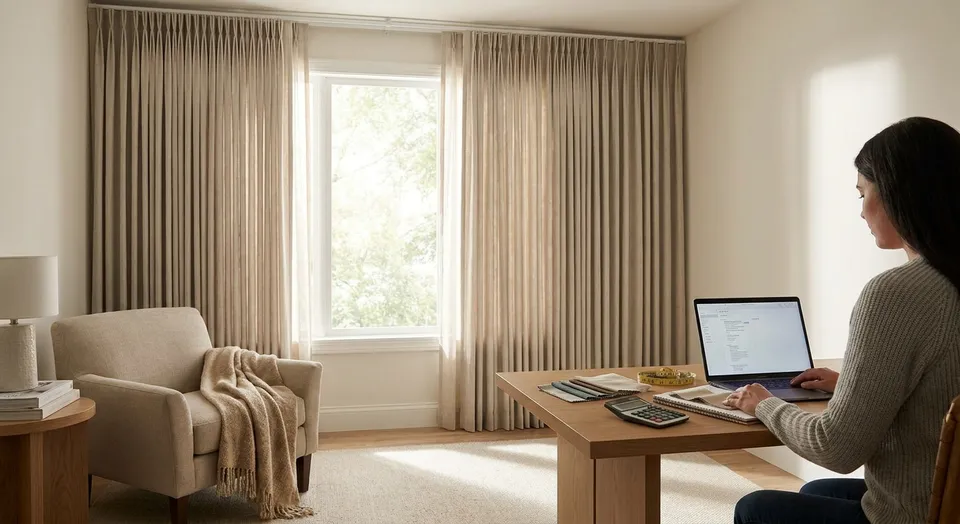
Budgeting for custom window treatments in 2026 means pricing the whole house before one showroom sample talks you into a single fabric, then building in room order, material tier, and installation labor before you sign anything.
- Budgeting for custom window treatments in 2026 starts with a full house window count, not a single-room quote.
- Set aside 10-15% of your total budget for motorization or hardware added mid-project.
- Rainier Blinds runs its own installation crew, so labor isn't a subcontractor markup tacked on after the sale.
- Compare three full quotes -- big-box, online, and local -- before committing; installation fees change the math.
- Roller shades cost less upfront than cellular shades but skip the insulation value cellular adds through a Pacific Northwest winter.
Why This Matters
Most people budget for one room, get a number, then panic when the whole house costs three or four times that. A 10-window house and a 20-window house are not the same project, and treating them the same is how homeowners in the Greater Seattle Area end up over budget by the time they reach the primary bedroom.
Rainier Blinds measures and installs across Auburn, Bellevue, Tacoma, Kent, and Renton, and the pattern repeats: the budget conversation gets skipped until the invoice shows up. Fixing that takes one afternoon of counting windows and ranking rooms, not a spreadsheet.
What You'll Need
- A tape measure or a rough window count for every room (don't skip the hallway or the stairwell)
- A ranked list of rooms by how often you use them and how much light control matters there
- A decision on manual versus motorized before you get quotes, at least for your top two rooms
- Three quotes minimum: one big-box, one online, one local installer
- A contingency line item -- 10-15% of your working total -- for hardware, mounting brackets, or motorization you add after the first walkthrough
The Steps
1. Count Every Window in the House First
A per-room budget without a full-house count is a guess wearing a spreadsheet. Walk the house and count every window, including the ones you never think about -- laundry room, stairwell landing, the small window over the kitchen sink. A 12-window house and an 18-window house split the same total budget very differently, and the difference shows up fast once quotes start coming in.
Common mistake: counting only the windows visible from inside the rooms you spend time in and forgetting hallways, bathrooms, and basement daylight windows entirely.
2. Rank Rooms by Priority, Not by Which Window You Noticed Last
Living rooms, primary bedrooms, and home offices typically claim 50-60% of a whole-house window treatment budget because they're used daily and privacy or light control matters most there. Secondary bedrooms, guest rooms, and bonus rooms can wait for a phase two order without anyone noticing.
This ranking is what keeps a whole-house project from stalling out after room one. Decide now which three rooms get treated in 2026 and which two can wait until next year.
3. Pick a Material Tier Before You Shop Price
Roller shades, cellular shades, zebra shades, roman shades, and drapery all land at different price tiers before a single quote comes in. Comparing roller shades against cellular shades for South King County homes shows the trade-off clearly: roller shades cost less per window, cellular shades add insulation value that shows up on the energy bill through a Seattle-area winter.
Common mistake: picking a fabric in one room, loving it, then assuming every other room in the house should match at the same price point regardless of window size or function.
4. Decide Where Motorization Earns Its Keep
Motorization is not an all-or-nothing decision. Motorized shades make sense for hard-to-reach windows, high-traffic living areas, and rooms where you want a scheduled open-close routine -- they make far less sense on a guest bathroom window nobody adjusts twice a year.
Budget motorization for your top two or three priority rooms first, then decide later whether the rest of the house needs it. Retrofitting motorization after manual shades are already installed almost always costs more than specifying it up front.
5. Add a 10-15% Contingency Line for Hardware and Retrofits
Mounting brackets for deep window sills, valance returns, and hardware upgrades rarely show up in an initial online estimate. Building a 10-15% contingency into your total budget before you get quotes means a bracket surprise doesn't force you to cut a room from the plan.
This is the single most common gap between a homeowner's mental budget and the final invoice.
6. Get Three Full Quotes, Not Three Sticker Prices
A sticker price from a big-box store, an online configurator total, and a local installer's number are three different things unless every one of them includes measurement, hardware, installation labor, and warranty terms. Rainier Blinds runs its own crew rather than subcontracting the install, so labor cost is part of the quote, not an add-on discovered on install day.
A quote that doesn't include installation labor isn't a real number -- it's a guess.
Common mistake: comparing a DIY online price against a fully installed local quote and concluding the online option is cheaper, without adding back the hours and hardware the DIY route still requires.
7. Schedule the Measure Before You Finalize Anything
Custom window treatments are made to the window, not to a size chart, so a professional measure is what turns your budget estimate into a real number. Get the measure scheduled before you commit to a material tier for every room -- window depth and mounting surface can change which products even fit.
Get a Real Number for Your House
Rainier Blinds measures and quotes homes across Auburn, Kent, Renton, and the Greater Seattle Area.
Troubleshooting
Problem: The quote jumped after the in-home measure. Fix: Ask exactly which line items changed -- mounting hardware, window depth adjustments, and valance returns are the usual culprits, and a legitimate installer will itemize them rather than give you one new total.
Problem: Motorization quotes are double what you expected. Fix: Scale back motorization to your top one or two rooms in 2026 and treat the rest of the house manually; you can add motorization in phase two without redoing the shades themselves.
Problem: One room's fabric choice is eating the whole budget. Fix: Downgrade that room's material tier by one level -- roller instead of cellular, for example -- and reserve the higher tier for the room you actually spend the most time in.
Problem: The big-box price looked cheaper until installation was added. Fix: Get the fully installed number in writing before comparing anything; a lower sticker price with a separate installation charge often lands above a local installed quote.
Problem: You can't tell if a warranty is actually different between two quotes. Fix: Ask what's covered on the hardware versus the fabric versus the motor, since these are frequently warrantied separately and one quote may be silent on motor coverage entirely.
Tools and Resources
- A full-house window count, room by room, before any quote request
- Rainier Blinds' comparison of roller shades against cellular shades for South King County homes, used to pick a material tier
- The motorized shades guide for Kent, WA, used to decide which rooms justify the upgrade
- Rainier Blinds' guide to motorized living room shades for Renton homes, useful for pricing out your highest-priority room
- A written, itemized quote from at least three sources before you commit
What To Do Next
Once your room ranking and material tiers are set, the next move is getting an in-home measure scheduled -- everything before that step is an estimate, and everything after it is a real number. Homeowners in Auburn working through a full-house project in 2026 can walk through the room-by-room breakdown in more detail before locking in a final order.
FAQ
How to budget for custom window treatments for a whole house?
Count every window first, rank rooms by daily use, then allocate 50-60% of the total budget to your top two or three rooms in 2026. Add a 10-15% contingency for hardware and mounting brackets before you get quotes.
Are motorized shades worth the extra cost in 2026?
Motorized shades are worth the cost on hard-to-reach windows and high-traffic living areas, but not on every window in the house. Budget motorization for your top-priority rooms first and phase in the rest later if the whole-house cost feels too high.
Is it cheaper to buy window treatments online or through a local installer?
An online configurator price often looks cheaper until installation, hardware, and warranty coverage are added back in. Compare the fully installed total, not the sticker price, before deciding.
How much should I set aside as a contingency for custom shades?
Set aside 10-15% of your working total for hardware, mounting brackets, or motorization added after the first walkthrough. This is the most common gap between an initial estimate and the final invoice.
Should I treat the whole house at once or room by room?
Room by room is the more common approach for full-house budgets in 2026 -- treat your top two or three priority rooms first and phase in secondary bedrooms and bonus rooms later. This keeps the project from stalling if the total comes in higher than expected.
What's the difference in cost between roller shades and cellular shades?
Roller shades cost less per window than cellular shades, but cellular shades add insulation value that shows up on winter energy bills in the Pacific Northwest. Pick roller for budget rooms and cellular for rooms where insulation matters most.
Does a professional measure change the budget?
Yes -- window depth and mounting surface discovered during a professional measure can change which products fit, and that can shift the material tier or hardware needed. Get the measure scheduled before finalizing a whole-house material plan.
One Last Thing
The fastest way to blow a whole-house budget in 2026 isn't picking an expensive fabric -- it's skipping the room ranking step and letting whichever window you're standing in front of dictate the priority order. Rank the rooms first, get the measure scheduled second, and the fabric decision gets a lot easier.