
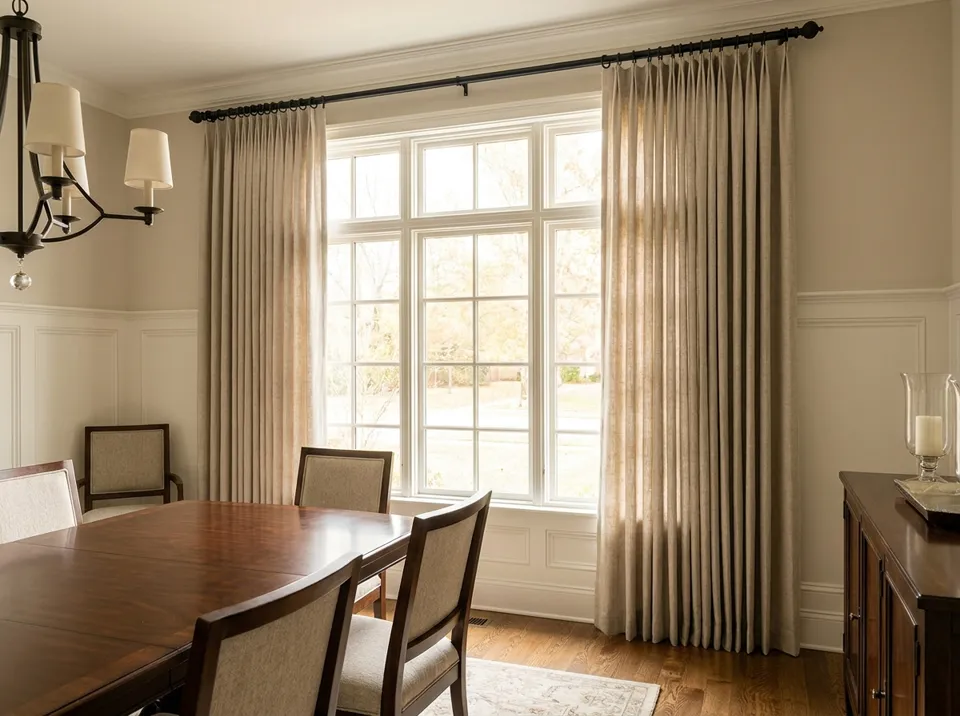
Custom drapery in Auburn, WA should solve a room's light, privacy, and framing problems-not just add fabric. This 2026 guide compares ceiling-mounted tracks, rod-and-rings, lining, panel layout, layered options, and the measure-and-install process Rainier Blinds uses; review the custom drapery services before you order.
TL;DR
- Custom drapery Auburn WA: a ceiling-mounted track is the clean pick for wide openings. Buy.
- Rod-and-rings drapery is the flexible pick when visible hardware fits the room. Consider.
- Light-filtering lining suits day rooms; blackout lining suits bedrooms and media rooms.
- Rainier Blinds measures, has drapery custom-made to your exact measurements, and installs with its own crew.
Why this matters
Auburn homes run from established West Auburn and Auburn Highlands properties to newer Lea Hill and Lakeland Hills construction. Window height, trim depth, door handles, and the way a room is used change from house to house. Drapery has to clear the opening, stack where it will not block a door or view, and deliver the light control the room actually needs.
The wrong order usually looks fine in a fabric photo. The problem appears at the window: a track that collides with a shade cassette, panels that stack over a slider handle, or a bedroom that still glows after the curtains close. In 2026, the best local buying decision starts with the opening and the room's failure, then chooses the fabric and hardware.
Who this guide is for
This guide is for Auburn homeowners replacing dated curtains, finishing a remodel, furnishing a new home, or solving one wide, tall, or awkward opening. It also fits homeowners in nearby South King County communities such as Kent and Federal Way who want custom drapery/curtains with local measurement and installation.
What to look for in custom drapery for Auburn homes
Start with the opening and the room's job
Stand in the room when it fails. Is afternoon glare hitting the television? Does the front room need privacy after dark? Does a bedroom need deeper darkness? Is the opening a sliding door that must keep its full travel path?
Write the answer beside each opening before choosing a fabric. A dining room used in the evening needs a different lining conversation than a living room used from breakfast through late afternoon. A curtain panel that looks good closed can still be a poor choice if it blocks a door handle, a walkway, or the usable part of the glass when stacked.
Choose track versus rod and rings
Rainier Blinds' services page currently shows two drapery hardware paths: a slim ceiling-mounted track and a decorative rod-and-rings setup. The track is the clean pick when you want the hardware to recede, the ceiling line to stay quiet, or the fabric to travel across a wide opening.
Match the lining to the light problem
The face fabric is only half the decision. Ask which lining options are available and match one to the room's job:
- Light-filtering lining softens daylight without making a daytime room feel closed.
- Privacy lining reduces direct sightlines when the room needs coverage but not full darkness.
- Blackout lining is the direct choice for bedrooms, media rooms, and daytime sleep.
Do not call every lined curtain blackout. The fabric, lining, mount, overlap, and gaps at the sides all affect the final result. If the sleeper needs a dark room, say that at the measure visit and plan the overlap and stack, not just the color.
Plan panel width and stack-back
Panel width decides whether drapery looks full or stretched. A narrow panel pulled across a wide opening looks temporary; enough fabric gives the folds room to hang and travel. Ask Rainier Blinds to show the finished panel plan rather than guessing from a single swatch.
For wide openings, two panels usually open from the center; one panel works when the stack must stay on one side. Either way, the stack needs a clear landing zone.
Keep fabric away from door handles, wall switches, baseboard heaters, and the active path of a slider. On a room with a shade underneath, leave enough clearance for both treatments to operate without rubbing.
Coordinate drapery with other treatments
Drapery is not required to do every job alone. A roller shade can handle daytime glare while curtains add evening privacy. Cellular shades can address insulation while drapery handles the finished-room layer. Zebra, day/night, and dual shades can cover changing light when the opening needs more than one setting.
Measure the layers together. Shade depth, track or rod projection, door handles, and the panel stack all occupy the same space around the window. A coordinated plan prevents hardware from fighting after installation.
Confirm the measure-and-install process
Ask three plain questions before you commit: Who measures? Who has the treatment custom-made? Who installs and handles follow-up?
We bring fabric samples to your home and help you choose the weave, texture, and finish in your own light. Your shades are custom-made to your measurements, and our local crew handles measuring and installation.
Top picks for Auburn and South King County
The clean opening: ceiling-mounted track
The safe pick. A slim ceiling-mounted track keeps attention on the fabric and gives wide openings a quiet top line. It is the strongest choice for large living-room glass, broad sliders, and rooms where visible hardware would compete with trim or lighting. Buy when the track can run clear of the shade, door, and ceiling obstacles.
The finished hardware option: rod and rings
The flexible pick. Decorative rod and rings make the hardware part of the room rather than hiding it. This fits a dining room, formal living room, or bedroom where the rod finish should sit beside the fabric as a deliberate detail. Consider when the room has enough wall and ceiling structure for the projection.
The sleep pick: blackout-lined drapery
The dark-room pick. Blackout lining is the right starting point when a bedroom or media room needs deeper darkness. Buy when the room's main failure is early light, screen glare, or daytime sleep, and confirm side overlap and the lower finish during measurement.
The day-room pick: light-filtering or privacy-lined curtains
The everyday pick. Light-filtering or privacy lining suits living rooms, dining rooms, offices, and front-facing spaces that need daylight as well as coverage. Buy when the room should stay usable during the day and privacy is the bigger need after sunset.
The layered pick: drapery with a shade
The two-job pick. Pairing curtains with a roller, cellular, zebra, day/night, or dual shade gives each layer a clear assignment. Buy when the room needs daytime glare control plus a softer evening finish, or when insulation and room framing both matter.
What to avoid
Choosing fabric before hardware
A fabric sample cannot tell you whether a ceiling track will clear a beam or whether a rod will hit a shade cassette. Check the opening, ceiling, trim, and stack location first. Then choose fabric and lining within that physical plan.
Treating panel width as an afterthought
Curtains that barely cover the glass look thin when closed and leave little room to stack open. Confirm the number of panels, finished width, and open position before ordering. The goal is folds that hang correctly and a stack that does not swallow the view.
Ignoring the treatment underneath
If roller, cellular, zebra, day/night, or dual shades will sit behind the drapery, measure both systems together. Shade depth, rod projection, rings, door handles, and furniture must all clear each other. A beautiful curtain that cannot close around the shade is not a finished installation.
Verdict comparison
| Drapery option | Best Auburn-area use | Main spec | Verdict |
|---|---|---|---|
| Ceiling-mounted track | Wide windows and sliders | Slim, low-visibility hardware | Buy |
| Rod and rings | Dining and formal living rooms | Decorative hardware and clearance | Consider |
| Blackout-lined drapery | Bedrooms and media rooms | Lining plus side overlap | Buy |
| Light-filtering or privacy-lined curtains | Day rooms and front windows | Daylight-to-privacy balance | Buy |
| Drapery plus a shade | Two distinct room problems | Coordinated two-treatment depth | Buy when needed |
How Rainier Blinds measures and installs
The local process stays simple:
- Consult: describe the room, the opening, the light problem, and how the treatment should operate.
- Measure: check width, height, ceiling or wall structure, trim, handles, shade depth, floor clearance, and the intended stack position.
- Select: choose track or rod and rings, panel layout, face fabric, lining, and any shade layer that must operate behind it.
- Custom-made to your measurements: the selected treatment is custom-made to the confirmed measurements. Rainier Blinds does not manufacture drapery in-house.
- Install: Rainier Blinds' own crew installs the track or rod, hangs the panels, checks travel and stack-back, and confirms that doors and underlying shades still work.
The current quote page says new requests receive a response within 1 business day. Use the quote request with the city, room count, approximate opening sizes, and the main problem in each room. Exact pricing depends on the hardware, panel plan, fabric, lining, window count, and any shade layer.
FAQ
What is the best custom drapery for Auburn WA homes?
How much does custom drapery cost in Auburn, WA?
Should I choose a drapery track or a rod and rings?
What lining is best for bedroom curtains?
Can custom curtains cover wide sliding doors in Auburn?
Can I layer drapery with roller or cellular shades?
Does Rainier Blinds manufacture custom drapery in-house?
How long does custom drapery take to make and install?
One last thing
Do not choose the fabric color first. Choose the place where the fabric will live when the curtains are open. That stack-back decision tells you whether the track or rod can clear the door, shade, handle, and furniture; it also tells you whether the window will still feel open during the day.