
Our available controls: Rainier Blinds offers Roman and woven wood shades with motorized operation only. Available controls and power options for other products are confirmed at your consultation.
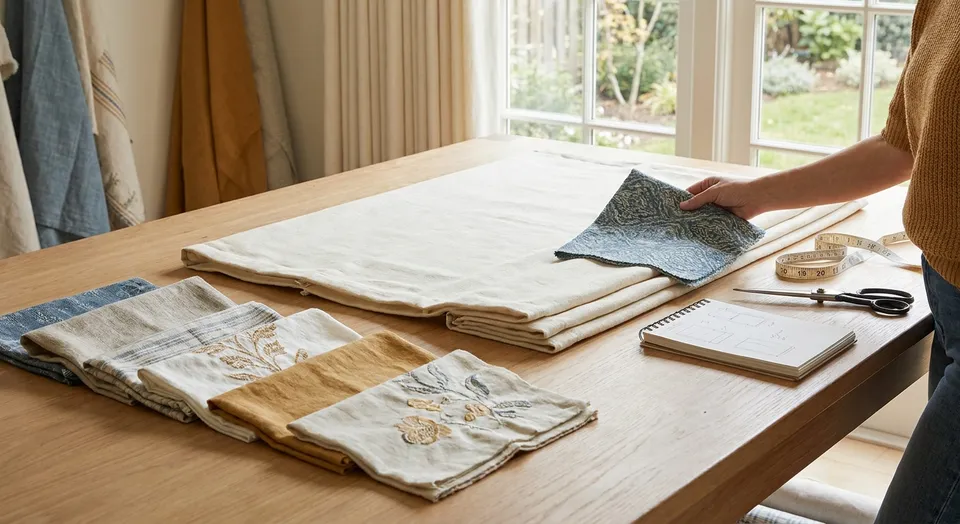
Picking fabric for custom Roman shades in 2026 means balancing weight, light control, and pattern repeat before you ever touch a swatch book. Get those three right and the rest is just color.
- Mid-weight linen-cotton blends (9-13 oz/sq yd) fold cleanest on Roman shades over 36 inches wide. Buy for most living rooms.
- Choose lining for the room's light and privacy needs, and allow for its effect on folded depth and stacking. Blackout lining reduces light through the material, but gaps at the mount can still admit light. Confirm the exact fabric, lining, and clearances before ordering.
- Railroaded fabric avoids seams on wide windows past 54 inches; standard bolts force a seam every 54 inches without it.
- Rainier Blinds recommends testing a fabric swatch against your window at both 9am and 3pm before ordering, since Seattle-area light shifts fabric color fast.
Why this matters
Fabric choice on a Roman shade isn't cosmetic. It decides whether the shade folds crisply for the next 10 years or sags into a wrinkled mess by year two. A shade that looks flat on the sample card can bag out once it's cut to 60 inches and hung with 8-10 folds. Rainier Blinds measures and installs custom Roman shades across the Greater Seattle Area, and the single biggest callback reason is fabric that was picked for color alone, not for how it performs at width.
Get the fabric right in 2026 and you avoid three expensive mistakes: sagging folds, light leaking down the sides, and a pattern that mismatches the moment you add a second window in the same room.
What you'll need
- Exact window measurements, width and height at three points (top, middle, bottom)
- A fabric swatch book or physical sample, not a screen color
- Mounting decision made first: inside mount or outside mount
- Liner decision: none, privacy, or blackout
- A sense of fold count. Most Roman shades run one fold per 8-10 inches of drop
- Natural light check at two times of day (morning and afternoon)
The steps
1. Measure before you shop for fabric
Get exact width and height first, because fabric requirements change with size. A 30-inch-wide shade uses one fabric width off a standard 54-inch bolt; a 60-inch-wide shade needs a seam or railroaded fabric to avoid one down the middle.
Measure at three points across the window since older frames are rarely square. Common mistake: measuring only the top of the frame and ordering fabric that's a quarter-inch short at the bottom, which shows as a visible gap once the shade is mounted.
2. Decide fold count before picking pattern scale
A Roman shade's folds compress the fabric, so a bold repeat pattern gets chopped into segments you didn't plan for. Standard folds run every 8-10 inches, meaning a 72-inch-drop shade shows 7-9 folds.
Small geometric or solid fabrics hide fold lines best. Large florals or wide stripes can look disjointed once folded. Order a sample and fold it by hand before committing. Common mistake: choosing a fabric with a 27-inch pattern repeat for a 9-inch fold shade, which cuts the motif in half on every panel.
3. Match fabric weight to your mount type
Fabric weight in ounces per square yard determines how crisply a shade folds and how much it sags over time. Light fabrics under 7 oz/sq yd can billow on outside-mount installations where wind or HVAC airflow hits the shade directly.
Mid-weight cotton-linen blends between 9 and 13 oz/sq yd hold a fold shape on both inside and outside mounts. Anything heavier than 16 oz/sq yd needs a reinforced headrail and usually looks better on a flat Roman than a hobbled (scalloped) style.
4. Choose a liner based on the room's function
No liner shows the most fabric character and lets in the most light, good for a kitchen or dining nook where you want daytime brightness. A privacy liner blocks visibility from outside without killing light, the right call for a street-facing living room.
Choose lining for the room's light and privacy needs, and allow for its effect on folded depth and stacking. Blackout lining reduces light through the material, but gaps at the mount can still admit light. Confirm the exact fabric, lining, and clearances before ordering.
5. Check railroading for wide windows
Railroading turns the fabric 90 degrees so the pattern runs horizontally, letting one continuous piece cover widths beyond the standard 54-inch bolt without a seam. This matters for picture windows and sliders wider than 54 inches, which are common in Renton and Kent living rooms with west-facing glass.
Not every fabric can railroad. Stripes and directional patterns usually can't without looking sideways. Confirm with your fabricator before ordering for anything over 54 inches. Read more in the motorized shades Kent guide if you're pairing wide fabric runs with a motor.
6. Factor in UV exposure and fade resistance
Sun exposure can fade fabrics over time. Compare the selected fabric's documented lightfastness and care instructions, and choose a suitable lining or additional layer when reducing exposure is important.
If the window gets more than four hours of direct sun daily, prioritize fade-resistant fiber content over pattern. Common mistake: picking a deep saturated color (navy, burgundy) for a west-facing window, dark dyes show fade faster than mid-tones.
7. Order a cutting for the actual window, not just a swatch
A 4-inch swatch tells you almost nothing about drape or color under real light. Order a larger cutting, at least 12x12 inches, and hang it against the window frame for 24 hours before finalizing.
Check it at 9am and again at 3pm since north Seattle light shifts warm-to-cool through the day and can make a beige read gray by afternoon. Expected outcome: the fabric you approve on the window is the fabric you get, with zero surprise once it's installed.
Get a Roman shade fabric quote
Rainier Blinds measures your windows and has your shades custom-made to your exact measurements, then installs with its own crew.
Troubleshooting
Fabric sags between folds after a few months. The fiber is too light for the drop length. Swap to a 9-13 oz/sq yd blend or add a lining layer for structure.
Colors look different once installed versus on the swatch card. Store lighting rarely matches home lighting, always test a larger cutting on the actual window before ordering the full yardage.
Seam line is visible down the middle of a wide shade. The fabric wasn't railroaded and the width exceeded the standard 54-inch bolt. Request railroaded yardage for anything over 54 inches next time.
Blackout liner makes the shade too stiff to fold smoothly. Drop to a privacy liner or request a lighter-weight blackout fabric rated for Roman-specific fold depth.
Pattern repeat looks chopped up across the folds. The repeat size didn't account for fold spacing, recalculate fold count first, then pick a pattern scale that completes within one or two folds.
Fabric already shows fading after one summer. It wasn't solution-dyed or UV-treated, for south- or west-facing windows, request fade-resistant fiber content on the next order.
Tools and resources
- Compare fold behavior across shade types in the roller shades vs cellular shades breakdown for South King County homes
- A tape measure and a helper for the three-point measurement in step 1
- A fabric swatch book with weight (oz/sq yd) listed, not just color
- A window with real daylight exposure for the 24-hour cutting test
What to do next
Once fabric is chosen, the mount decision (inside vs outside) and headrail style lock in the final look. For a full walkthrough of choosing treatments room by room, the custom window treatments in Auburn guide covers how fabric choice interacts with room function across an entire house.
FAQ
What fabric weight is best for custom Roman shades?
A mid-weight cotton-linen blend between 9 and 13 oz per square yard works best for most Roman shades in 2026. Lighter fabrics billow on outside mounts, and anything over 16 oz/sq yd needs a reinforced headrail.
How do I choose fabric for Roman shades on wide windows?
Request railroaded fabric for any window wider than 54 inches to avoid a visible center seam. Not every pattern can railroad, so confirm with your fabricator before ordering.
Do Roman shades need a liner?
Choose lining for the room's light and privacy needs, and allow for its effect on folded depth and stacking. Blackout lining reduces light through the material, but gaps at the mount can still admit light. Confirm the exact fabric, lining, and clearances before ordering.
Is fabric or pattern more important for Roman shade folds?
Fold count matters more than pattern choice. Standard folds run every 8-10 inches, so large pattern repeats can get cut in half across panels. Solids and small geometrics hide fold lines best.
How much does fabric fade on Roman shades in Seattle-area homes?
Sun exposure can fade fabrics over time. Compare the selected fabric's documented lightfastness and care instructions, and choose a suitable lining or additional layer when reducing exposure is important.
Can I use the same fabric on Roman shades and roller shades in the same house?
Yes, but weight requirements differ by shade type, so the same fabric that folds well on a Roman shade may not roll cleanly on a roller shade. Check fold and roll tolerance separately before ordering both.
What's the biggest mistake people make choosing Roman shade fabric?
Picking color from a small swatch under store lighting instead of testing a larger cutting on the actual window. Home light shifts color enough that a beige swatch can read gray by afternoon.
One last thing
The fabric that looks best in the store swatch book is rarely the one that performs best folded 9 times across a 72-inch drop. Order the larger cutting, hang it for 24 hours, and judge it at both 9am and 3pm before you sign off on yardage in 2026.