
Lakewood winters mean gray skies, rain off American Lake, and heating bills that creep up every January. Cellular shades are the one window treatment built specifically for that climate, and this guide ranks the five configurations worth buying in 2026, plus the ones to skip.
- Double-cell blackout cellular shades are the top pick for Lakewood WA homes facing I-5 traffic noise and cold snaps in 2026.
- Motorized cellular shades cost more upfront but solve the problem of tall or hard-to-reach windows common in split-level Lakewood homes.
- Single-cell light-filtering shades remain the safe, budget pick for bedrooms and home offices, not for street-facing living rooms.
- Skip vinyl big-box cellular shades under $40 a window, cell walls collapse within two winters in Pacific Northwest humidity.
Why this matters
Lakewood sits in a rain shadow pocket near Joint Base Lewis-McChord, but the marine layer off Puget Sound still pushes damp cold through single-pane and older double-pane windows from November through March. A cellular shade with the right cell size traps a pocket of dead air against the glass, and that pocket is what cuts your furnace's workload, not the fabric color.
Rainier Blinds measures and installs cellular shades across Lakewood, Tacoma, and the rest of the Greater Seattle Area, and the difference between a shade that lasts eight years and one that sags at eighteen months almost always comes down to cell size and mount type, not brand name. Start with Rainier Blinds if you want an in-person measure before you commit to a configuration.
How we ranked these
This list ranks cellular shade configurations, not individual retail SKUs, because the right pick depends on which room and which exposure you're covering. Rankings weigh four things: insulation value for Lakewood's climate, noise dampening for homes near I-5 or Steilacoom Boulevard, light control range, and real-world durability based on how honeycomb cells hold their shape under Pacific Northwest humidity. Every verdict below assumes a professional measure. Stock sizes from a big-box store routinely run a half-inch off on Lakewood's older window frames, which voids the insulation benefit entirely.
The ranked list
1. Single-cell light-filtering shades: the everyday workhorse
A 3/4-inch single-cell shade in a light-filtering fabric is the baseline configuration most installers quote first, and it earns that spot honestly. It softens glare without blacking out a room, works in bedrooms, home offices, and dining rooms, and holds up fine on interior-facing windows that don't take direct weather exposure. For a north-facing Lakewood living room where privacy matters more than insulation, this is the Buy.
2. Double-cell blackout shades: the insulation champion
Cellular shades trap insulating air and can help reduce heat transfer at a window. Results depend on the product, fit, glazing, climate, and how the shade is used; a specific energy or bill saving is not guaranteed.
3. Motorized cellular shades: the convenience pick
Motorized lift solves a real problem in split-level Lakewood homes: tall stairwell windows and shades mounted eight feet up that nobody wants to crank by hand. A motorized double-cell shade runs a higher install cost than a manual pull, but it's the configuration that actually gets used daily instead of left open or closed for a season. The motorized shades guide breaks down which rooms justify the extra cost and which don't. Consider this pick if you have hard-to-reach windows or want shades tied into a smart home schedule for 2026.
4. Top-down/bottom-up cellular shades: the privacy-light balance
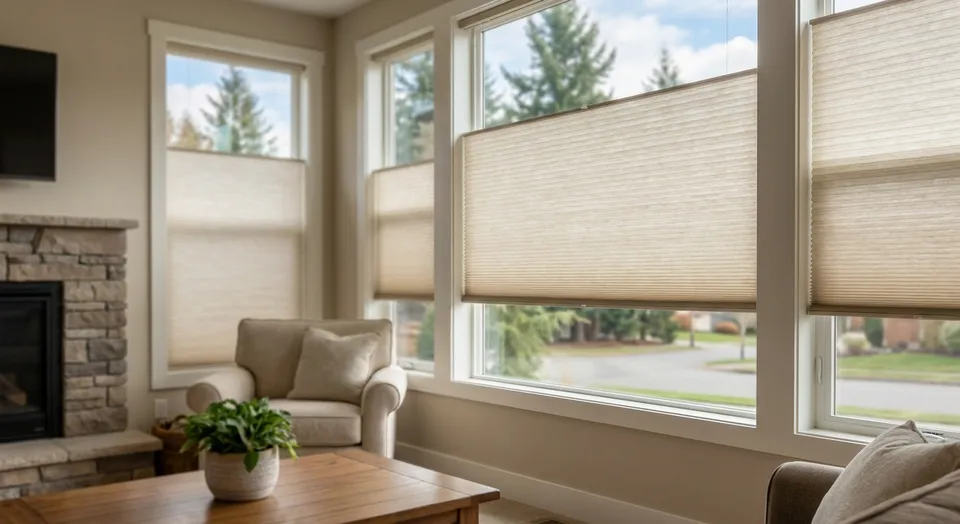
This configuration lets the shade drop from the top of the frame while the bottom stays covered, so a Lakewood street-facing window gets privacy at eye level and natural light through the top pane at the same time. It costs more per window than a standard cellular shade because of the added hardware, and the mechanism has more moving parts to maintain. Consider for front-facing living rooms; Skip for interior rooms where you don't need the split function.
5. Day/night dual cellular shades: the two-in-one
Dual shades combine a light-filtering layer and a blackout layer in one headrail, controlled independently. It's the most expensive configuration on this list and adds width to the window frame that can crowd a narrow Lakewood window trim. For a primary bedroom that needs full blackout at night and soft light during the day, it earns a Buy. For anywhere else in the house, it's overkill, Skip and put that budget toward motorized lift instead.
Get a measured cellular shade quote
Rainier Blinds measures your Lakewood windows in person before you commit to a configuration.
Comparison table
| Configuration | Best room | Verdict |
|---|---|---|
| Single-cell light-filtering | Bedroom, office | Buy |
| Double-cell blackout | North/west-facing rooms | Buy |
| Motorized cellular | Tall/hard-to-reach windows | Consider |
| Top-down/bottom-up | Street-facing living room | Consider |
| Day/night dual | Primary bedroom only | Buy (bedroom only) |
What to avoid
- Sub-$40 vinyl cellular shades from big-box stores. The cell walls flatten out within two Pacific Northwest winters because the paper-thin fabric can't hold shape once humidity gets into the folds.
- Stock sizes on non-standard Lakewood window frames. Homes built before the 1990s in this area often run a half-inch or more off nominal sizing, and a stock shade that doesn't seat flush against the frame leaks the exact air pocket you bought the shade for.
- Cordless-only mounts on tall windows without checking lift strength. Cordless cellular shades over 60 inches tall can sag at the headrail within a year if the lift mechanism isn't rated for the fabric weight.
Where to buy
- Get a professional measure before ordering anything. A quarter-inch of gap on either side of the shade cancels out most of the insulation benefit cellular shades are supposed to deliver.
- Buy locally installed over mail-order when cell size matters. Online retailers rarely stock the smaller 3/8-inch cells that perform best on narrow Lakewood window trim.
- Confirm warranty coverage on the lift mechanism separately from the fabric. Fabric and mechanical failures are covered differently across most installers, and motorized units especially need a clear mechanical warranty in writing.
FAQ
What are the best cellular shades for Lakewood WA homes in 2026?
Double-cell blackout cellular shades rank highest for Lakewood WA homes in 2026 because the double air pocket delivers the most insulation against the area's cold, damp winters. Single-cell light-filtering shades are the better pick for interior rooms that don't need full blackout.
Do cellular shades actually save on heating bills?
Cellular shades trap insulating air and can help reduce heat transfer at a window. Results depend on the product, fit, glazing, climate, and how the shade is used; a specific energy or bill saving is not guaranteed.
Is motorized better than manual for cellular shades?
Motorized is better for tall or hard-to-reach windows, which are common in split-level Lakewood homes with stairwell glass. Manual cellular shades are cheaper and just as effective for standard-height windows you can reach easily.
How much do cellular shades cost installed in Lakewood WA?
Pricing depends on cell size, fabric, motorization, and window count, and it varies enough by home that a measured quote is the only reliable number. Big-box stock sizing usually looks cheaper upfront but fits Lakewood's older window frames poorly.
What cell size is best for insulation?
Smaller cells, in the 3/8-inch range, insulate more efficiently per inch of shade than the larger 3/4-inch or 1-inch cells. Double-cell construction in any cell size outperforms single-cell for pure insulation value.
Are top-down bottom-up cellular shades worth the extra cost?
They're worth it specifically for street-facing rooms where you want privacy at eye level and natural light at the same time. For interior rooms without a privacy concern, the added hardware cost isn't justified.
How long do cellular shades last?
Properly measured and installed cellular shades hold their cell shape for eight years or more in Pacific Northwest humidity. Cheap vinyl versions under $40 a window commonly fail within two winters.
Can cellular shades reduce street noise near I-5?
Double-cell cellular shades add measurable sound dampening compared to a single-layer roller shade, though they won't match dedicated acoustic panels. For Lakewood homes near I-5 or Steilacoom Boulevard, double-cell is the better noise-control pick among shade options.
One last thing
The detail most homeowners miss: cell size matters more than fabric color for anything insulation-related, and a lot of Lakewood quotes lead with color swatches instead of cell size. Ask for the cell size first, 3/8-inch double-cell beats a 1-inch single-cell on every insulation metric that matters for a 2026 heating bill.