
Our available controls: Rainier Blinds offers Roman and woven wood shades with motorized operation only. Available controls and power options for other products are confirmed at your consultation.
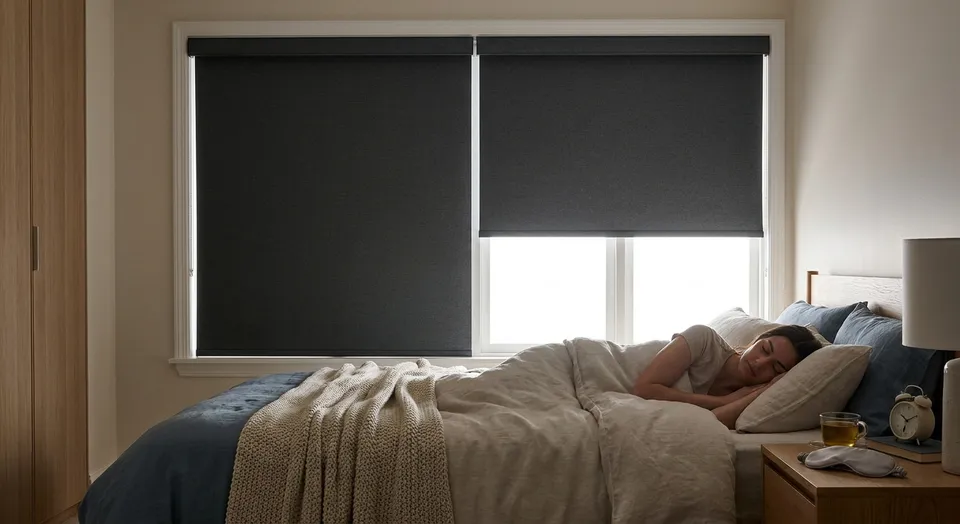
Shift workers who sleep at 9 a.m. need bedrooms that go fully dark while the rest of the neighborhood is at lunch, and standard blinds rarely get there. This guide breaks down what actually blocks daylight, which shade types hold up to daily cycling, and which options from Rainier Blinds fit a rotating or night-shift schedule in 2026.
- Cellular blackout shades with sealed side channels are the top pick for shift workers who need blackout shades for a shift worker bedroom without added noise.
- Motorized blackout roller shades let a graveyard-shift household schedule daylight blockage without setting an alarm to close them. Buy for rotating schedules.
- Blackout fabric is designed to block light through the material. Light can still enter around the sides, top, or bottom, so mounting, overlap, and suitable edge treatments determine how dark the room becomes.
- Layered drapery over a blackout liner is the total-blackout pick when a single shade still lets light leak at the edges.
Why this matters
A person sleeping on a night-shift schedule loses roughly two hours of REM sleep compared to someone sleeping in full dark, according to sleep-research summaries cited by occupational health groups through 2026. Daylight leaking through a half-inch gap at the window frame is enough to disrupt that cycle. The fix isn't just "get blackout curtains." It's picking the shade construction that actually seals the window, because the wrong pick looks like blackout in the showroom and still lets in a visible glow at 2 p.m.
Rainier Blinds measures and installs custom blinds and shades across Auburn, Kent, Renton, Federal Way, and the rest of South King County, and shift-work households are one of the most common reasons homeowners call for a true blackout upgrade rather than a big-box room-darkening shade.
Who this is for
This guide is for anyone sleeping during daylight hours on a fixed or rotating schedule, nurses, first responders, warehouse and logistics crews, and anyone working a swing or graveyard shift. If you're closing shades once a day at a consistent time, your needs are simpler. If your shift rotates weekly, motorization and scheduling matter as much as the fabric itself.
What to look for in blackout shades for a shift worker bedroom
True blackout fabric, not "room-darkening"
Blackout fabric is designed to block light through the material. Light can still enter around the sides, top, or bottom, so mounting, overlap, and suitable edge treatments determine how dark the room becomes.
Sealed side channels
Most of the light in a "blackout" shade doesn't come through the fabric. It comes around the edges. Side channels or U-channel tracks close the gap between the shade and the window frame down to under a quarter-inch, instead of the half-inch to inch of daylight a standard mount leaves exposed.
Motorization for rotating schedules
A fixed 9-to-5 sleeper can close a shade by hand once a day. A rotating-shift worker whose bedtime shifts from 7 a.m. to 3 p.m. across a two-week schedule needs a shade that can be reprogrammed on a phone, not a cord that has to be reset manually every few days. Motorized blackout roller shades handle that shift with a scheduling app instead of a memory jog.
Noise dampening
Cellular (honeycomb) shades trap air in their cell structure, which cuts sound transfer along with light. That matters for a shift worker sleeping while a household runs a normal day around them, lawn crews, delivery trucks, kids home from school.
Durability under daily cycling
A shade that opens and closes once a day for years needs a motor and chain rated for daily cycling, not an occasional-use product. Check that a motorized option is built for that cycle count before installing it in a room used for sleep every single day of the year.
Fit for the specific window, not a stock size
A stock blackout shade ordered to the nearest inch leaves gaps a custom-measured shade doesn't. Custom measurement is the difference between a shade that blocks light and one that just looks like it should.
Top picks for shift worker bedrooms
Blackout cellular shades combine light-blocking fabric with insulating cells. Address edge gaps during measurement for daytime sleeping. Do not rely on ordinary shades to soundproof a room or reduce traffic noise by a specified amount. Acoustic performance needs test data for the selected product and installation; discuss dedicated acoustic treatment if noise control is a priority.
Motorized blackout roller shades, the rotating-shift pick. Roller shades with a battery or hardwired motor let a night-shift or swing-shift household set the shade to close at a specific hour every day, then reprogram it in minutes when the schedule flips. Rainier Blinds' motorized shades guide for Kent, WA covers scheduling setup and battery life expectations for 2026 installs. Buy for anyone whose shift rotates.
Blackout roman shades, the softer-look pick. Same blackout fabric core as a roller shade, folded into a fabric-forward style instead of a flat panel. Slightly less airtight at the fold lines than a cellular shade, so pair it with a side-channel mount if the room faces a streetlight. Consider if you want blackout performance without the flat-panel look.
Layered drapery over a blackout liner, the total-blackout pick. For rooms with a west-facing window and full afternoon sun, a single shade sometimes isn't enough. Adding lined drapery over a blackout roller or cellular shade closes the remaining edge light almost entirely. Buy for the brightest rooms in the house; skip if the window already sits in shade most of the day.
Basic vinyl mini blinds, the false-economy pick. Slats look opaque in the store but leave visible gaps at every slat edge and at the headrail. They block glare, not daylight. Skip for a shift worker bedroom.
Get a blackout shade quote for your bedroom
On-site measuring and installation across Auburn, Kent, Renton, and Federal Way.
What to avoid
- Blackout fabric is designed to block light through the material. Light can still enter around the sides, top, or bottom, so mounting, overlap, and suitable edge treatments determine how dark the room becomes.
- Cordless spring-roller shades sold as one-size-fits-all. Stock widths rarely match a real window opening within a half-inch, and that half-inch is where the light gets in.
- Smart shades on a shared home Wi-Fi hub with no local schedule backup. If the hub drops during a rotating shift change, a shade with no manual override leaves you stuck on yesterday's schedule.
Rainier Blinds' custom window treatments guide for Auburn, WA walks through the measure-first approach that avoids the stock-size gap problem entirely.
Verdict comparison
| Shade type | Light blockage | Rotating-schedule fit | Verdict |
|---|---|---|---|
| Cellular blackout | Depends on fabric, fit, and edge coverage | Manual, needs daily habit | Buy |
| Motorized blackout roller | Depends on fabric, fit, and edge coverage | Scheduling with compatible controls | Buy |
| Blackout roman | Depends on fabric, fit, and edge coverage | Motorized for Rainier Roman shades; otherwise confirm product | Consider |
| Drapery over blackout liner | Depends on fabric, fit, and edge coverage | Motorized for Rainier Roman shades; otherwise confirm product | Buy for bright rooms |
| Vinyl mini blinds | Depends on fabric, fit, and edge coverage | Motorized for Rainier Roman shades; otherwise confirm product | Skip |
See the roller versus cellular comparison for mounting, light-control, and thermal considerations. Insulation ratings do not describe blackout performance.
FAQ
What is the best blackout shade for a shift worker bedroom?
Cellular blackout shades with sealed side channels are the top pick for most shift worker bedrooms in 2026 because they block light through the fabric and cut outside noise at the same time. Motorized blackout roller shades are the better pick for anyone on a rotating schedule.
Do blackout shades really block 100% of light?
Blackout fabric is designed to block light through the material. Light can still enter around the sides, top, or bottom, so mounting, overlap, and suitable edge treatments determine how dark the room becomes.
Is room-darkening the same as blackout?
Blackout fabric is designed to block light through the material. Light can still enter around the sides, top, or bottom, so mounting, overlap, and suitable edge treatments determine how dark the room becomes.
How much does a motorized blackout shade cost in 2026?
Pricing depends on window size, fabric, and motor type, and varies by installer. Get an on-site measurement for an exact quote rather than relying on a national average.
Can motorized shades work on a rotating shift schedule?
Yes. Motorized blackout roller shades can be reprogrammed through a scheduling app in minutes, which matters for anyone whose bedtime shifts week to week on a rotating schedule.
Do blackout shades block noise as well as light?
Do not rely on ordinary shades to soundproof a room or reduce traffic noise by a specified amount. Acoustic performance needs test data for the selected product and installation; discuss dedicated acoustic treatment if noise control is a priority.
Should I choose blinds or shades for a shift worker bedroom?
Shades with a blackout liner and sealed side channel outperform slatted blinds for daytime sleep, because blinds leave visible light gaps at every slat edge even when closed fully.
Do I need custom measuring for blackout shades?
Yes, if the goal is true blackout. A stock-size shade ordered to the nearest inch leaves edge gaps that a custom-measured shade closes, which is the main source of light leak in a supposedly blackout room.
One last thing
Blackout fabric is designed to block light through the material. Light can still enter around the sides, top, or bottom, so mounting, overlap, and suitable edge treatments determine how dark the room becomes.