
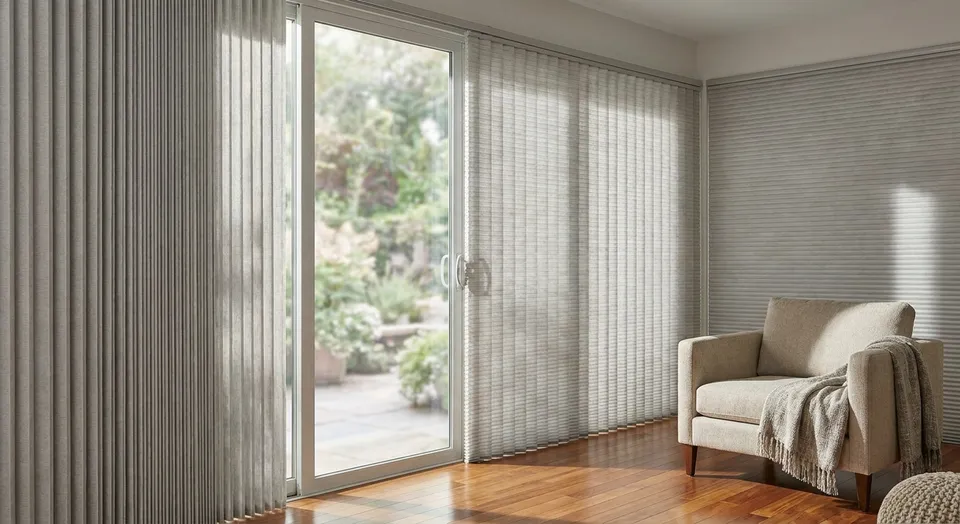
Sliding glass doors need coverage that stacks completely out of the doorway without blocking the path in and out, and vertical cellular shades solve that better than horizontal blinds or fixed drapery ever will in 2026.
- Vertical cellular shades on a dual track stack fully to one side, leaving the sliding door path clear. Buy for daily-use patio doors.
- Cordless wand-operated panels are the safe pick for most Auburn and Seattle homes with 6 to 10-foot doors.
- Motorized vertical cellular shades make sense on 10-foot-plus doors or doors used multiple times a day. Consider, not a default.
- Skip sheer vertical cellular fabric on west-facing doors; light-filtering or blackout cells handle Pacific Northwest afternoon glare better.
- 3/8-inch cells fit standard door heights; 3/4-inch cells cover taller sliders and stack narrower.
Who this is for
This guide is for homeowners replacing vertical blinds or bare glass on a sliding or French-style patio door and who want insulation, not just coverage. If your door sees daily foot traffic, kids running to the backyard, a dog door routine, a deck you use April through October. You need a track system that opens fast and stacks clean. Custom blinds for sliding glass doors covers the broader category; this page narrows in on the cellular fabric option specifically, because honeycomb cells trap air in a way flat vertical vinyl slats never could.
Why this matters
A sliding glass door is the single biggest heat-loss point in most Seattle-area homes built before double-pane code updates. Vertical vinyl blinds, the kind big-box stores push. Don't insulate; they just filter light. Vertical cellular shades use the same honeycomb cell structure as horizontal cellular shades, turned 90 degrees and hung on a track so panels glide left and right instead of tilting. That construction traps a pocket of air against the glass, which matters more in a 2026 Pacific Northwest winter than most homeowners expect walking into a showroom.
What to look for in vertical cellular shades for sliding glass doors
Track and glide mechanism
The track is what makes or breaks daily use. A single-track system pushes all panels to one side; a dual-track (bypass) system splits the stack in two directions, which matters on doors wider than 8 feet where a full one-side stack blocks part of the opening. Test the glide resistance before you commit, a track that binds after a few months of humidity swings in a Tacoma or Bellevue home is a warranty call waiting to happen.
Cell size and fabric opacity
Standard vertical cellular panels come in 3/8-inch or 3/4-inch cells. The 3/8-inch cell stacks narrower and suits standard 80-inch door heights; 3/4-inch cells give more insulating air volume and fit taller sliders up to roughly 96 inches. Opacity ranges from sheer to light-filtering to blackout. Pick based on the room, not the showroom sample. A blackout cell on a living-room slider blocks your view when closed; light-filtering is the more common call for daytime-use spaces.
Cordless vs. motorized operation
Cordless wand operation is the baseline for any door a child or pet passes daily. See how to childproof cordless blinds for the safety case. Motorized vertical cellular shades add app or remote control, which earns its cost on doors opened multiple times a day or doors that are hard to reach because of furniture placement.
Panel width and total stack coverage
Each vertical cellular panel typically runs 18 to 36 inches wide before it's engineered for your specific door. A 9-foot slider needs 3 to 5 panels depending on width choice, and the full stack has to clear the door handle and lock hardware. This is a measure-twice detail, not a guess-and-order one.
Energy performance
Honeycomb cells create a dead-air insulating layer against the glass, which is the whole reason to pick cellular fabric over flat vertical vinyl or fabric-wrapped vertical blinds. If cutting heat loss through a big glass door is the actual goal, best cellular shades for energy savings in Rainier area homes walks through the cell-size-to-performance tradeoff in more depth.
Durability under daily traffic
Sliding doors get touched constantly. Panels get brushed by hands, bags, dog leashes. Fabric-wrapped vane clips and reinforced bottom rails hold up better than lightweight consumer-grade tracks. This is where a professional install crew catches problems a DIY online order misses.
Top configurations to consider
Cordless wand, light-filtering, dual-track, the safe pick. Fits most 6 to 10-foot doors, clears the opening on both sides, and light-filtering fabric handles daytime glare without blacking out the view. Buy for the majority of Auburn, Kent, and Federal Way homes with standard patio doors.
Motorized, blackout cell, single-track. The bedroom-slider pick. Works for primary bedrooms with a slider to a deck or balcony where full blackout at night matters more than daytime view. Motorization solves the reach problem on taller 90-plus inch doors. Best motorized shades for sliding glass doors covers the motor and remote options in more detail. Consider. Worth the upgrade cost only if you're already using motorized shades elsewhere in the home.
Sheer cell, single-track. The budget-minded pick. Lower opacity, cheaper fabric, works fine on north-facing doors with limited direct sun. Skip this on west-facing doors; sheer cells do almost nothing against a 6 p.m. summer glare compared to light-filtering fabric.
3/4-inch cell, dual-track, cordless, the tall-door pick. Built for 8-plus-foot doors and rooms where insulation matters more than stack width. Fits sunrooms and great rooms with oversized sliders well. Buy if your door height exceeds 84 inches and energy performance is a priority.
What to avoid
- Flat vertical vinyl blinds marketed as an "upgrade." They look similar in a catalog photo but carry none of the insulating cell structure, you're paying more for the same air-leak problem.
- Exposed window-covering cords can create a strangulation hazard. CPSC recommends cordless coverings where young children are present. Cordless controls avoid exposed operating pull cords. Follow the product safety instructions and keep beds, furniture, and other climbing objects away from windows.
- Undersized track hardware on doors wider than 9 feet. A track rated for a standard 6-foot slider will bind and sag on a wider opening. This is a measuring mistake, not a fabric problem, and it's the single most common warranty complaint on oversized doors.
Verdict comparison
| Configuration | Cell size | Operation | Best for | Verdict |
|---|---|---|---|---|
| Light-filtering, dual-track | 3/8" | Cordless wand | Standard 6-10 ft doors | Buy |
| Blackout, single-track | 3/4" | Motorized | Bedroom sliders, tall doors | Consider |
| Sheer, single-track | 3/8" | Cordless wand | North-facing, budget | Skip on west-facing |
| 3/4" light-filtering, dual-track | 3/4" | Cordless wand | 8-plus ft, insulation priority | Buy |
Get an exact measure for your slider
On-site measure and real pricing for vertical cellular shades in the Greater Seattle Area.
FAQ
What are vertical cellular shades and how do they differ from vertical blinds?
Vertical cellular shades use honeycomb-shaped fabric cells that glide on a track like vertical blinds, but the cell structure traps air against the glass for insulation. Standard vertical blinds are flat vinyl or fabric slats with no insulating layer.
Are vertical cellular shades good for sliding glass doors?
Yes, vertical cellular shades are one of the better options for sliding glass doors because the panels stack fully to the side on a track, clearing the doorway completely. They outperform horizontal blinds on doors that get opened daily.
Can vertical cellular shades be motorized?
Yes, vertical cellular shades come in motorized versions with remote or app control. Motorization is worth the added cost on doors taller than 90 inches or doors opened multiple times a day.
Do vertical cellular shades block heat and cold from a sliding door?
Yes, the honeycomb cells create a dead-air pocket against the glass that reduces heat transfer, which matters most on older single or double-pane sliding doors common in pre-2010 Pacific Northwest construction.
Are vertical cellular shades cordless and child safe?
Exposed window-covering cords can create a strangulation hazard. CPSC recommends cordless coverings where young children are present. Cordless controls avoid exposed operating pull cords. Follow the product safety instructions and keep beds, furniture, and other climbing objects away from windows.
How wide can vertical cellular shades go for large sliding doors?
Vertical cellular panels typically run 18 to 36 inches wide each, and a dual-track system can cover sliding doors well beyond 9 feet by splitting the stack in two directions. Doors over 9 feet need a dual-track measure to avoid binding.
What's the difference between vertical cellular shades and roller shades for patio doors?
Roller shades roll up vertically from the bottom or top of the window and work best on fixed glass, while vertical cellular shades glide side to side on a track, which is the only practical motion for a door you actually walk through.
Are vertical cellular shades better than drapery for sliding glass doors?
Vertical cellular shades give more consistent insulation and a cleaner stack than drapery, though drapery can add a softer look layered over a functional shade. Most homeowners pick one as the functional layer rather than combining both on a daily-use door.
One last thing
The detail most homeowners miss: cell size affects stack width just as much as it affects insulation. A 3/4-inch cell insulates better but takes up more room stacked against the wall, so on a narrow door opening a 3/8-inch cell sometimes wins even though it's the "lesser" insulator on paper. Measure the stack zone before you pick the cell size, not after.