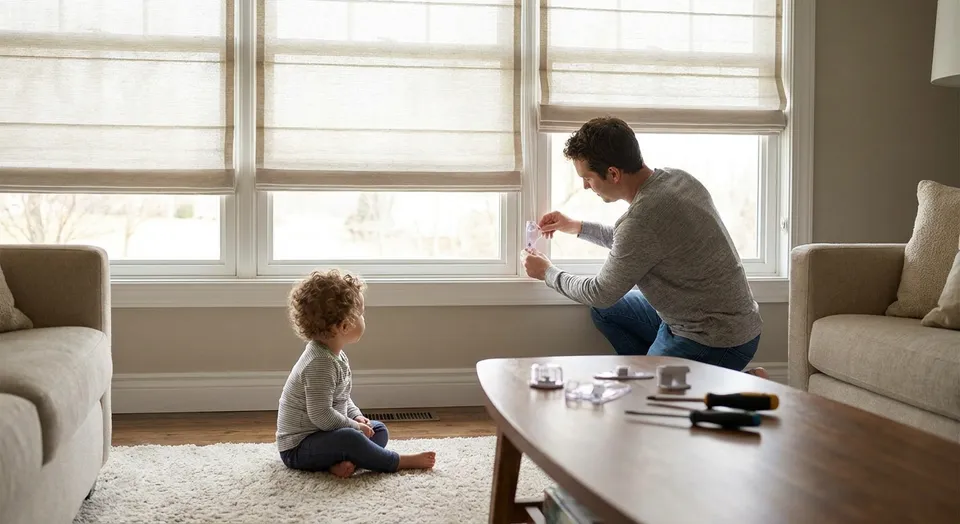
How to childproof cordless blinds

Cordless doesn't automatically mean child-safe — a blind with no pull cord can still have an inner lift cord, a looped chain, or a wand that a toddler chews through in a week. Childproofing means auditing every string, loop, and chain in the room, not just swapping the word "corded" for "cordless" on a product label.

TL;DR
  • How to childproof cordless blinds starts with an inner-cord check, not just a cordless label on the box.
  • The WCMA cordless standard took effect in December 2018 — blinds sold before that date likely still have loop cords.
  • Motorized shades remove the cord entirely and solve the problem in one step instead of yearly retrofits.
  • Retrofit cord-shortening clips are a stopgap for 2026, not a permanent fix — plan to replace within a year.
  • Nurseries and playrooms should be the first rooms converted, before living rooms or home offices.

Why this matters

Window cords are one of the few hidden hazards that look completely normal until a child is alone in the room for 60 seconds. A looped cord across a crib rail, a wand left within reach on a beanbag chair, or a lift chain that's been shortened but not capped — all three still pull tight under weight.

The Window Covering Manufacturers Association's voluntary cordless standard went into effect in December 2018, which means anything installed before that date is a candidate for review in 2026, not an automatic pass. Rainier Blinds measures and installs cordless and motorized systems across Auburn, Kent, and the rest of the Greater Seattle Area, and the most common call is a homeowner who assumed "cordless" on the original invoice meant fully cord-free — it usually doesn't.

What you'll need

  • A stepladder tall enough to reach the headrail without stretching
  • A cord cleat remover or small pry tool (most cleats are screwed, not glued)
  • Cord shortening clips or a cord cutter kit if you're retrofitting instead of replacing
  • A tape measure to log which windows still have loop cords or wands
  • 15-30 minutes per window for a full retrofit, less for a cord-cleat removal only
  • A phone camera to photograph the lift mechanism before removing anything — you'll want the reference if a part gets swapped

The steps

1. Walk every room and log what you actually have

Open a notes app and list every window covering by room, noting whether it has a continuous loop cord, a wand, a beaded chain, or nothing external at all. This takes under 10 minutes for a typical 3-bedroom house and it's the step people skip, which is why retrofits miss a window.

Common mistake: assuming all the blinds in a house are the same age and style just because they match. Builders often mix vendors between the original install and later replacements.

2. Remove or relocate any cord cleats first

A cord cleat wound with slack cord is worse than no cleat at all — it invites a loop to form at exactly toddler-grab height. Unscrew the cleat, then either discard the cord entirely if the lift mechanism doesn't need it, or route it through a permanent tensioner mounted flush to the sill.

Why it matters: cleats are marketed as the safety fix, but they only work if a cord is wound around them every single time, and that discipline breaks down within a few weeks in most households.

3. Cut and cap any loop cords with a shortening kit

For blinds with a continuous loop, a cord shortening kit splits the loop into two capped, individually anchored cords, each tensioned to the sill. This takes about 5 minutes per window with the kit's included tool and works on most roller and cellular lift systems.

Expected outcome: no loop longer than a few inches remains accessible, and both cord ends terminate in a tension device instead of hanging free.

4. Replace beaded chains with a cordless spring or clutch lift

Beaded chains on vertical blinds and some roman shades are a strangulation risk even when "tensioned," because the tension device itself can be pulled off the wall by a determined 2-year-old. Swapping to a cordless spring lift or motorized clutch removes the chain from the equation instead of managing it.

Common mistake: buying a universal spring lift kit online without matching the headrail width — mismatched kits stall halfway up and get abandoned.

5. Check wands for length and mounting

A wand under 8 inches with a rounded, non-detachable tip is the standard for child-safe operation; anything longer or removable should be swapped. Confirm the wand bracket is screwed into the headrail, not just clipped, since a loose wand becomes a separate loose object a child can carry off.

6. Consider going motorized in the rooms kids actually use

Motorized shades remove cords, wands, and chains from the room entirely, which is the only option that doesn't rely on ongoing maintenance. Motorized shades cost more upfront than a retrofit kit, but they're a one-time fix instead of a yearly cord check, and that math tends to favor motorization in nurseries and playrooms specifically.

Why it matters: retrofits require a parent to remember to keep cords tensioned every time the blind is used; a motorized lift has nothing to forget.

Get a cordless upgrade quote

Custom-made to your exact measurements and installed by our own crew across Auburn, Kent, and the Seattle area.

Get a quote

Troubleshooting

  • The shortening kit clips won't grip the cord. Most kits are sized for standard 1/8-inch cord — measure yours before assuming the kit is defective.
  • The spring lift stalls at half-mast. This usually means the headrail width doesn't match the kit's tension rating; check the product listing's width range before reinstalling.
  • A cordless cellular shade still has slack fabric a toddler can pull down on. Cordless doesn't mean the shade can't be yanked from the bottom rail — anchor the bottom rail to the sill with a bracket if the room sees a lot of climbing.
  • The cleat keeps coming loose from drywall anchors. Swap to a longer screw into the stud if one is within 4 inches, or use a heavier-duty anchor rated for pull weight, not just hold weight.
  • You removed the cord but the lift mechanism won't hold position. Some corded systems rely on the cord for both raising and friction-holding; those need a clutch or spring conversion kit, not just a cord removal.
  • Kids are chewing on the wand itself. Swap to a shorter, blunt-tip wand or move to a wandless clutch system — length alone doesn't fix a chewing habit.

Tools and resources

  • Cord shortening kit (sold at most hardware stores and through blind manufacturers)
  • Cordless spring or clutch lift conversion kit matched to headrail width
  • Custom window treatments for a full room-by-room replacement plan in Auburn
  • A tape measure and stepladder rated for the ceiling height in the room
  • Manufacturer's install sheet or a photo of the original lift mechanism for reference

What to do next

Once cords are handled, the next decision is what to replace them with long-term — a straight cordless retrofit, or a full swap to a different lift type. Roller shades vs. cellular shades breaks down which lift systems hold up best in rooms with kids, since not every fabric and headrail combination handles daily cordless operation the same way.

FAQ

What's the best way to childproof cordless blinds?

Remove or tension every cleat, cut and cap any loop cords with a shortening kit, and swap beaded chains for a cordless spring or clutch lift. Motorized shades remove the risk entirely and need no ongoing maintenance.

Is motorized better than a cordless retrofit for child safety?

Motorized removes cords, wands, and chains permanently, while a retrofit still relies on cords being tensioned correctly every time. For nurseries and playrooms, motorized is the lower-maintenance choice in 2026.

How much does it cost to childproof existing blinds?

A cord shortening kit runs a few dollars per window and takes about 5 minutes to install. A full cordless spring or motorized conversion costs more upfront but removes the annual re-check that retrofits require.

Are all blinds sold in 2026 cordless by default?

Most stock blinds sold since the WCMA's voluntary standard took effect in December 2018 ship cordless, but blinds installed before that date often still have loop cords or chains that need retrofitting.

Do cordless cellular shades still pose a safety risk?

Cordless removes the pull cord, but a loose bottom rail can still be pulled down by a climbing toddler. Anchor the bottom rail to the sill in high-traffic kids' rooms.

How long is a safe wand length for blinds?

A child-safe wand is under 8 inches with a rounded, non-detachable tip screwed into the headrail bracket, not clipped on.

Can I retrofit vertical blinds with beaded chains myself?

Yes, most beaded-chain verticals accept a cordless spring or clutch conversion kit matched to the headrail width, and the swap takes under 30 minutes per window.

Should I replace or retrofit blinds installed before 2018?

Retrofitting works as a near-term fix, but blinds installed before the 2018 cordless standard are often older mechanically too, so full replacement is usually the better long-term call.

One last thing

The room that gets skipped most often isn't the nursery — it's the home office or guest room that later becomes a playroom without anyone re-auditing the window coverings. Log every room in the house once, not just the ones currently occupied by kids, because the retrofit list changes the day a guest room becomes a toddler's room.

Related guides