
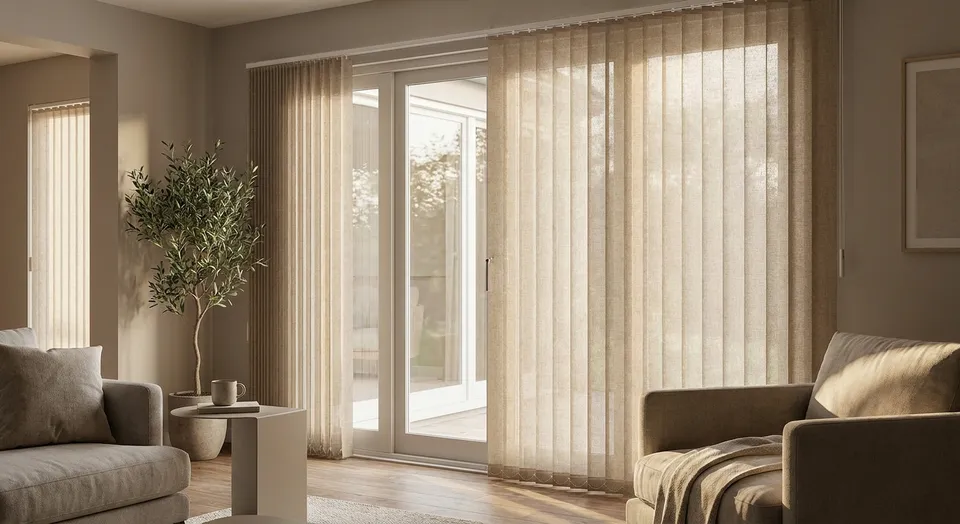
Sliding glass doors need a window treatment that can span 6 to 12 feet without sagging, dragging, or blocking the track. And stock horizontal blinds from a big-box store rarely do the job right. This guide breaks down what actually works for sliders in Seattle-area homes and which options to skip.
- Vertical panel track blinds win for sliders over 8 feet wide, full stack-back clears the door path. Buy.
- Cellular shades cut heat loss best for Pacific Northwest winters but cost more per square foot. Consider.
- Motorized roller shades solve the high-traffic slider problem in living rooms and kitchens. Buy.
- Stock horizontal blinds under 6-foot width rods sag and jam on sliders wider than that. Skip.
- Custom blinds for sliding glass doors run wider tracks, heavier headrails, and reinforced brackets that off-the-shelf kits don't include.
Why this matters
A sliding glass door isn't a standard window. It's often 6, 8, or 12 feet wide, gets opened and closed daily, and takes direct sun exposure for hours at a time in South King County homes. A treatment sized for a 36-inch window will either not cover the opening or will bind every time someone slides the door.
For a sliding door, check the measured opening, hardware capacity, stack-back, and full walking path before selecting the system. Correct installation and care matter, but no fixed service life is promised.
Who this is for
This guide is for homeowners in Auburn, Kent, Federal Way, Renton, Bellevue, Tacoma, or Seattle with a sliding glass door leading to a patio, deck, or backyard, especially if that door gets daily foot traffic, faces west or south for afternoon sun, or currently has mini blinds that catch on the track every time the door opens.
What to look for in custom blinds for sliding glass doors
Stack-back clearance
The panels or slats need somewhere to go when the door is open, and that space is the stack-back. A vertical panel track system typically stacks to one side within 8 to 12 inches, while a wide roller shade needs a clear headrail run with no obstruction. Get this measurement wrong and the door won't open past halfway.
Track width and door span
Most sliders run 6 feet (a single panel plus fixed pane) or 8 to 12 feet for a three-panel door. Off-the-shelf blind kits max out around 6 feet before the headrail sags in the middle. Anything wider needs a reinforced or segmented track built to spec.
Light control without full blackout
Sliders usually sit on the main living or dining space, so full blackout is rarely the goal. Roller shades vs cellular shades each solve this differently: rollers use a single opaque or light-filtering fabric, cellular shades trap air in honeycomb pockets that diffuse light while adding insulation. Compare the two before deciding, the roller shades vs cellular shades comparison covers the tradeoff in more detail.
Daily-use durability
A slider gets opened and closed multiple times a day, and any treatment mounted near it needs hardware that won't wear out from constant contact. Cordless lift systems and reinforced headrails hold up better than string-and-wand kits over a few years of daily use.
Motorization for hard-to-reach or high-traffic doors
If the slider sits behind a kitchen island, dining table, or a couch that blocks manual access, a remote or app-controlled lift removes the reach problem entirely. Motorized window shades for Renton living rooms and similar high-traffic spaces are one of the fastest-growing requests Rainier Blinds gets in 2026, mostly from homeowners tired of manually adjusting a treatment they can't easily get to.
Energy performance for winter and summer
West- and south-facing sliders in the Puget Sound region lose heat fast in January and gain it fast in July. Cellular shades with sealed side channels cut both effects noticeably more than a flat roller fabric, which matters if the slider backs onto a living room or bedroom you actually spend time in.
Top picks for sliding glass doors
Vertical panel track blinds, the classic pick. Tracks span up to 12 feet in a single system with individually adjustable vanes, and stack-back clearance runs as tight as 8 inches per panel. This is the standard answer for wide three-panel sliders where a rolled shade would need an oversized headrail. Buy for any slider over 8 feet wide.
Cellular (honeycomb) shades, the insulation pick. The honeycomb structure traps a layer of air that measurably slows heat transfer through the glass, which matters most on north- or west-facing sliders that catch cold drafts in December and January. Cordless versions avoid dangling cords near a door kids and pets pass through daily. Buy for energy-conscious households, Consider if budget is the deciding factor since cellular runs higher per square foot than a basic roller.
Roller shades, the low-profile pick. A single continuous fabric panel rolls into a slim headrail, giving the cleanest sightline of any option and the smallest stack-back footprint. Manual chain-lift versions cost less, but a slider that gets touched daily wears the chain mechanism faster than a motorized lift will. Consider for moderate-traffic sliders, Buy if paired with motorization.
Motorized shades. The convenience pick. Remote or app control solves the access problem on sliders blocked by furniture, and scheduling features let the shade open at sunrise and close at sunset automatically. Motorized window shades for Renton living rooms walks through the setup homeowners in similar layouts have used. Buy for high-traffic or hard-to-reach sliders.
Outdoor-style drapery panels. The soft-side pick. Fabric panels add texture and a softer look than hard window treatments, but loose fabric near a daily-use door snags on handles and door pulls more than any other option on this list. Skip for sliders with heavy foot traffic; Consider only for a slider that's rarely opened.
What to avoid
- Stock horizontal mini blinds over 6 feet wide. The headrail sags in the middle and the slats stop closing evenly within a year or two, a mistake covered in more detail in custom blinds for Federal Way homes.
- Cord-lift systems on doors kids or pets pass through daily. Cords near a high-traffic door create a snag and safety hazard that cordless or motorized lifts avoid entirely.
- Full blackout fabric on a main living space slider. It blocks the view and natural light homeowners actually want from a patio door, light-filtering or room-darkening (not full blackout) fits sliders better.
Verdict comparison
| Option | Best for | Stack-back | Verdict |
|---|---|---|---|
| Vertical panel track | Sliders 8-12 ft wide | 8-12 in per panel | Buy |
| Cellular shades | Winter insulation | Compact, side-channel | Buy / Consider on budget |
| Roller shades | Clean sightlines | Slim headrail | Consider |
| Motorized shades | High-traffic, hard-to-reach | Varies by base type | Buy |
| Drapery panels | Low-traffic, soft look | Wide | Skip on high-traffic doors |
FAQ
What's the best window treatment for sliding glass doors?
Vertical panel track blinds are the best fit for sliders over 8 feet wide because the track handles the span without sagging. For narrower single-panel sliders, a cordless roller or cellular shade works just as well.
How much does custom blinds for sliding glass doors cost in 2026?
Pricing depends on door width, fabric or material choice, and whether the lift is manual or motorized. Getting an on-site measurement is the only way to get a real number instead of a rough online estimate.
Are motorized shades worth it for a patio door?
Motorized shades are worth it when the slider is blocked by furniture or gets opened multiple times a day, since remote or app control removes the manual reach problem. For a rarely-used slider, a manual cordless lift covers the same light control at lower cost.
Do cellular shades work on sliding glass doors?
Yes, cellular shades work on sliding glass doors and add measurable insulation value against Pacific Northwest winter drafts. Side-channel track versions seal the edges tighter than a standard mount.
Can vertical blinds be replaced with something more modern?
Vertical panel track systems have replaced the old plastic vertical blind look with fabric or vinyl vanes that stack tighter and look closer to a roller shade when closed. The track function stays the same but the material and finish are 2026-current.
What width sliding door needs custom-sized blinds?
Any slider over 6 feet wide generally needs a custom or reinforced track, since standard blind kits are built for single windows up to that width. A three-panel 12-foot slider almost always requires a custom measurement.
Do blinds on a sliding door get in the way when it's open?
They shouldn't if the stack-back is measured correctly before installation. Vertical panel track systems stack to one side within 8 to 12 inches, leaving the full door opening clear.
One last thing
Most homeowners assume a slider needs the same treatment as a regular window, just wider. But the daily open-and-close cycle is what actually breaks cheap hardware, not the width. A headrail rated for daily cycling outlasts a wider-but-cheaper kit by years, even at the same price point in 2026.