
Our available controls: Rainier Blinds offers Roman and woven wood shades with motorized operation only. Available controls and power options for other products are confirmed at your consultation.
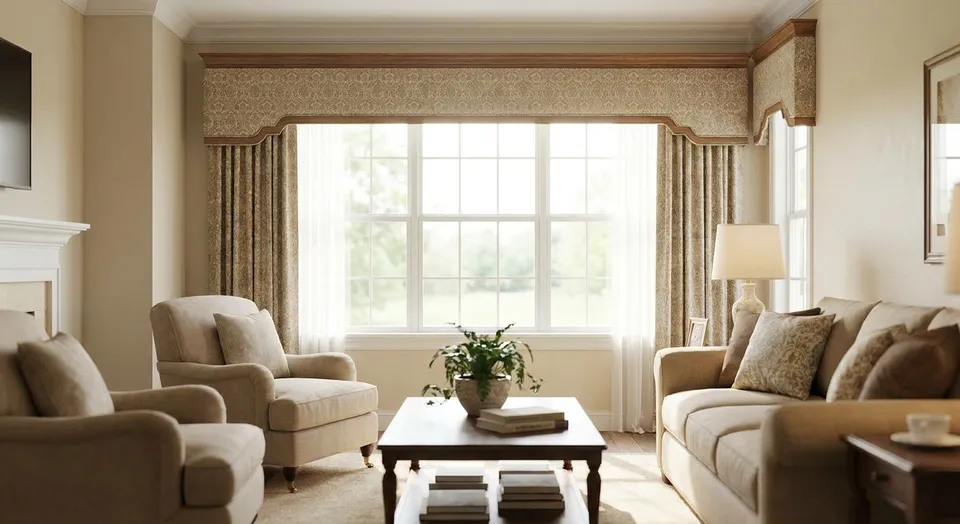
Cornices show up in a lot of living room mood boards, but the traditional cornice-a boxed, upholstered or wood shell mounted above the window frame-is a finish-carpentry project, not a shade purchase. If you're comparing custom cornices for living room windows against soft window treatments, here's the honest breakdown of what a cornice actually does, what it needs to work, and which fabric-based alternatives get you the same finished top-of-window look without a custom millwork order.
- Custom cornices for living room windows need 4-6 inches of return depth to clear a motorized shade headrail underneath.
- Custom drapery panels for living rooms is the closest soft substitute to a built cornice and mounts in a day, not weeks.
- Skip stock foam cornice kits under 48 inches wide on a full-wall living room window, proportion looks off immediately.
- Dual layered zebra shades for living rooms hide the headrail entirely, so you skip the cornice decision altogether in 2026.
Who this is for
This guide is for a homeowner in the Greater Seattle Area, Bellevue, Tacoma, Auburn, Seattle proper, finishing a living room remodel who wants the tailored, top-of-window look a cornice delivers but hasn't decided between hard millwork and a soft treatment. If you already have a general contractor pricing a built-in cornice box, you're past this guide. If you're still weighing options and want something installed on a normal residential timeline, keep reading.
What to look for in custom cornices for living room windows
Proportion relative to window width and ceiling height
A cornice that's too shallow or too narrow reads as an afterthought once it's mounted eight feet up a wall. On a living room window wider than 60 inches, the box needs enough projection to look intentional rather than pasted on, and that projection has to scale with your ceiling height, not just the window frame.
Return depth for clearance behind shades or blinds
If you're layering a cornice over a roller shade, cellular shade, or motorized headrail, the box needs enough return depth, typically 4 to 6 inches, to clear the hardware without the fabric brushing the shade every time it moves. Skimp here and you'll hear the fabric catch on the headrail within the first month.
Fabric or finish match to your drapery and wall color
If a cornice or topper needs to coordinate with drapery, compare physical samples and confirm fabric, dye lot, and finish details before ordering. Buying through one source does not guarantee an exact match.
Mounting hardware and wall condition
Plaster walls, vaulted trim, and older Seattle-area homes with non-standard stud spacing all change what a cornice bracket can hold. A box that's fine on drywall in a 2020s build can pull loose on lath-and-plaster in a Craftsman.
Maintenance and dust exposure
A boxed cornice is a dust shelf. In a high-traffic living room near a fireplace or an open kitchen, that means more frequent cleaning than a flat roman shade or a drapery panel that can go through routine care.
Cost and lead time versus soft alternatives
A custom-built cornice runs through a carpenter or upholsterer on a project timeline measured in weeks. A fabric valance or drapery panel from a window treatment installer typically ships and installs faster, which matters if you're finishing a remodel on a deadline.
The soft alternatives that do the cornice's job
Rainier Blinds doesn't fabricate hard wood or upholstered cornice boxes. That's a finish-carpentry scope. What the crew does install, on a normal residential schedule, are the fabric-based treatments that solve the same problem: a finished, tailored top-of-window line without an exposed headrail.
Custom drapery panels for living rooms. The classic pick. Mounted 4 to 6 inches above the window frame on a decorative rod, floor-length panels create the same vertical lift a cornice gives a room, and they layer cleanly over a roller or cellular shade underneath. Custom drapery panels for living rooms is the most direct swap if the cornice was ever about softening a hard window line. Verdict: Buy.
Custom valances can provide a soft fabric finish above the window. Compare the style and mounting requirements with any proposed cornice, then confirm the schedule for the selected treatment.
Roman shades. The tailored pick. Mount a roman shade on an outside-mount board 3 to 4 inches wider than the window frame and the folded fabric stack at the top does visual work similar to a shallow cornice, minus the separate box. Roman shades for living rooms covers fabric and fold options for this exact mount style. Verdict: Buy.
Dual layered zebra shades, the modern pick. These hide the headrail behind alternating sheer and solid bands, so there's no exposed hardware to disguise with a topper in the first place. If the whole reason you were considering a cornice was hiding a headrail, this sidesteps the question. Dual layered zebra shades for living rooms is worth a look before you spec any topper. Verdict: Buy.
“If the box clears less than four inches behind the headrail, skip the cornice and go with a soft valance instead.”
What to avoid
- Stock foam or MDF cornice kits under 48 inches wide stretched across a full living room window wall. The proportion mismatch shows the moment it's mounted.
- A cornice ordered separately from your drapery or shade fabric. Dye lots and weave don't match across vendors as often as showrooms promise.
- Boxed cornices over motorized shades without confirming return depth first. Less than 4 inches of clearance means the fabric drags on the headrail every cycle.
Compare cornice alternatives in person
Get real pricing on drapery, valances, and shades measured for your living room.
Verdict comparison
| Option | Best for | Mount depth needed | Verdict |
|---|---|---|---|
| Custom drapery panels | Full living room walls, layered look | 4-6 inches for rod + shade underneath | Buy |
| Custom valances | Smaller windows, faster install | 2-3 inches for headrail | Consider |
| Roman shades | Tailored, single-layer finish | Outside mount, 3-4 in. wider than frame | Buy |
| Dual layered zebra shades | Hiding hardware without a topper | Standard headrail, no extra depth | Buy |
| Built cornice box | Formal rooms with carpentry budget | 4-6 in. return, needs center support over 12 ft | Skip unless budgeted separately |
Why this matters
A custom cornice is a carpentry decision dressed up as a window treatment decision. Homeowners search for it because they want a finished, tailored top-of-window line, not because they specifically want a plywood box built and upholstered. In 2026, most living rooms get that same finished line faster and at lower total project risk from a drapery panel, a valance, or a shade mounted with the right board width. Knowing that before you call a finish carpenter saves a remodel timeline.
FAQ
What's the best alternative to a custom cornice for a living room window?
Custom drapery panels mounted 4 to 6 inches above the frame give the closest look to a built cornice without carpentry. Roman shades on an outside mount board are the second-best swap for a single-layer treatment.
Is a valance better than a cornice for a living room?
A valance uses soft fabric while a cornice has a more rigid structure. The best choice and schedule depend on the intended appearance, mounting requirements, and supplier availability.
Does Rainier Blinds install wood cornices?
No. Rainier Blinds installs fabric-based treatments, drapery, roman shades, valances, and cellular and zebra shades, measured and installed by its own crew across the Greater Seattle Area. Built wood or upholstered cornice boxes are a separate finish-carpentry scope.
How much clearance do you need behind a cornice for a motorized shade?
Plan on 4 to 6 inches of return depth so the cornice doesn't brush the shade's headrail during operation. Less than that and the fabric will catch on the hardware within weeks.
Can you pair a cornice with roman shades?
Yes, as long as the cornice has enough return depth to clear the shade's mounting board, typically 3 to 4 inches beyond the window frame. Matching the cornice fabric to the roman shade fabric avoids a visible mismatch.
What's the difference between a cornice and a valance?
A cornice is a rigid box built over a wood or buckram frame, usually upholstered or painted. A valance is soft fabric mounted on a headrail with no rigid structure, which makes it faster to install and lighter to mount.
How wide can a cornice be before it needs center support?
Cornice support depends on its span, weight, construction, mounting surface, and hardware. Follow the fabricator’s or hardware manufacturer’s support requirements; a general width threshold is not a safe design rule.
Are cornices out of style for living rooms in 2026?
Cornices haven't disappeared, but soft treatments, layered drapery, roman shades, and dual layered zebra shades, are the more common living room finish in 2026 because they install faster and adapt more easily to motorized shades.
One last thing
The detail that trips up most cornice plans isn't the fabric. It's the return depth. Measure for the shade or blind going underneath first, add the clearance it needs, and only then size the topper. Get that order backward and you'll be re-measuring the cornice after the shade is already installed.