
Our available controls: Rainier Blinds offers Roman and woven wood shades with motorized operation only. All other shade styles are available with manual, motorized, or smart control. Your consultation confirms the controls and power options for your product.
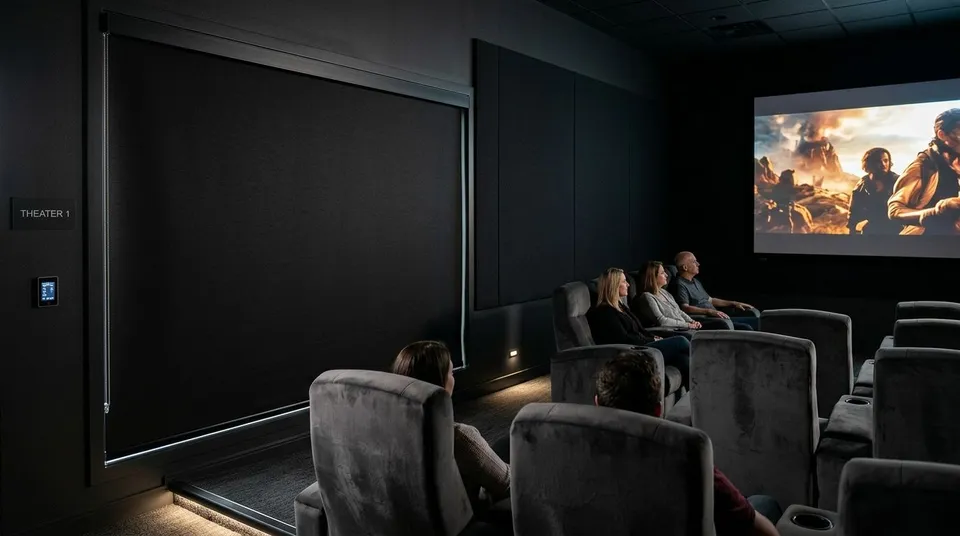
Screening rooms and media rooms only work in the dark, and the shade doing that job matters more than the projector or the seating. This guide ranks the blackout shade types that actually hold up in commercial screening rooms and home media rooms in 2026, based on how each performs against light leak, noise, and wide-wall coverage.
Best overall: Motorized Blackout Roller Shades. Best for boutique screening rooms: Blackout Roman Shades. Best for full light-seal coverage on glass walls: Blackout Drapery Panels.
- Motorized blackout roller shades with side channels are the best blackout shades for screening rooms in 2026 for most commercial and home theater setups.
- Blackout cellular shades add real acoustic dampening on top of light control, best for media rooms doubling as recording or office space.
- Blackout drapery panels are the only option that reliably covers wall-of-glass screening rooms without side-channel hardware.
- Roman shades bring the decorative finish boutique screening rooms want but lose points on pure light blockage.
- Smart blackout shades tied to a scene controller are worth the extra step for rooms used as a screening space every day.
Why this matters
A shade rated "room darkening" and a shade rated "blackout" are not the same product, and the difference shows up the moment the projector turns on and light bleeds in around the frame. For home theaters, that gray glow at the edges kills contrast on the screen even with the lights off.
Commercial screening rooms have a second problem: wide walls. A single roller shade tops out around the width the fabric roll allows, so a 12-foot media wall needs either a wider fabric option, a multi-panel drapery track, or a shade built specifically for wide openings. Get the shade type wrong and you're re-measuring the room in 2027.
What makes the best blackout shades for screening rooms
- Light blockage rating – the fabric itself has to be rated blackout, not room-darkening, which is a lower opacity tier
- Edge and side-channel seal – light leaks around the frame more than through the fabric, so side channels or overlapping drapery panels matter as much as the fabric
- Wide-wall coverage – can the shade span the actual opening without seams or gaps
- Noise and acoustic behavior – matters when the room doubles as a home office, studio, or conference room
- Motorization and smart integration – screening rooms get used on a schedule, and a wall switch defeats the point
- Maintenance – fabric that holds shape and color under repeated open-close cycles in a room that's used daily
Blackout shades for screening rooms at a glance
| Shade type | Best for | Standout feature | Key limitation |
|---|---|---|---|
| Motorized Blackout Roller Shades | Commercial screening rooms overall | Flat fabric plus side channels seal the frame | Single layer offers little sound dampening |
| Blackout Cellular Shades | Media rooms needing noise control | Honeycomb structure softens echo and blocks light | Bulkier stack height on tall walls |
| Blackout Roman Shades | Boutique and luxury screening rooms | Decorative fold pairs with any interior style | Fold stack lets small light gaps at the top |
| Blackout Drapery Panels | Wall-of-glass media rooms | Covers oversized openings without a fixed track width | Needs extra fabric width to avoid edge gaps |
| Smart Blackout Shades (any type, motorized) | Daily-use AV-integrated rooms | Ties shade close to a scene or schedule | Adds electronics cost and a second site visit |
1. Motorized Blackout Roller Shades: best blackout shades for commercial screening rooms overall
A roller shade with true blackout fabric and side channels is the default answer for most screening rooms because the flat fabric gives an even, gap-free surface and the side channels close the last gap where light usually gets in. Motorized operation means the shade closes on a schedule or a button press instead of a pull cord across a dark room.
Motorized Blackout Roller Shades pros:
- Minimal profile, so the shade doesn't compete visually with a projector screen
- Side channels or sill fins close the frame gap that ruins most blackout claims
- Wide fabric widths cover most commercial screening walls without seams
- Works with a smart hub for scene presets tied to movie start
Motorized Blackout Roller Shades cons:
- A single fabric layer doesn't add meaningful sound dampening
- Side channels are an added hardware cost and a longer install
- Glossy or reflective fabric finishes can bounce projector light back into the room
Best for: commercial screening rooms and home theaters where light control is the only job. Verdict: Buy.
2. Blackout Cellular Shades: best blackout shades for media rooms needing noise control
Cellular shades trap air in honeycomb pockets, which softens echo in a room full of hard surfaces, screens, and speakers. Add a blackout lining behind the honeycomb and the shade does double duty in rooms that also get used for recording, calls, or quiet work between screenings.
Blackout Cellular Shades pros:
- Honeycomb structure adds real acoustic softening, not just light control
- Blackout lining blocks nearly all direct light through the fabric
- Insulation benefit on rooms with poor window seals
- Cordless and motorized lift options both available
Blackout Cellular Shades cons:
- Taller stack height at the top of the window than a roller shade
- Wide walls often need multiple panels, which reintroduces seams
- Honeycomb pleats can collect dust over years of use
Best for: media rooms that double as home offices or recording spaces. Rainier Blinds gets this question often on jobs adjacent to home recording studios, where the shade has to manage light and echo at the same time. Verdict: Buy for noise-sensitive rooms.
3. Blackout Roman Shades: best blackout shades for boutique screening rooms
A fabric roman shade with a blackout lining brings a decorative, tailored look that a flat roller shade can't match, which is why it shows up in boutique screening rooms that double as a lounge. The tradeoff is the fold itself: roman shades stack in soft pleats rather than a flat roll, and that stack lets a thin line of light through at the very top.
Blackout Roman Shades pros:
- Fabric folds add a finished, designed look instead of a utility shade
- Layers naturally with drapery for rooms that want both function and style
- Custom fabric choices match the rest of the interior
Blackout Roman Shades cons:
- Fold stack allows a small light gap at the header, worse than a roller with side channels
- Not the right pick for a room that needs total darkness for daytime screenings
- Wide walls push fabric cost up fast compared to roller shades
Best for: upscale home theaters where design matters as much as darkness. If the room is part of a larger design project, a custom drapery design consultation is worth booking alongside the roman shade measure. Verdict: Hold for pure light control, Buy for style-forward rooms.
4. Blackout Drapery Panels: best for wall-of-glass media rooms
When a screening room has a full glass wall instead of a standard window, drapery is often the only practical answer. Floor-to-ceiling panels on a traverse or motorized track cover openings a roller shade fabric roll simply can't span, and overlapping panels at the center close the seam a single shade would leave open.
Blackout Drapery Panels pros:
- Covers oversized openings without being limited to one fabric roll width
- Overlapping panels close the center seam that a single shade leaves exposed
- Motorized traverse tracks automate the close for daily-use rooms
- Interlining behind the blackout lining adds a second barrier against light and cold
Blackout Drapery Panels cons:
- Needs generous fabric width, or panels won't overlap enough to block the center gap
- Heavier blackout and interlined fabric needs drapery hardware rated for the extra weight
- Fabric care requirements are higher than a wipe-down shade
Best for: rooms with a wall of glass instead of standard windows. Verdict: Buy for wall-of-glass rooms.
5. Smart Blackout Shades: best for daily-use, AV-integrated screening rooms
Any of the four shade types above can be built with a smart motor instead of a standard motorized one, which means the shade can be tied to a schedule, a voice command, or a scene trigger alongside the projector and lights. For a screening room used on a regular schedule, this is the difference between someone remembering to close the shade and the room being ready automatically.
Smart Blackout Shades pros:
- Ties shade close to a scene trigger alongside lights and screen
- Scheduling handles daytime screenings without manual operation
- No wall switch needed, useful in commercial spaces with multiple users
Smart Blackout Shades cons:
- Adds electronics cost on top of the shade itself
- Needs power access nearby or a battery maintenance routine
- Integration with an existing AV system usually takes a separate site visit
Best for: commercial screening rooms and media rooms used daily rather than occasionally. Verdict: Buy for daily-use rooms.
“A blackout shade with a gap along the side channel isn't a blackout shade, it's a room-darkening shade with a better fabric.”
How we ranked these
Each shade type was scored against the six criteria above: light blockage rating, edge seal, wide-wall coverage, acoustic behavior, motorization fit, and maintenance. Roller shades won overall because side channels solve the edge-leak problem directly. Cellular shades moved up for acoustic behavior. Roman shades and drapery ranked by the specific room condition they solve, oversized glass for drapery, design intent for roman.
Get a screening room shade consultation
Free in-home measure and real pricing on the spot, no online quotes.
Which blackout shade should you choose?
For a standard commercial screening room or home theater with normal window sizes, motorized blackout roller shades with side channels are the default pick in 2026. If the room doubles as a home office or recording space, move to blackout cellular shades for the added noise dampening. A wall of glass instead of a window points straight to blackout drapery, and a boutique screening room built around interior design points to roman shades layered with drapery. Rooms used every day, commercial or residential, are worth the extra step into smart, scene-triggered operation regardless of which shade type you land on.
FAQ
What's the best blackout shade for a screening room?
Motorized blackout roller shades with side channels are the best overall pick for screening rooms in 2026 because the flat fabric and sealed edges close both the fabric and the frame gap. Boutique or wall-of-glass rooms have better-fitting alternatives, roman shades or drapery respectively.
Is blackout drapery better than blackout roller shades for media rooms?
Drapery wins on oversized walls of glass a roller shade fabric roll can't span, but roller shades with side channels seal the frame edge more tightly on standard window sizes. Pick based on the opening size, not personal preference.
Do blackout cellular shades actually block all light?
Blackout cellular shades block nearly all direct light through the fabric and add acoustic dampening the other shade types don't, but the honeycomb stack height at the top of the window is taller than a roller shade.
Can blackout shades be motorized and controlled by a smart home hub?
Yes, roller, cellular, roman, and drapery-track systems all come in motorized versions that pair with a smart hub for scheduled or scene-triggered closing, which matters most in rooms used for screenings every day.
Why does my blackout shade still let light in around the edges?
Most light leak in a screening room comes from the frame gap, not the fabric, which is why side channels on roller shades or overlapping panels on drapery matter more than the blackout rating of the fabric alone.
Are roman shades good enough for a home theater?
Roman shades with a blackout lining bring a decorative, tailored look but the fold stack at the header lets a thin line of light through, so they suit boutique home theaters more than commercial screening rooms needing total darkness.
What's the difference between room-darkening and blackout shades?
Room-darkening fabric is a lower opacity tier that still lets some light through the weave, while blackout fabric is built to block essentially all direct light, which is the rating a true screening room needs.
One last thing
The fabric rating on the shade almost never causes the light leak in a finished screening room, the frame does. Even a small gap along the sides or header undoes most of the light-blocking benefit a blackout fabric is supposed to deliver, which is why side channels, overlapping drapery panels, and a correct mount type matter as much as the shade itself in 2026 screening room installs.