
Our available controls: Rainier Blinds offers Roman and woven wood shades with motorized operation only. All other shade styles are available with manual, motorized, or smart control. Your consultation confirms the controls and power options for your product.
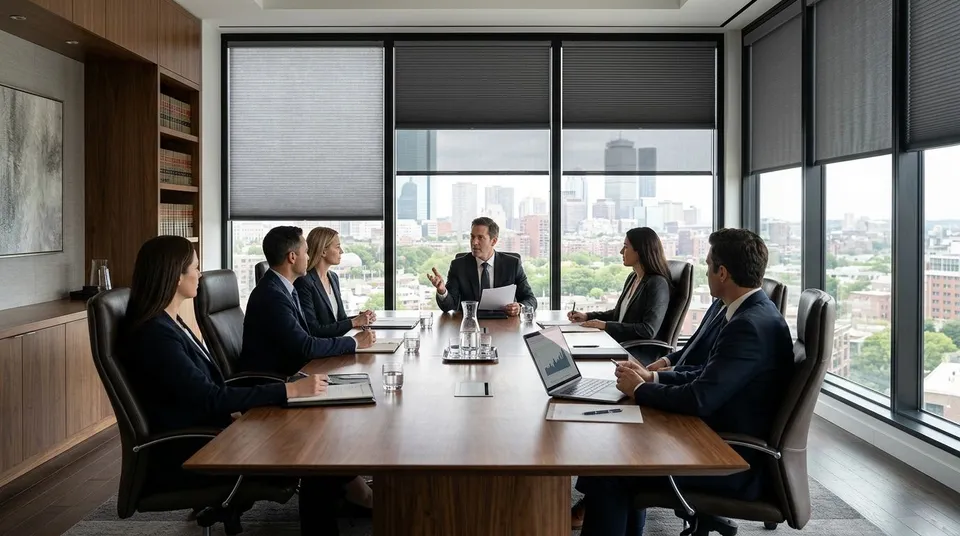
Law offices and conference rooms need window treatments that control glare on video calls, keep client conversations private, and hold up under daily foot traffic, not decorative curtains built for a living room. This guide ranks the shade types that perform best in Seattle-area legal offices in 2026, from downtown Bellevue towers to Auburn storefront practices.
- Motorized light filtering roller shades are the best window treatments for law offices needing video-call ready glare control in 2026.
- Zebra shades win for conference rooms that switch between open discussion and full privacy during depositions.
- Cellular shades cut noise transfer best for private consultation offices and client meeting rooms.
- Motorized shades scale best across multi-window corporate suites in downtown Seattle and Bellevue towers.
- Drapery and Roman shades suit reception areas and executive offices wanting a tailored, formal look.
Why this matters
A law office window treatment has a different job than a bedroom shade. It has to survive fluorescent light bouncing off a laptop screen during a 9 a.m. deposition, block a passerby's view into a partner's office, and still look like it belongs in a professional building instead of a rental unit. Rainier Blinds measures and installs shades and drapery for offices across the Greater Seattle Area, and the pattern shows up in almost every consultation: firms buy the wrong product first, usually a basic light filtering roller shade with no blackout layer, and end up replacing it within a year once video calls become the daily norm.
Getting this right in 2026 means picking a shade category for the job it actually does, not the one that looks best in a catalog photo.
What makes the best window treatments for law offices
- Glare control on screens for video depositions and client calls
- Privacy that adjusts, not just fully open or fully closed, for confidential conversations
- Noise dampening between glass-walled offices and open conference rooms
- A professional look that reads as corporate, not residential
- Motorized or smart operation for tall windows and multi-window suites that staff won't manually crank twice a day
- Durability for daily use in high-traffic commercial hallways and reception areas
At a glance
| Window treatment | Best for | Standout feature | Key limitation |
|---|---|---|---|
| Light filtering roller shades | Video-call ready private offices | Flat profile, cuts screen glare | Less privacy than a blackout layer |
| Zebra shades | Conference rooms with switching privacy needs | Alternating bands go sheer to opaque | Banded look reads casual to some firms |
| Cellular shades | Private consultation and client rooms | Honeycomb pockets dampen sound | Bulkier stack than a roller shade |
| Motorized corporate shades | Multi-window glass office towers | Scheduled raise and lower across a floor | Needs power or battery planning upfront |
| Roman shades | Reception areas and partner offices | Fabric folds add texture without slats | Bulkier stack when fully raised |
| Custom drapery | Executive offices and formal conference rooms | Softens acoustics, frames large windows | More upkeep than shades alone |
1. Light filtering roller shades: best window treatment for law offices with video calls
A flat, motorized light filtering roller shade is the default pick for private offices and small conference rooms that run video calls daily. The fabric cuts direct glare without turning the room dark, which matters when three or four people are staring at a laptop camera for an hour.
Light filtering roller shades pros:
- Flattest stack of any shade category, minimal visual bulk on glass walls
- Motorized versions raise and lower on a schedule without staff touching a cord
- Screens read clearly on camera without harsh window backlight
- Fabric options range from near-sheer to heavier weaves for west-facing exposure
Light filtering roller shades cons:
- Does not fully block outside view, so pair with a blackout layer for deposition rooms
- Motorized versions add setup time compared to manual pull shades
Best for: private offices and small conference rooms running daily video calls. Verdict: Buy.
2. Zebra shades: best for conference rooms with switching privacy needs
Zebra shades (dual light filtering shades) use alternating bands of sheer and solid fabric on one roll, so a conference room can go from an open, bright view to nearly full privacy without swapping shades. That flexibility matters in a room used for both casual client meetings and closed-door depositions on the same day.
Zebra shades pros:
- One shade covers two very different privacy needs
- Smart and motorized options available for boardrooms with high ceilings
- Adjustable band alignment lets staff dial in exact light and sightline
- Works well on the large picture windows common in newer office buildouts
Zebra shades cons:
- The banded look is more contemporary than traditional, which some conservative firms skip
- Costs more than a single-layer roller shade for the same window
Best for: conference rooms alternating between open meetings and confidential sessions. Verdict: Buy.
3. Cellular shades: best for private consultation offices needing quiet
Cellular shades trap air in a honeycomb structure, which does more for sound and temperature control than any flat shade. In a private office next to a busy hallway or an open bullpen area, that structure noticeably cuts the noise bleeding through the glass.
Cellular shades pros:
- Honeycomb pockets reduce sound transfer and street noise better than roller shades
- Cordless and motorized safe for hallways with regular foot traffic
- Blackout cellular options available for rooms that need zero screen glare
- Insulating structure can lower HVAC noise from vents cycling near windows
Cellular shades cons:
- Stacks bulkier than a roller shade, which shows on very tall glass walls
- Less of a clean, minimal look than flat shades favored in newer buildouts
Best for: private consultation rooms and client meeting offices near noisy corridors. Verdict: Buy.
4. Motorized shades for corporate office buildings: best for multi-window suites
Downtown Seattle and Bellevue office towers often mean a dozen windows across one floor, all needing to open and close on the same schedule. Motorized shades built for corporate office buildings solve that by running on a program instead of relying on staff to manage each window by hand every morning and evening.
Motorized corporate shades pros:
- Scheduled operation manages solar heat gain across an entire floor automatically
- Cuts down on cord clutter across many windows, which matters for ADA and safety compliance
- Integrates with a smart hub for remote control from a front desk or facilities office
- Consistent look across every window in the suite
Motorized corporate shades cons:
- Requires planning for power access or battery servicing before installation
- Higher upfront coordination than buying manual shades window by window
Best for: multi-window glass office suites and full-floor corporate buildouts. Verdict: Buy.
5. Roman shades: best for reception areas and partner offices
Roman shades fold into soft horizontal pleats when raised, which gives a reception area or a partner's corner office a tailored look without the segmented slat appearance some firms want to avoid. They pair well with wood furniture and darker interior palettes common in legal offices.
Roman shades pros:
- Fabric folds add texture and warmth compared to a flat roller shade
- Motorized lift options available (no lift cords)
- Reads as upscale and tailored in reception and partner office settings
- Works well on standard and slightly oversized windows alike
Roman shades cons:
- Stacks bulkier than a roller shade when fully raised
- Not the best fit for very tall floor-to-ceiling glass
Best for: reception areas and partner or senior associate offices. Verdict: Buy.
6. Custom drapery: best for executive offices and formal conference rooms
Drapery adds a layer that shades alone can't, softening hard acoustics in a conference room full of glass and drywall while framing large windows in a formal, finished way. It works best layered over a functional shade rather than as the only window covering.
Drapery pros:
- Softens sound in rooms with hard surfaces better than shades alone
- Motorized traverse rod systems available for large window walls
- Pairs with a shade underneath for full light and privacy control
- Adds a finished, formal look to executive offices and boardrooms
Drapery cons:
- Needs more upkeep than shades, including periodic cleaning
- Takes up more wall space on either side of the window
Best for: executive offices and formal conference rooms wanting a layered, finished look. Verdict: Hold, unless the room already has a functional shade underneath.
How we ranked these
Each shade type was scored against the six criteria above: glare control, adjustable privacy, noise dampening, professional appearance, motorized readiness, and commercial durability. No single product wins every category, which is why this list assigns a specific job to each one instead of naming one universal winner. A law office rarely needs just one shade type across an entire suite in 2026, it needs the right one per room.
Get shades measured for your office
Free in-home or in-office consultation across the Greater Seattle Area.
Which window treatment should your law office choose?
For most private offices and standard conference rooms, motorized light filtering roller shades are the safest default pick for 2026, they handle video calls without turning a room dark and keep a clean, professional line on the glass. Rooms that double as deposition space should add zebra shades for switchable privacy, and any office bordering a noisy hallway does better with cellular shades. Reception areas and formal boardrooms are where Roman shades and drapery earn their keep, since the priority shifts from function to finished appearance.
FAQ
What is the best window treatment for a law office conference room?
Zebra shades are the best window treatment for a law office conference room that needs to switch between open meetings and confidential, closed-door sessions. Motorized light filtering roller shades work better in smaller rooms used mainly for daily video calls.
Are motorized shades worth it for law offices?
Motorized shades are worth it for law offices with multiple windows or tall glass walls, since a scheduled program manages solar heat and privacy without staff adjusting each window by hand. Single-window private offices can often get by with manual shades.
Do zebra shades work well for video conferencing?
Zebra shades work well for video conferencing because the sheer band cuts direct glare while still letting in natural light for the camera. Switching to the solid band adds full privacy for confidential portions of a call.
How do cellular shades reduce noise in a law office?
Cellular shades reduce noise because their honeycomb structure traps air, which dampens sound transfer through the glass better than a flat roller or Roman shade. This matters most in private offices next to busy hallways or open work areas.
What is the difference between roller shades and drapery for a law office?
Roller shades control light and privacy on their own, while drapery is a layered finishing piece usually installed over a functional shade. Drapery adds acoustic softening and a formal look but is not built to be the only window covering.
Can Rainier Blinds install shades in downtown Seattle or Bellevue office buildings?
Rainier Blinds measures and installs shades and drapery for offices across the Greater Seattle Area, including Bellevue, Tacoma, and Seattle, using its own measure and install crew rather than a subcontractor.
How long does shade installation take for a multi-window conference room?
Installation time depends on the number of windows and whether shades are manual or motorized, since motorized systems need additional setup for power or battery placement. A free in-home or in-office consultation is the fastest way to get a firm timeline for your space.
One last thing
Most firms shopping for law office window treatments in 2026 focus on fabric color and skip the stack profile, but on a floor-to-ceiling glass wall, stack depth matters more than color. A bulky cellular or Roman shade stacking six inches down from the header line looks fine on a standard window and looks unfinished on a full glass wall, where a flat roller or zebra shade keeps the sightline clean when raised.