
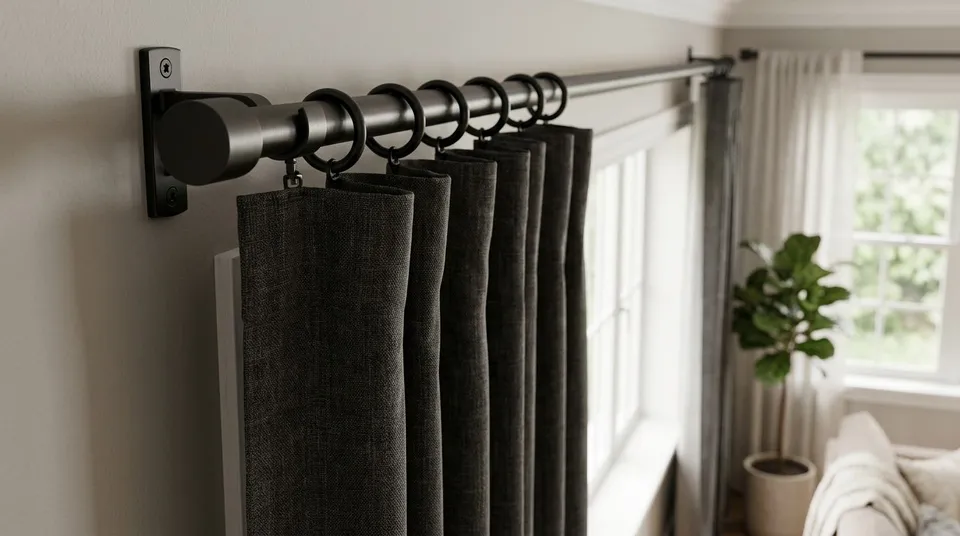
Heavy blackout drapery only performs as advertised when the hardware behind it can carry the weight without sagging, bowing, or pulling out of the wall within a year. This guide ranks the drapery hardware types that actually hold up under blackout-weight fabric, and tells you which one fits your window, your wall, and how you want the panels to move.
- Motorized traverse track wins for wide great room windows carrying heavy blackout panels.
- Ceiling-mounted track is the best drapery hardware for blackout curtains when wall studs aren't available.
- Reinforced wall rods with 1.5 inch or 2 inch poles handle standard bedroom windows without motorization.
- Double rod systems let you layer blackout and sheer panels on separate tracks for daytime and night control.
- Manual cord and pulley traverse rods deliver traverse function on a tighter budget in 2026.
Why this matters
Blackout drapery fabric is heavier than standard curtain fabric because of the layered lining that blocks light, and a rod built for lightweight cotton panels will bow within months under that load. The wrong bracket spacing or mount point turns a good fabric choice into a maintenance headache: sagging centers, dragging panels, and drywall anchors that eventually pull loose.
Getting the drapery fabric weight and the hardware matched from the start is the difference between drapery that traverses smoothly for a decade and drapery that needs a service call in year two. Rainier Blinds fields this question constantly from Seattle-area homeowners upgrading bedrooms and home theaters to full blackout, and the hardware conversation always comes before the fabric swatch.
What makes the best drapery hardware for heavy blackout curtains
- Rod or track diameter: 1.5 inch and 2 inch poles carry blackout weight far better than the thin 5/8 inch rods sold for sheers.
- Mount type: wall studs support more weight than drywall anchors alone, and ceiling mounts change the load path entirely.
- Traverse vs stationary: traverse hardware lets heavy panels glide on a cord or wand instead of being pushed by hand, which reduces wear on the fabric and the track.
- Bracket spacing: wider windows need more support brackets along the span, not just end brackets, or the center sags.
- Motorized vs manual: motorized traverse systems reduce daily stress on the hardware since the panels move at a consistent speed instead of being yanked.
- Layering capacity: a system built to run two rods (blackout plus sheer) needs double the bracket depth of a single-rod setup.
Drapery hardware for blackout curtains at a glance
| Hardware type | Best for | Standout feature | Key limitation |
|---|---|---|---|
| Motorized traverse track | Great rooms and wide walls of glass | Even glide across long spans without manual pull | Requires power access near the track |
| Reinforced wall rod (1.5 to 2 inch) | Standard bedroom and single windows | Permanent, simple, no moving parts to service | Manual push/pull wears fabric edges over years |
| Ceiling-mounted traverse track | Windows without usable wall studs | Load path runs into ceiling joists, not drywall | Installation is more involved than wall mount |
| Double rod system | Layering blackout with a sheer panel | Runs two fabrics independently for day and night control | Needs deeper brackets and more wall clearance |
| Manual cord and pulley traverse rod | Budget-conscious traverse function | Traverse glide without motor cost | Cords need periodic tension adjustment |
1. Motorized traverse track: best drapery hardware for great rooms and wide glass walls
A motorized traverse track runs on a track channel rather than a round pole, with a motor that pulls the carriers along a cord path instead of a hand or wand. For windows spanning 10 feet or wider, this is the hardware Rainier Blinds points customers toward most often, because the track distributes blackout panel weight across the full run instead of concentrating it at two end brackets.
Motorized traverse track pros:
- Handles wide spans without a visible center sag
- Consistent, even glide reduces fabric stress compared to hand-pulling heavy panels
- Pairs with a motorized traverse drapery system for great rooms with multiple window walls
Motorized traverse track cons:
- Needs an outlet or hardwired power run near the track
- More components than a simple pole, so there's more to service over time
- Overkill for a single standard window
Best for: great rooms, wide window walls, and multi-panel setups. Verdict: Buy if the window span exceeds 8 to 10 feet.
2. Reinforced wall rod: best drapery hardware for standard bedroom windows
A 1.5 inch or 2 inch diameter pole, mounted into wall studs with heavy-duty brackets, is the simplest hardware that still holds blackout weight without sagging on a standard single or double window. No motor, no track channel, just a thicker rod and stronger brackets than what ships with lightweight sheer curtain kits.
Reinforced wall rod pros:
- Lower installation complexity than a track system
- No motor or power dependency
- Widely compatible with grommet, ring, or pinch-pleat blackout panels
Reinforced wall rod cons:
- Manual push and pull wears panel edges faster over years of daily use
- Center support brackets become necessary past roughly 6 feet of span
- Not built for daily automated open and close routines
Best for: single bedroom windows and rooms where the drapery opens and closes occasionally rather than daily. Verdict: Buy for straightforward, budget-friendly bedroom installs.
3. Ceiling-mounted traverse track: best drapery hardware when wall studs aren't available
Some window walls, especially floor-to-ceiling glass or homes with unusual framing, don't have wall studs positioned where a rod bracket needs to go. A ceiling-mounted traverse track solves that by running the load path up into the ceiling joists instead of the wall, which is a more reliable anchor point for blackout-weight fabric than a drywall toggle alone.
Ceiling-mounted track pros:
- Anchors into ceiling joists rather than relying on wall stud placement
- Works well for floor-to-ceiling glass and modern great room layouts
- Can run drapery further out from the glass for a cleaner sightline
Ceiling-mounted track cons:
- Installation takes longer and requires precise joist location
- Not necessary on a standard window with accessible wall studs
- Visible ceiling hardware if not boxed or valanced
Best for: floor-to-ceiling windows and rooms where wall stud placement doesn't line up with the window. Verdict: Buy only when a wall mount genuinely isn't an option; otherwise it adds cost without adding benefit.
4. Double rod system: best drapery hardware for layering blackout with sheer panels
A double rod setup runs two separate rods or tracks from the same bracket assembly, one closer to the wall for a sheer or light-filtering panel and one further out for the blackout layer. This is the hardware behind most layered living room drapery setups where homeowners want soft daytime light and full blackout at night from the same window.
Double rod system pros:
- Independent control of sheer and blackout layers
- One installation covers two fabric functions
- Works with either motorized or manual hardware on each rod
Double rod system cons:
- Brackets need more depth and stronger wall anchoring than a single rod
- Two fabrics means two panels to maintain and clean
- More visually complex than a single-rod setup
Best for: living rooms and primary bedrooms where light control needs to flex between day and night. Verdict: Buy if you already own or plan to add a sheer layer alongside blackout panels.
5. Manual cord and pulley traverse rod: best budget drapery hardware for heavy blackout curtains
A manual traverse rod uses a cord and pulley system to glide heavy panels open and closed without a motor, giving you the even traverse motion of a track system at a lower hardware cost. It's a reasonable middle ground between a fixed wall rod and a full motorized track.
Manual traverse rod pros:
- Traverse glide without motor or power requirements
- Lower complexity than motorized systems, easier to service
- Works on most standard and medium-width windows
Manual traverse rod cons:
- Cords stretch and need periodic tension adjustment
- Not practical for windows wider than roughly 10 to 12 feet
- Daily hand operation adds wear over the years compared to motorized glide
Best for: homeowners who want traverse function on a tighter budget. Verdict: Hold if the window is wider than 10 feet; Buy for standard to medium spans.
Get the hardware matched to your window
A free in-home consultation covers hardware, fabric, and measurements together.
How this ranking works
Each hardware type above was weighed against the six criteria listed earlier: rod diameter, mount type, traverse capability, bracket spacing, motor option, and layering capacity. Motorized traverse track ranks first because it satisfies the most criteria at once for the widest range of window sizes, while the manual traverse rod ranks last among the recommended options because cord stretch and hand-wear limit it on the largest spans.
Which drapery hardware should you choose?
For a single bedroom window, a reinforced 1.5 to 2 inch wall rod is the right call in 2026, plain and simple. For a great room wall of glass, motorized traverse track carries the weight evenly and skips the daily wear that manual pulling causes. If your wall studs don't cooperate with the window layout, ceiling-mounted track solves the anchor problem outright. Anyone layering blackout with a sheer should default to a double rod system from the start rather than retrofitting later.
The one rule that holds across every option: match the rod or track diameter to the fabric weight before you pick a color or pattern. A wide rod with the wrong bracket spacing will still sag under blackout lining, so get the hardware conversation settled first.
FAQ
What's the best drapery hardware for heavy blackout curtains?
Motorized traverse track is the best drapery hardware for heavy blackout curtains on wide windows because it distributes weight across the full span instead of concentrating it at two end brackets. Standard bedroom windows do fine with a reinforced 1.5 to 2 inch wall rod instead.
Is a motorized traverse track better than a manual rod for blackout drapery?
Motorized traverse track is better for wide windows and daily use because it moves panels at a consistent speed and reduces fabric wear. A manual rod is simpler and works fine on single, standard-width windows that open and close occasionally.
Do I need a ceiling-mounted track for heavy curtains?
Only if your wall doesn't have usable studs positioned near the window, which happens with some floor-to-ceiling glass installs. Ceiling mount runs the load into the joists instead, but it adds installation time compared to a standard wall mount.
What rod diameter holds up blackout fabric?
A 1.5 inch or 2 inch diameter rod handles blackout fabric weight far better than the thin 5/8 inch rods sold for lightweight sheers. Wider windows also need center support brackets, not just end brackets.
How much weight can a standard curtain rod support?
Weight capacity depends on rod diameter, material, and bracket spacing, and it varies enough between products that there's no single number that applies everywhere. Thicker rods anchored into wall studs consistently outperform thin rods on drywall anchors alone for blackout-weight fabric.
Can I hang blackout curtains without drilling into studs?
It's possible with heavy-duty drywall anchors, but studs remain the more reliable anchor point for blackout-weight fabric over years of daily use. Ceiling-mounted track is the better fallback when wall studs aren't positioned where you need them.
Is a double rod system worth it for blackout and sheer layering?
Yes, if you want independent control of daytime light filtering and nighttime blackout from the same window. It requires deeper brackets and more wall clearance than a single-rod setup, so plan for that during installation.
How do I know if my wall can support heavy drapery hardware?
A stud finder locates the framing behind the drywall near your window, and brackets anchored into those studs hold blackout-weight fabric more reliably than anchors alone. If studs don't line up with the bracket positions you need, a ceiling-mounted track is the more dependable fix.
One last thing
The hardware decision that gets skipped most often isn't rod diameter, it's bracket spacing across the middle of a wide window. A rod rated for blackout weight at the ends will still sag by 2026's third winter if there's no center support past the 6 foot mark, so ask about intermediate brackets before the fabric goes up, not after.