
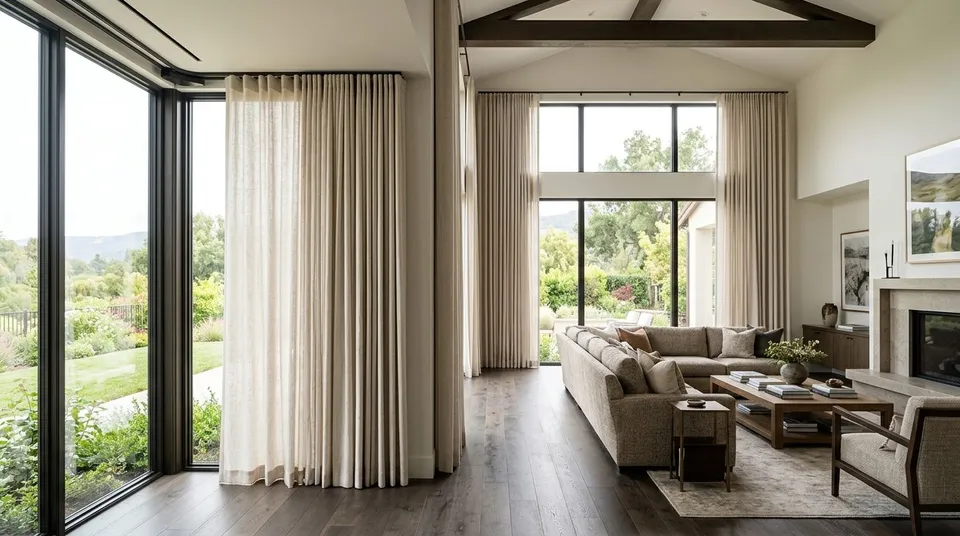
Motorized traverse drapery systems for great rooms are remote or app-controlled drapery tracks that pull full-width panels across a window wall with one button, built for rooms where a hand-pulled cord or wand isn't practical. A great room typically runs 16 to 24 feet of glass with a vaulted ceiling above it, so the track, the fabric weight, and the operation method all have to answer to that scale, not to a standard 6-foot living room window.
- Motorized traverse drapery systems for great rooms handle window walls of 12 feet or more that manual wands can't reach safely.
- Rainier Blinds installs manual, motorized, and smart-hub traverse drapery, measured and installed by its own Auburn, WA crew.
- Pair drapery with a layered shade for daytime privacy without closing the full panel, a common great room fix in 2026.
- Vaulted ceilings and curved or bay window walls need a curved track option decided before fabric is ordered.
Why motorized traverse drapery matters for great rooms
A standard living room drape closes with a short pull. A great room drape spans a whole wall of glass, often 15 feet or more, and a manual traverse cord across that distance means walking the length of the room, sometimes on a step stool if the header sits above 9 feet. That's the gap motorized shades for open-concept great rooms are built to close on the shade side, and the same logic applies to drapery tracks.
Great rooms also carry more glare and heat gain than a standard window because the glass area is larger relative to the room. A motorized traverse drapery system closes the full wall in seconds, which matters more in a great room than anywhere else in the house because the glass area is bigger and the west or south exposure hits harder. Homeowners searching for this in 2026 are usually replacing a fixed rod that never got used because pulling it was a two-person job.
Measure the window wall first
Start with the wall, not the window. Great room walls often combine two or three window units or a slider plus flanking windows into one visual span, and the track needs to run the full width, not just the glass.
- Measure wall-to-wall, not glass-to-glass, to decide stack-back space on each side
- Note ceiling height at the header point, vaulted ceilings often slope
- Check for beams, transoms, or HVAC returns that block a straight track run
- Confirm floor-to-header height for panel length, great rooms often need 10 to 14 foot panels
- Flag any curve in the wall (bay or bow) before ordering track hardware
Choose the track type for a wide wall
A straight traverse rod works for a flat wall. A curved or corner track is required the moment the great room wall bends around a bay, a corner window, or a wraparound slider.
- Straight traverse track for a single flat wall run
- Curved track for bay windows or rounded wall sections
- Corner track for two walls meeting at 90 degrees with continuous glass
- Ceiling-mount track when there's no header wall to anchor a wall-mount bracket
- Center-split or one-way draw, decided by which side of the room gets foot traffic
Decide manual, motorized, or smart operation
This is the step where the operation tier gets locked in, and it's worth doing by hand-testing the track length before you commit. A 20-foot manual traverse cord is a two-hand pull every time, which is why most great room installs in 2026 move to motorized or smart control at this stage.
- Manual: lowest-cost track, works fine on walls under 10 feet, gets heavy to pull past that
- Motorized: wall switch or remote closes the full panel in one motion, standard choice for window walls over 12 feet
- Smart: motorized track paired to a home hub for schedules, voice control, or app control from another room
- Battery-powered motors avoid running new wiring through a finished great room wall
- Hardwired motors suit new construction or a wall already open for other work
Select fabric and lining for the room's light exposure
Great rooms carry more sun exposure per square foot of window than most rooms in the house, so fabric weight and lining choice affect both fade and heat gain, not just look.
- Blackout lining for west-facing great rooms with afternoon glare
- Light-filtering fabric where the room needs daytime brightness with drapery closed
- Heavier weight fabric for a cleaner fold on 10-plus foot panels
- Fade-resistant fabric for any wall that gets direct sun more than 4 hours a day
- A lining test swatch held against the actual window before ordering, screen color shifts under real light
Plan the smart home integration before install day
Hub pairing is easier to plan before the track goes up than to retrofit after. If the great room already runs a smart speaker or hub system, the motorized drapery should join that ecosystem at the same visit as the install, not weeks later.
- Confirm hub compatibility (voice assistant, app, or wall panel) before ordering the motor
- Group the drapery with existing motorized shades on one schedule if the room has both
- Set a sunset-close schedule for west-facing great rooms to cut evening glare automatically
- Decide on a wall switch as backup control in case the hub goes offline
- Review pairing steps in how to pair motorized shades with a smart home hub before the consult, so questions are ready
Layer with a shade for daytime privacy
Drapery closed all day blocks the view the great room was built around. Most great rooms end up layering a roller or cellular shade behind the drapery for daytime privacy and glare control, keeping the drapery for evening close and full blackout.
- Roller shade behind drapery for daytime light filtering without losing the view at night
- Cellular shade where insulation matters as much as privacy
- Zebra shade for a middle setting between full light and full privacy
- Drapery reserved for evening close and full blackout in bedrooms off the great room
Budget and schedule the in-home consult
Pricing on a track this size depends on wall length, fabric, and motor type, all of which get measured in person rather than guessed over the phone. A free in-home consult is where the actual numbers get set for the specific wall.
- Bring wall measurements and photos to speed up the first visit
- Ask about curved track and center-split options if the wall isn't flat
- Confirm which operation tier (manual, motorized, smart) fits the wall height
- Ask what a layered shade adds to the same window wall
Get a great room drapery consult
Free in-home measure and install by Rainier Blinds' own crew.
Maintain the system after install
A motorized traverse system needs less upkeep than a corded one, but it isn't zero-maintenance. Track alignment and motor battery checks keep the panel gliding evenly across a wide wall.
- Check track alignment every few months on wide spans, sagging shows up first at the center
- Replace or recharge motor batteries per the schedule set at install
- Vacuum drapery fabric with a soft brush attachment rather than washing panels
- Test the smart hub connection after any router or app update
Comparison: traverse drapery options for great rooms
| Option | Best for | Key limitation |
|---|---|---|
| Manual traverse drapery | Walls under 10 feet, simple flat runs | Pulling a wide cord gets heavy past 10 feet |
| Motorized traverse drapery | Window walls over 12 feet, vaulted ceilings | Needs a wall outlet or a battery pack near the track |
| Smart traverse drapery | Homes already running a hub system | Extra pairing step during the install visit |
| Layered roller or cellular shade | Daytime privacy without closing full drapery | Adds a second mount or track to the same wall |
Common mistakes in great room drapery installs
- Ordering width from the glass instead of the wall. Great room panels need to stack back onto solid wall, not just glass width, or the drapery never fully opens.
- Skipping motorization on a vaulted-ceiling wall. A 14-foot header height puts a manual wand out of reach without a ladder every single time.
- Choosing a lightweight fabric on a west-facing wall. Great rooms get more direct sun per square foot than a standard window, and thin fabric fades faster there.
- Not deciding on curved track before ordering fabric. A bay or corner great room wall changes the track hardware, and that has to be settled before fabric gets cut.
- Planning the smart hub pairing after install day. Pairing a motorized traverse drapery system to an existing hub goes faster when it's scheduled at the same visit as the physical install.
FAQ
What is a motorized traverse drapery system?
It's a drapery track with a motor built in, so a full panel opens or closes by remote, wall switch, or app instead of a hand-pulled cord. Great rooms use them on wide window walls where a manual cord across 12 or more feet becomes a two-hand pull every time.
Is motorized drapery better than motorized shades for a great room?
They solve different problems: drapery gives full blackout and a softer look at night, while a motorized shade gives daytime light control without closing off the view. Most great rooms in 2026 end up with both, layered on the same window wall.
Can a curved great room wall use a motorized traverse track?
Yes, curved and corner traverse tracks exist specifically for bay windows and wraparound glass walls. The curve has to be decided before fabric gets ordered, since it changes the hardware.
How wide can a motorized traverse drapery track go?
Great room installs commonly run 15 to 24 feet on a single track, which is well past what a manual traverse cord can handle comfortably. Measurement should be done in person to confirm stack-back space on each side.
Do motorized traverse drapery systems need a wired power source?
Not always. Battery-powered motors are common in finished great rooms where running new wiring isn't practical, while hardwired motors suit new construction.
Can motorized traverse drapery connect to a smart home hub?
Yes, most motorized traverse tracks pair with a home hub for scheduling, voice control, or app control, and pairing goes smoother when it's planned before the install visit rather than after.
What fabric works best for a great room with lots of west-facing sun?
Fade-resistant fabric with a blackout or heavier light-filtering lining holds up best against direct afternoon sun. Thin, light fabric fades faster in a great room than in a smaller, shaded room.
Should a great room use drapery alone or drapery plus a shade?
Most great rooms layer a roller or cellular shade behind the drapery, using the shade for daytime privacy and the drapery for evening close and full blackout.
One last thing
The detail most homeowners miss until the consult: a straight traverse track that looks fine on paper often needs a curved or corner section once the great room wall is measured in person, because builder plans round off bay angles that the eye catches immediately. Get the wall measured before ordering fabric, not after.