
Our available controls: Rainier Blinds offers Roman and woven wood shades with motorized operation only. Available controls and power options for other products are confirmed at your consultation.
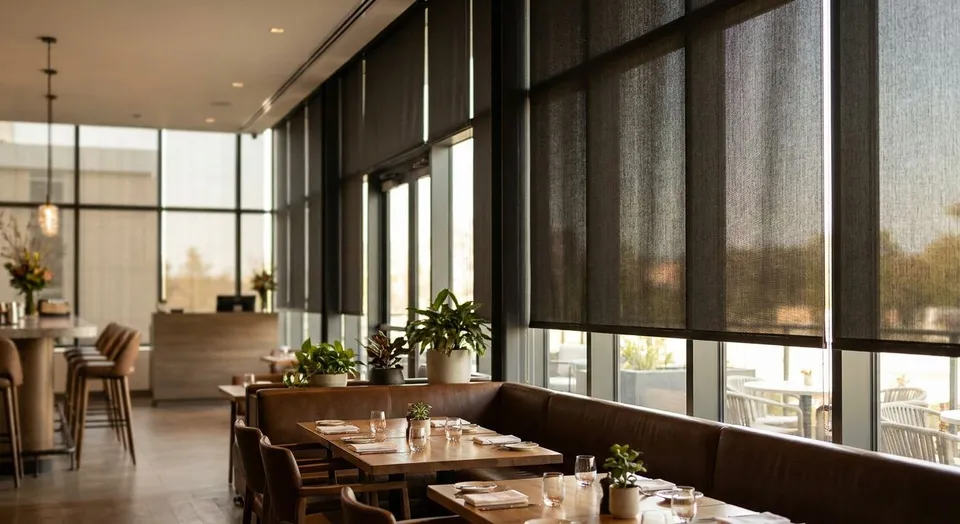
Commercial blinds for restaurants means window coverings sized, rated, and operated for a dining room, bar, or patio, not the mini blinds you would hang in a spare bedroom. A restaurant or hospitality space needs shades that block afternoon glare off a four-top by the window, survive nightly foot traffic and kitchen steam, and still look sharp at the host stand. Rainier Blinds measures and installs custom roller, zebra, cellular, and outdoor shades plus drapery for restaurants and hospitality properties across Auburn, Tacoma, Bellevue, and the wider Seattle area in 2026.
- Commercial blinds for restaurants in 2026 means glare control and durable fabric, not traditional slat blinds.
- Roller and zebra shades cut dining room glare; outdoor roller shades cover patio seating without blocking staff traffic.
- Motorized operation beats manual wands once a dining room passes eight or ten windows.
- Rainier Blinds measures and installs commercial shades and drapery, never venetian or vertical blinds, across South King County.
Why commercial blinds matter for restaurants and hospitality
A dining room built around big storefront glass looks great on Instagram and terrible at 5pm when the sun sits low and hits every table on the west wall. Restaurants lose usable seating to glare long before they lose it to slow business, and staff end up improvising with paper taped to windows, which is the fastest way to undo a design budget.
Hospitality spaces also carry constraints a house never does: commercial window treatments in a restaurant get opened and closed by staff on a schedule, not by whoever feels like it, and they take steam, grease, and higher foot traffic than a living room ever will. Fabric choice, mount type, and operation style all have to hold up to that, not just look good on day one.
Audit glare and sun exposure by seating zone
Walk the dining room at lunch and again at dinner before picking anything. Sun angle changes by season in the Pacific Northwest, and a window that is fine in January can be unusable by June.
- Mark which tables get direct sun between 11am and 2pm
- Note west-facing walls separately, since evening service takes the worst of it
- Check if any windows face a patio heater or kitchen exhaust, which changes fabric needs
- Flag windows near the host stand or bar where glare hits guests waiting to be seated
- Record which rooms need blackout capability for private events versus daytime ambiance
Match fabric openness to your dining room's light needs
A restaurant dining room usually wants light filtering rather than full blackout, since natural light during lunch service is part of the draw. Openness percentage on roller and zebra fabric controls how much of that light gets through while still cutting glare.
Start with the manual option: swap in a lighter-openness fabric on the worst-affected windows and see how service changes before committing to a full room.
- 1% to 5% openness for direct west or south glare zones
- 5% to 10% openness for general dining room ambiance
- Dual-layer zebra shades where a room needs both open and closed settings across a single day
- Darker back-coated fabric for private dining rooms used for evening events
- Solar shades for west-facing windows that take direct sun during peak dinner hours
Add outdoor shades for patio and rooftop seating
An exterior-rated shade can help with sun and glare. Select the exact system for the opening, mounting structure, and exposure. Follow its documented wind limits and retraction instructions; neither cable guides nor zipper tracks guarantee protection from wind, rain, or storms.
Check the exposure before choosing a track system: a covered patio with side walls needs less hardware than an open rooftop deck.
- Confirm the selected system’s exposure limits
- Confirm the selected system’s exposure limits
- Mesh fabric that cuts glare without blocking the view guests are paying for
- Motorized outdoor shades for staff who need to raise and lower them daily without a crank
- Outdoor roller shades sized to the patio's actual footprint, not a stock width
Choose motorized or smart operation for staff efficiency
A manual wand or chain works fine for two or three windows. It stops working once a dining room has ten windows and one server trying to close them all before the dinner rush.
Rainier Blinds installs motorized and smart shades as the faster path once a space passes that threshold, but the decision comes down to how many windows one staff member has to manage on a schedule.
- Group shades on one remote or wall switch by seating zone
- Set a schedule for opening at lunch and closing for evening ambiance
- Choose battery-powered motors where wiring to a storefront window is impractical
- Compatibility, hub requirements, and available controls depend on the selected motor and your home setup. We confirm those details before ordering.
- Keep a manual override option for the one window a manager wants control over daily
Layer drapery for private dining rooms and bars
A private dining room or bar area often wants a softer look than a roller shade alone provides. Drapery adds that without losing the light control the shade behind it handles.
Keep drapery away from an open kitchen pass or grill line, since fabric near heat and grease sources needs a different approach than a dining room across the building.
- Layer drapery over a light-filtering roller shade for private dining rooms
- Use drapery for sound softening in bar areas with hard flooring
- Pick fabric rated for higher-traffic public spaces over residential-weight material
- Reserve full custom drapery treatments for rooms without kitchen exposure
- Skip drapery entirely near any open flame or grill station
Plan mount type and hardware for commercial-grade durability
A hospitality property runs its window treatments harder than a home does. Mount type and hardware weight matter more here than color or fabric pattern.
- Inside mount for a clean storefront look on standard window frames
- Outside mount for arched, transom, or oversized dining room windows
- Reinforced brackets on any shade that gets opened and closed multiple times a day
- Controls and placement reviewed against the project’s applicable accessibility and health requirements
- Commercial-grade fabric rated for grease and steam exposure near open kitchens
Time installation around your slowest business day
Installation in an operating restaurant works best scheduled around a closed day or the slowest shift, not squeezed in during dinner service.
- Book installation for a Monday or another low-traffic day
- Measure every window in the space during one visit rather than room by room
- Confirm motor wiring or outlets ahead of time if going motorized
- Walk the finished install with the manager before staff opens for service
- Ask about a maintenance check-in after the first few months of daily commercial use
Comparison: commercial shade options for restaurants
| Option | Best for | Key limitation |
|---|---|---|
| Roller shades (light filtering) | Dining rooms with afternoon sun | Cuts glare well but offers less privacy once interior lights are on at night |
| Zebra/dual shades | Rooms needing adjustable privacy and light through the day | More moving parts than a single roller shade |
| Cellular shades | Back-of-house offices and break rooms | Bulkier stack, less common on storefront-style dining windows |
| Outdoor roller shades (steel wire/zipper track) | Patio and rooftop seating | Confirm the selected system’s exposure limits |
| Drapery | Private dining rooms and bar ambiance | Not suited near open kitchens or grill stations |
| Motorized/smart upgrade | High-traffic dining rooms with many windows | Higher upfront setup than a manual chain or wand |
The verdict for most South King County dining rooms: light-filtering roller or zebra shades on the windows, outdoor roller shades on the patio, and motorization once a room passes about eight windows.
Get a commercial shade consultation
Rainier Blinds measures dining rooms and patios across South King County.
Common mistakes restaurants make with commercial blinds
- Ordering stock-size shades for arched or oversized storefront glass. Restaurant windows rarely match standard residential sizing, and a stock width leaves gaps at the edges.
- Skipping outdoor-rated fabric on a covered patio. Standard interior fabric fades and mildews fast once it sits outside through a Pacific Northwest winter.
- Choosing full blackout fabric for a daytime dining room. Guests come for the natural light during lunch service; blackout belongs in private event rooms, not the main floor.
- Ignoring staff labor when picking manual chains for a ten-window room. A crew closing shades by hand every night adds up to real labor cost over a year.
- Skipping a cleaning plan for fabric near open kitchens. Grease and steam stain untreated fabric faster than any residential use case.
FAQ
What are commercial blinds for restaurants actually called if not blinds?
Most restaurants in 2026 use roller shades, zebra shades, cellular shades, or drapery rather than slatted blinds, since fabric shades cover wider storefront glass and hold up better to commercial traffic.
Are motorized shades worth it for a restaurant dining room?
Motorized shades pay off once a dining room passes roughly eight to ten windows, since staff no longer spend time opening and closing each one by hand before service.
Can outdoor shades handle a rooftop patio in the Pacific Northwest?
An exterior-rated shade can help with sun and glare. Select the exact system for the opening, mounting structure, and exposure. Follow its documented wind limits and retraction instructions; neither cable guides nor zipper tracks guarantee protection from wind, rain, or storms.
Does Rainier Blinds install vertical or venetian blinds for restaurants?
No. Rainier Blinds installs custom shades (roller, zebra, cellular, woven wood, roman, outdoor) and drapery, not vertical or venetian blinds.
How do restaurants control glare without losing natural light?
Light-filtering fabric at 5 to 10 percent openness cuts glare while still letting daylight into the dining room, which works better for lunch service than a full blackout fabric.
What fabric holds up best near an open kitchen?
Commercial-grade fabric rated for grease and steam exposure holds up longer than residential-weight material, and drapery should generally stay away from any window near a grill or open flame.
Should private dining rooms use different shades than the main floor?
Private dining rooms often use darker, back-coated fabric or added drapery for evening events, while the main dining floor usually stays lighter for daytime ambiance.
How long does commercial shade installation take in an operating restaurant?
Installation works best scheduled around a closed day or the slowest shift so measuring and mounting doesn't interrupt service, and a full dining room is typically measured in one visit.
One last thing
Most restaurant owners in South King County solve glare and patio weather as two separate problems and end up buying twice. Handle both in the same walkthrough: sun exposure inside the dining room and wind exposure on the patio come from the same seasonal shift, and pricing both at once during a single consultation in 2026 saves a second visit later.