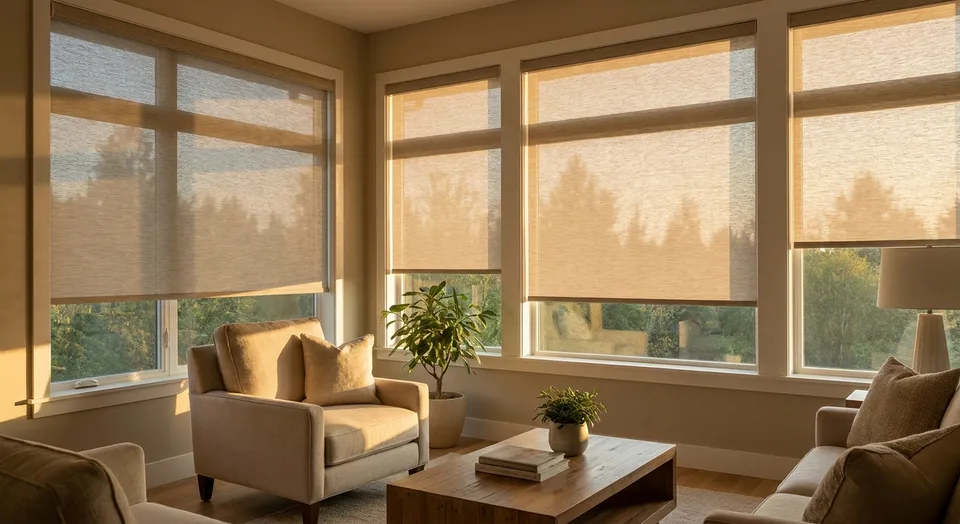
Solar shades for west-facing windows

West-facing windows across Auburn, Renton, Kent, and the rest of South King County take the hardest afternoon sun of any exposure in the house, and solar shades are the fix most homeowners land on once blackout curtains start feeling like overkill. This guide breaks down what actually matters when you're buying solar shades for west-facing windows in 2026, plus which openness percentage fits your room.

TL;DR
  • Solar shades west facing windows need 1-5% openness to cut real glare and heat, not the 10% sold in big-box stores.
  • A 3% dual-shade setup is the balanced pick for living rooms with both glare and view needs in 2026.
  • Motorized solar shades are worth it on tall or hard-to-reach west windows common in Kent and Renton homes.
  • Light-colored fabrics look nice but transmit more UV than dark or metallic-backed weaves - skip them on true west exposure.

Why this matters

West sun hits low and direct for 2-4 hours a day, usually right when people are home using the room. That's a different problem than south-facing light, which is more overhead and diffuse. Standard blinds and light-filtering shades don't touch the heat gain - you'll still feel a west window baking a room from 3pm to sunset even with the slats closed.

Solar shades solve this because the fabric itself blocks UV and infrared before it ever hits the glass, instead of just dimming visible light. Get the openness percentage wrong, though, and you've paid for a shade that still lets the room cook. That's the mistake worth avoiding before you order anything.

Who this is for

This is for homeowners in Bellevue, Tacoma, Seattle, and the South King County suburbs dealing with a living room, home office, or bedroom that faces west and turns into a greenhouse every afternoon between April and September. If your furniture is fading, your TV screen is unreadable at 5pm, or your AC is fighting a losing battle against one wall of glass, you're the buyer this guide is written for.

What to look for in solar shades for west-facing windows

Fabric openness percentage

Openness percentage is the single biggest lever on performance, and most retail stock defaults to 10% openness because it looks better on a showroom wall. On true west exposure, 10% still lets in enough direct sun to wash out a screen and heat a room. Drop to 1-5% openness for west windows that get unblocked afternoon sun, and reserve 10% for west windows shaded by trees, overhangs, or a neighboring structure.

UV and heat rejection, not just glare

Glare control and heat rejection aren't the same spec, even though most shoppers assume they are. A shade can cut visible glare while still passing a lot of infrared heat through a light-colored, loosely woven fabric. For west-facing rooms, ask specifically about heat rejection percentage, not just openness - dark and metallic-backed fabrics reject more heat at the same openness level than a light beige weave.

Inside mount vs outside mount

West windows run hotter at the glass and frame than any other exposure, and an inside-mounted shade sitting flush against hot glass traps that heat between the shade and the window. An outside mount, or an inside mount with enough side gap for airflow, keeps the fabric from baking and extends its working life. This matters more on west exposure than anywhere else in the house.

Motorization for hard-to-reach or oversized windows

A lot of west-facing rooms in Renton and Kent homes have tall windows, transoms, or window walls that are awkward to reach with a wand every afternoon. Motorized solar shades solve that with a scheduled close before the sun hits hardest, which matters because manual shades only work if someone remembers to close them at 2pm on a Tuesday.

Fade protection and fabric warranty

West sun is the fastest way to fade a fabric shade itself, along with the flooring and furniture behind it. Look for a fabric backed with a real fade warranty, not just a marketing claim about UV blocking - ask what's covered and for how long before you order.

Accurate measuring on older Pacific Northwest homes

Homes built before the 1990s across Auburn and Federal Way often have window openings that are slightly out of square, and a stock-sized solar shade ordered online won't seat evenly in an opening like that. A shade measured on-site accounts for that variance; a shade measured from a tape-measure guess online usually doesn't.

Openness percentage guide
1-3%
Best for direct, unblocked west sun
5%
Balanced glare and view-through
10%
Only for partially shaded west windows

Top picks by openness level

1% openness - the heat blocker

This is the tightest weave sold for residential solar shades, and it's built for west rooms that get zero relief from trees or overhangs. At 1% openness you lose almost all view-through, but heat rejection runs highest in this category. Verdict: Buy for a west-facing home office or media room where glare on a screen is the daily complaint.

3% openness - the balanced pick

This is the openness most Seattle-area homeowners land on for a west-facing living room, because it cuts real heat while still letting you see the yard. Paired as a dual-shade setup - a solar shade layered with a light-filtering shade - it handles both the 3pm glare problem and evening privacy in one system, a combination covered in more detail in the roller shades vs cellular shades comparison. Verdict: Buy for most west-facing living and dining rooms.

5% openness - the view keeper

Five percent openness is the right call for a west window that gets some afternoon shade from a neighboring roofline or mature tree, where full 1-3% blackout-level fabric is more than the room needs. Verdict: Consider if your west exposure is only direct sun for an hour or two rather than a full afternoon.

10% openness sheer weave - the wildcard

This is the openness most big-box stores stock as their default "solar shade," and on a true unblocked west exposure it underperforms. It looks good in a showroom because it lets in plenty of light, which is exactly the problem on a hot west wall. Verdict: Skip unless your west window already gets significant outside shade.

Motorized solar shade - the convenience pick

A motorized solar shade set on a schedule closes automatically before peak afternoon sun, which matters most on tall or multi-window west walls where manual operation is a daily chore. This is the setup covered in the motorized shades guide for Kent, WA homes, and it pairs well with any of the openness percentages above. Verdict: Buy for west-facing rooms with two or more windows or hard-to-reach hardware.

Get a real quote on solar shades

On-site measuring and installation across Auburn, Renton, Kent, and Seattle.

Get a quote

What to avoid

  • Light-colored, high-openness fabric on true west exposure - it looks clean in a photo but transmits more heat and UV than a darker or metallic-backed weave at the same percentage.
  • Stock online sizing on older homes - a window opening that's a half-inch out of square in an Auburn or Federal Way home built before 1990 won't seat right with an off-the-shelf size.
  • Skipping motorization on multi-window west walls - manual shades only help if someone actually closes them every afternoon, and most households don't.

Verdict comparison

Openness Heat rejection View-through Best for Verdict
1% Highest Minimal Home office, media room, direct sun Buy
3% High Moderate Living room, dining room Buy
5% Moderate Good Partially shaded west windows Consider
10% Low Best Only if already shaded outside Skip
Motorized (any %) Same as fabric chosen Same as fabric chosen Tall or multi-window west walls Buy

FAQ

What's the best openness percentage for solar shades on west-facing windows?

1% to 3% openness is best for west-facing windows with direct afternoon sun in 2026, since it blocks the most heat and glare. Save 10% openness fabric for west windows that already get partial shade from trees or a roofline.

Are solar shades better than blackout shades for west-facing rooms?

Solar shades are better than blackout shades for west-facing rooms when you still want to see outside, because they block heat and glare while keeping some view-through. Blackout shades work better for a bedroom where full darkness matters more than the view.

Do solar shades actually reduce heat from west sun?

Yes, a tight-weave solar shade at 1-5% openness noticeably reduces the heat coming through west-facing glass because the fabric blocks infrared before it passes through, not just visible glare. The lighter the fabric color, the less heat it rejects at the same openness level.

Should west-facing solar shades be inside mount or outside mount?

Outside mount, or an inside mount with side gap for airflow, works better on west-facing windows because it keeps the fabric from trapping heat against hot glass. A flush inside mount on a west window runs hotter and shortens fabric life faster.

Is motorization worth it for west-facing solar shades?

Motorization is worth it on tall or multi-window west exposures because a scheduled close before peak afternoon sun works even when nobody's home to operate a shade manually. It's less necessary on a single small west window within easy reach.

How much do solar shades cost for west-facing windows in 2026?

Pricing depends on window size, openness percentage, and whether the shade is motorized, and it varies enough by project that a real number requires an on-site measure. Ask for pricing on the spot rather than relying on an online estimate.

Will solar shades stop furniture from fading in a west-facing room?

A 1-3% openness solar shade with UV-blocking fabric significantly reduces fading on furniture and flooring in a west-facing room, though it won't eliminate fading entirely over years of daily sun exposure. Fabric with a documented fade warranty offers the most protection.

Can I use the same solar shade fabric on all my west-facing windows?

You can use the same openness percentage across west-facing windows in one room for a consistent look, but a window with partial outside shade may perform fine at 5-10% while an unblocked window needs 1-3%. Matching fabric color across the room still works even when openness varies slightly.

One last thing

The openness percentage matters more than the brand name on the shade - a 1% fabric from any reputable maker will outperform a 10% fabric from a premium brand on true west exposure, every time. Check the number on the spec sheet before you check anything else.

Related guides