
Our available controls: Rainier Blinds offers Roman and woven wood shades with motorized operation only. Available controls and power options for other products are confirmed at your consultation.
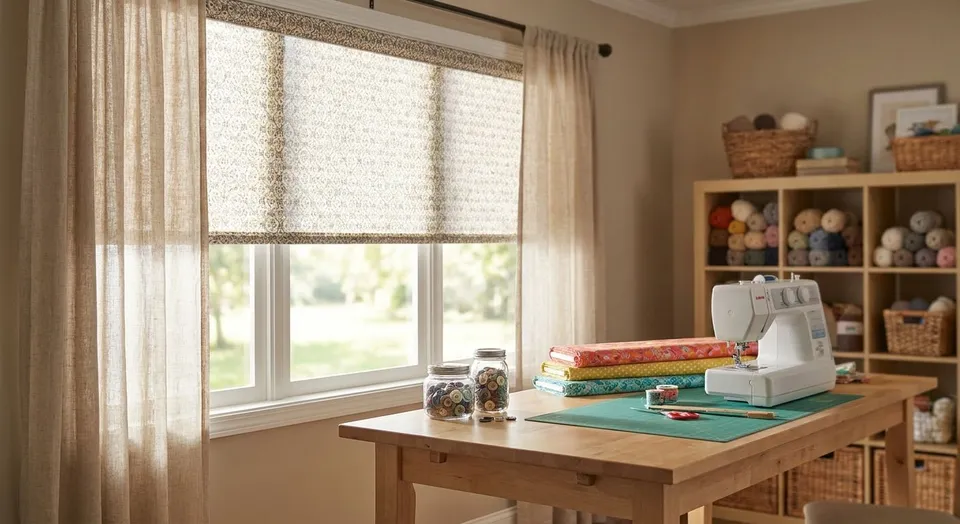
Craft rooms and sewing spaces need window treatments that control glare on fabric and thread colors without going dark - here is what actually works for quilters, sewists, and hobbyists across the Greater Seattle Area in 2026.
- Solar roller shades at 5% openness cut glare on fabric colors without dimming a sewing room - Buy.
- Custom Roman shades in performance fabric protect a fabric stash from UV fade - Buy.
- Top-down-bottom-up cellular shades give eye-level privacy while keeping daylight for cutting tables - Consider.
- Full blackout cellular shades kill the daylight a craft room needs for color matching - Skip.
- Window treatments for craft rooms in 2026 should prioritize UV protection and adjustable light, not room darkening.
Why this matters
A sewing machine table or cutting mat sitting under an unprotected window takes the same UV exposure as a couch or a hardwood floor - fabric bolts, thread spools, and finished quilts fade just as fast, just quieter. The difference between a craft room and a living room is what the space demands from its light: even, consistent brightness for color matching, not a dim, moody glow that photographs well but ruins your ability to tell teal from navy at 4 p.m. in a Pacific Northwest winter.
The same logic that applies to home art and painting studios - where color accuracy under natural light matters as much as it does on a canvas - applies directly to a sewing or quilting room. Get the window treatment wrong here and you are re-threading needles by lamp light or squinting at a swatch trying to guess a color under the wrong shade of afternoon sun. In 2026, more of these rooms are converted bonus rooms, spare bedrooms, and garage conversions across South King County, and most of them still have whatever blinds came with the house.
Who this is for
This guide is for anyone who dedicates a room, a bonus room, or a converted garage to sewing, quilting, scrapbooking, or fabric crafts in Bellevue, Tacoma, Seattle, or anywhere in South King County. If you have got a cutting table under a west-facing window, a fabric stash sitting on open shelving, or a machine that needs consistent daylight to thread correctly, the picks below are built for your room - not for a living room that just needs to look good in listing photos.
It is also for anyone who has already tried the blinds that came with the house and found them useless: slats that cast stripe shadows across a cutting mat, or drapery so heavy the room goes dark by 3 p.m. in November. None of that works when the whole point of the room is seeing true color.
What to look for in window treatments for craft rooms
Glare control without darkness
A craft room needs bright, diffused light, not a dim cave. Sheer or light-filtering fabrics scatter direct sun so you can read thread numbers and match fabric colors without a hard shadow falling across the cutting table. A shade that blocks glare but keeps the room bright is doing its job; one that just makes the room dark is solving the wrong problem.
UV protection for your fabric stash
Direct sun fades fabric bolts, thread, and finished projects faster than almost anything else in the room. A shade fabric rated to block a high share of UV rays keeps a stash usable for years instead of months, especially on the shelf closest to the window where most people store their newest fabric purchases.
Privacy without losing daylight
Craft rooms often sit at eye level to a sidewalk, driveway, or a neighboring yard, especially in Renton, Kent, and Auburn neighborhoods with closer lot lines. Top-down-bottom-up shades solve this by dropping the top of the shade down while the bottom stays raised, so you get privacy at head height and keep daylight coming in low where the cutting table sits.
Easy-clean surfaces for a dusty workspace
Fabric scraps, thread lint, and glue dust settle on window treatments faster in a craft room than anywhere else in the house. Smooth roller and cellular shades wipe clean in seconds with a microfiber cloth; heavy pleated drapery traps dust in the folds and needs a vacuum attachment every few months.
Cordless, snag-free operation near machines
A cord dangling near a sewing machine or serger is a snag risk, not just a household safety issue. Cordless lift systems or motorized shades keep the window clear of anything that can catch on thread, fabric, or a moving needle arm mid-project.
Top picks for craft and sewing rooms
1. Custom Roman shades in a performance fabric - the color-matching pick
Roman shades in a tightly woven, light-filtering fabric diffuse direct sun into even, shadow-free light across a cutting table instead of the harsh stripe shadows slatted blinds throw. Choosing the right fabric matters more here than pattern or color does - a tighter weave count filters glare without dimming the room the way a heavier, looser weave does. Verdict: Buy for any craft room where color accuracy on fabric or thread is non-negotiable.
2. Solar roller shades at 5% openness - the fabric-stash protector
A 5% openness solar fabric blocks the bulk of direct glare while still letting enough daylight through to see true color on a bolt of fabric or a finished quilt. Unprotected windows expose a fabric stash to fade every single day the sun is out, and protecting artwork or a fabric collection from sun fade works the same way whether you are hanging a painting or storing quilting cotton on open shelving. Verdict: Buy for any craft room with south- or west-facing windows.
3. Top-down-bottom-up cellular shades - the privacy-without-blackout pick
These shades drop the top panel down about 12 inches for eye-level privacy while the bottom stays raised, so daylight keeps flooding in near the floor and the cutting table. The honeycomb cell itself, ranging from a 3/8-inch single cell to a 3/4-inch double cell, also adds a layer of insulation against Pacific Northwest drafts near an older window frame. Verdict: Consider if your craft room windows face a street, sidewalk, or close neighbor.
4. Dual-layer zebra shades - the everyday adjuster
Alternating sheer and opaque fabric bands let you dial in exactly how much direct light hits a cutting table just by shifting the vane position, with no separate blackout layer needed. They are a good middle ground for a room used at different times of day for different tasks - piecing in the morning, hand-stitching by lamp in the evening. Verdict: Consider for craft rooms with big daylight swings between morning and afternoon.
5. Full blackout cellular shades - the one to skip
Full blackout fabric kills daylight completely, which is exactly wrong for a room built around color matching and fine detail work. They make sense in a bedroom or a home theater, not in a room where you need to tell whether a thread is charcoal or true black. Verdict: Skip for a working craft or sewing room in 2026.
Get real pricing for your craft room
Rainier Blinds measures and installs on-site across the Greater Seattle Area.
What to avoid in a craft room
A few window treatments look like reasonable options and are not, once you actually work in the room for a few hours at a stretch.
- Faux wood, real wood, or aluminum blinds. Horizontal slats cast stripe shadows across a cutting table, and the routine open-close angle adjustments needed to chase changing daylight get old fast in a room you use for hours at a time.
- Heavy, fully-lined blackout drapery. It looks finished in a bedroom, but it blocks the exact daylight a craft room depends on for color work and leaves the space dim by early afternoon in a Pacific Northwest winter.
- Cheap, non-UV-rated vinyl shades. They are the fastest way to end up replacing a shade within 18 months once the vinyl yellows, and the fabric stash behind it fades anyway.
Verdict comparison
| Pick | Light control | Privacy | Verdict |
|---|---|---|---|
| Roman shades (performance fabric) | Even, diffused | Moderate | Buy |
| Solar roller shades (5% openness) | High glare cut | Low-moderate | Buy |
| Top-down-bottom-up cellular shades | Adjustable | High | Consider |
| Dual-layer zebra shades | Fully adjustable | Moderate | Consider |
| Full blackout cellular shades | Blocks daylight | High | Skip |
FAQ
What is the best window treatment for a craft room?
Solar roller shades at 5% openness or Roman shades in a light-filtering performance fabric work best for craft rooms in 2026. Both cut glare and UV exposure while keeping the room bright enough for color matching.
Are blackout shades good for a sewing room?
No, full blackout shades are the wrong fit for most sewing rooms because they block the daylight needed for color and detail work. Blackout fabric belongs in a bedroom or home theater, not a workspace built around seeing true color.
Do solar shades protect fabric from fading?
Yes, solar shade fabrics block a large share of UV rays before they reach fabric bolts, thread, or finished projects. A 5% openness fabric is a common middle ground for craft rooms that still need daylight to see color accurately.
What openness percentage is best for a craft room?
5% openness solar fabric is the standard starting point for a craft or sewing room with direct sun exposure. It cuts glare and fade risk while letting enough daylight through for color-accurate work.
Are cordless shades safer for a sewing room?
Yes, cordless lift systems remove the loose cord that can catch on thread, fabric, or a moving needle arm near a sewing machine. Motorized shades solve the same problem while adding one-touch adjustment.
Can top-down-bottom-up shades work in a craft room?
Yes, top-down-bottom-up shades let you drop the top panel for eye-level privacy while the bottom stays raised for daylight near a cutting table. They are a strong fit for craft rooms facing a street, sidewalk, or close neighbor.
Is zebra shade fabric good for color matching?
Dual-layer zebra shades work well for craft rooms with big daylight swings, since the sheer and opaque bands adjust glare without a separate blackout layer. They are not as precise for fade protection as a dedicated solar fabric.
How much do custom window treatments cost in 2026?
Cost depends on the number of windows, fabric choice, and whether shades are motorized. A room-by-room quote gives an accurate number faster than any online estimate.
One last thing
Most people fixate on blocking light in a craft room and end up with a space that is too dark to work in by 2 p.m. The better fix in 2026 is a shade that filters and diffuses instead of one that just blocks - that is the whole difference between a Roman shade in performance fabric and a slatted blind, and it is the reason craft rooms in older Auburn and Kent homes with south-facing windows tend to end up re-treated within a year of the wrong first choice.