
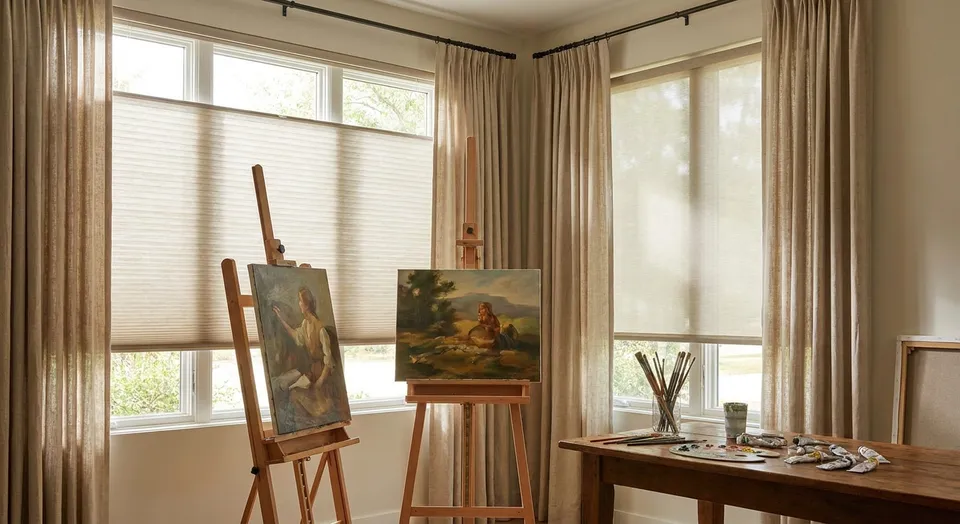
Painters need light that tells the truth about color, not light that lies. Window treatments for art studios have one job most other rooms don't: control glare and UV without flattening the daylight you're mixing paint under.
- Solar shades cut glare on bright studio windows without shifting how color reads on canvas, the safe pick for 2026 setups.
- Skylight shades matter most for garage or attic studios with vaulted ceilings and direct overhead sun.
- Zebra shades give painters adjustable diffusion so light stays consistent from morning to afternoon sessions.
- Skip standard blackout curtains for daily studio use. They kill daylight entirely and cast a warm tint on wet paint.
- Motorized shades keep paint-covered hands off cords and fabric, worth the upgrade for a studio used daily.
Why this matters
A studio window that throws hard, direct sun creates hot spots on canvas that trick your eye into overworking a shadow or underworking a highlight. Fluorescent overheads can't fix that. You need the window itself to behave.
UV exposure between roughly 300 and 400 nanometers is what accelerates fading in oil paints, watercolor paper, and framed work sitting near a window. A studio that gets direct afternoon sun for years without any UV control will show it in yellowed varnish and faded pigment long before the rest of the house does.
Most home studios in the Greater Seattle Area sit in repurposed sunrooms, garages, or bonus rooms, spaces that weren't designed with painting in mind. That's exactly where the wrong window treatment either wrecks the light or wrecks the work.
Who this is for
This guide is for the home painter who's converted a spare room, garage, or sunroom into a working studio and needs the window to cooperate, not the person shopping for decorative curtains. If you're mixing color, working on paper, or leaving canvases near a window for weeks at a time, the treatment on that glass matters as much as your palette.
What to look for in window treatments for art studios
UV protection for pigments and paper
Unprotected glass lets UV wavelengths hit canvas, paper, and varnish every session, and the damage compounds silently over months. A shade fabric with UV-blocking backing protects finished work stored or drying near the window without you having to think about it.
Diffused light over harsh glare
Direct sun through bare glass creates a hot spot that skews how you judge value and saturation on the rest of the canvas. Diffusing fabrics scatter that light across the room instead of concentrating it in one blinding patch, which keeps your color judgment consistent whether you're standing at the easel or stepping back to check the whole piece.
Adjustable light levels throughout the day
A studio window facing east gets harsh morning light and calm afternoon light. The same shade setting won't work for both. Treatments that adjust in stages, not just open or closed, let you match the room's light to whatever daylight-balanced temperature (roughly 5500K to 6500K) you're working under.
Skylight and vaulted ceiling coverage
Garage conversions and bonus rooms often come with a skylight or vaulted glass that standard shades can't reach. If your studio has overhead glass, that opening needs its own coverage plan. It's usually the single biggest source of midday glare in a converted space. Skylight shades for vaulted ceilings cover exactly this gap.
Privacy without losing daylight
A street-facing studio window means you're either working in full view of the sidewalk or closing off the light entirely with heavy curtains. Light-filtering fabrics solve both problems at once, privacy during the day without the cave effect.
Get studio light figured out
In-home measure and a quote for your selected options for South King County homes.
Top picks for art studio window treatments
Solar shades: the color-accurate pick
Solar shades come in openness percentages that control exactly how much direct light gets through while keeping the view and daylight intact. For a west-facing studio catching hot afternoon sun, a tighter weave cuts glare without turning the room dim or shifting how paint colors read. Solar shades for west-facing windows are built for this exact light problem. Verdict: Buy.
Skylight shades: the overhead light fix
Garage and attic studios with vaulted ceilings often have one uncovered skylight doing all the glare damage. A motorized skylight shade closes off harsh overhead sun during peak hours and opens back up for even, indirect light the rest of the day. Verdict: Buy if your studio has any overhead glass. Otherwise Skip, it's not worth the cost for a standard wall window.
Zebra shades: the adjustable diffuser
Zebra shades alternate sheer and opaque bands, so sliding the fabric shifts you between soft diffused light and near-blackout without swapping treatments. That range makes them useful for a studio that runs morning sessions and afternoon sessions under different light. Dual-layered zebra shades work the same way in any room that needs adjustable diffusion. Verdict: Buy.
Insulated cellular shades: the garage-conversion pick
A garage turned into a studio usually has single-pane or poorly insulated glass, which means temperature swings that affect how paint and varnish cure. Cellular shades add an insulating air pocket in the cell structure, which helps stabilize the room's temperature alongside its light. Insulated cellular shades for garage conversions are worth the upgrade if your studio used to be a garage bay. Verdict: Consider. Skip it if your studio is already in a fully insulated room.
Motorized shades: the hands-free upgrade
Adjusting a pull cord or wand with wet paint on your fingers means smudged fabric and paint on the hardware. Motorized shades solve that with a remote or wall switch, and most 2026 systems pair with a schedule so the room adjusts itself between morning and afternoon light without you touching anything. Programming motorized shades once at setup means you never think about it again. Verdict: Buy for a daily studio; Wait if you paint only occasionally.
What to avoid in an art studio
- Aluminum or wood-look blinds: the slats scatter dappled, uneven light across the room instead of diffusing it, which makes color judgment inconsistent depending on where you're standing.
- Standard blackout curtains from a box store: most use a dark liner that casts a warm or gray tint on the room, which throws off how you read cool and warm tones on canvas.
- Sheer curtains alone: they look right for a bright, airy studio but do nothing for UV or glare control, so finished work near the window still fades.
Verdict comparison table
| Treatment | UV/Glare Control | Adjustability | Best For | Verdict |
|---|---|---|---|---|
| Solar shades | High | Openness-percentage tiers | West-facing studio windows | Buy |
| Skylight shades | High (overhead) | Motorized or manual | Vaulted ceilings, garage studios | Buy |
| Zebra shades | Moderate to high | Sheer-to-opaque slide | Studios used morning and afternoon | Buy |
| Insulated cellular shades | Moderate | Cordless or motorized | Garage-conversion studios | Consider |
| Motorized shades | Depends on fabric | Remote or scheduled | Daily studio use, messy hands | Buy |
Rainier Blinds measures and installs each of these window treatments across the Greater Seattle Area, from Auburn to Bellevue to Tacoma, with an in-house crew rather than a subcontractor.
FAQ
What is the best window treatment for a home art studio?
Solar shades and zebra shades are the best window treatments for art studios in 2026 because they diffuse harsh light without shifting how color reads on canvas. Skylight shades come in for garage or attic studios with overhead glass.
Do blackout curtains work for a painting studio?
Standard blackout curtains are a poor fit for daily studio use because they eliminate daylight entirely and many liners cast a warm or gray tint. They work better for occasional evening sessions than for a room used for color-accurate work all day.
How do I stop glare on a west-facing studio window?
A solar shade with a tighter weave openness percentage cuts direct afternoon glare while keeping the room bright and the view intact. Zebra shades offer a similar fix with adjustable sheer-to-opaque bands.
Are motorized shades worth it for an art studio?
Motorized shades are worth it for anyone painting daily, since they keep paint-covered hands off cords and fabric. A scheduled setting also adjusts the room automatically between morning and afternoon light.
What window treatment protects paintings from fading?
A shade fabric with UV-blocking backing protects paintings and paper from fading caused by UV wavelengths between roughly 300 and 400 nanometers. Solar shades and cellular shades with UV-rated fabrics both offer this protection.
Can cellular shades help a garage-conversion studio?
Insulated cellular shades help stabilize temperature in a garage-conversion studio because the honeycomb cell structure traps an air pocket against single-pane or poorly insulated glass. That temperature stability matters for how paint and varnish cure.
What should I avoid for studio window treatments?
Avoid aluminum or wood-look blinds, since the slats create uneven, dappled light that throws off color judgment. Sheer curtains alone are also a poor fit because they offer no UV or glare control.
One last thing
The detail most home painters miss is temperature, not just brightness, a studio with unshaded glass swings 10 to 15 degrees between a sunny afternoon and an overcast morning, and that swing changes how paint and varnish cure on the canvas. Getting the window treatment right in 2026 isn't just about the light you see, it's about the conditions the work sits in when you're not looking at it.
In-home consultations are free within 60 driving miles of Auburn. Farther projects are considered individually; any consultation fee is quoted before booking and credited toward your order.