
Our available controls: Rainier Blinds offers Roman and woven wood shades with motorized operation only. Available controls and power options for other products are confirmed at your consultation.
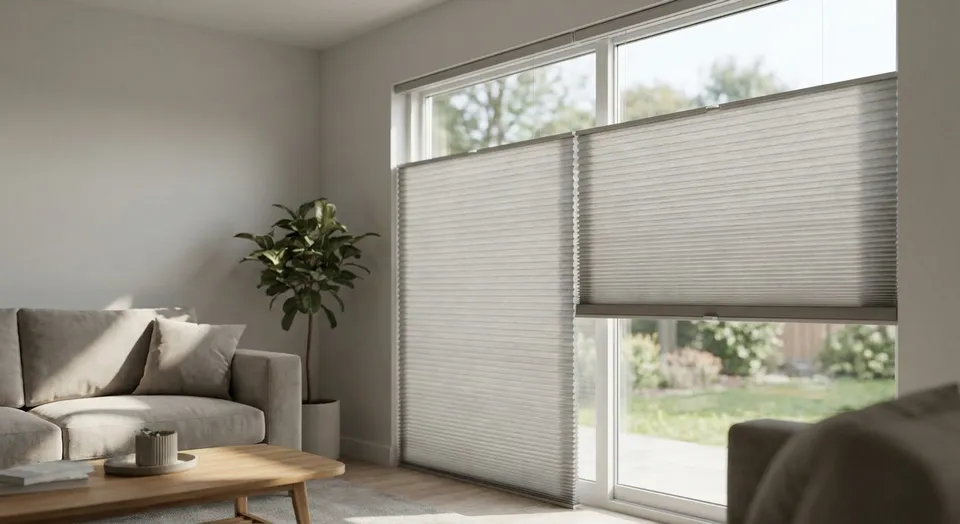
Top-down bottom-up shades let you drop the top of the shade for privacy while the bottom stays open for light, or reverse it entirely, one shade, two zones, no compromise between a curtain-free view and a private room.
- Cordless cellular shades with top-down bottom-up control are the strongest all-around pick for 2026 privacy and light control.
- Woven wood roman shades in a top-down bottom-up build work best for living rooms that need texture without losing daylight.
- Motorized top-down bottom-up shades solve the reach problem on picture windows and skylights. Buy if the window is over 6 feet tall.
- Skip single-rail roller shades if you need true top-down bottom-up control; the mechanism doesn't exist on a standard roller.
Why this matters
A standard shade gives you one choice: open or closed, top to bottom. Top-down bottom-up shades split that into two independent rails, so a bedroom window can stay covered at eye level while sunlight still comes in near the ceiling, or a street-facing living room can block the bottom half for foot-traffic privacy and leave the top open for daylight.
The configuration is a mount option, not a separate product category. It shows up most often on cellular shades and on select roman shade builds. Homeowners across the Greater Seattle Area ask for it in bathrooms, home offices, and first-floor rooms facing a sidewalk or a neighbor's window, where a full pull-down shade blocks too much light and a fully raised shade blocks no privacy at all.
How we ranked
This list ranks top-down bottom-up shade options by how they perform across the two jobs they're bought to do: privacy control and light control, without one canceling out the other. Ranking weighs mount compatibility (not every fabric or headrail supports dual rails), operating ease (cordless vs. motorized vs. corded), and fit for the room types where installers across Auburn, WA and the wider Seattle region see this configuration requested most in 2026, bedrooms, home offices, bathrooms, and street-facing living rooms. Products excluded from big-box or faux-wood lines aren't part of this ranking; the comparison stays within fabric-based shades that actually support a true two-rail build.
The ranked list
1. Cordless cellular shades: the safe pick
Cellular shades hold their shape in a top-down bottom-up build better than almost any other fabric shade, because the honeycomb structure keeps both rails square instead of sagging in the middle. The bottom rail typically lifts up to 18 inches without losing tension, enough to clear a windowsill AC unit or a low bench seat.
They also carry the best insulation value of any shade in this list, which matters for west-facing rooms that overheat by afternoon. Verdict: Buy for bedrooms, home offices, and any window where energy performance matters as much as privacy.
2. Woven wood roman shades: the texture pick
A top-down bottom-up roman shade brings the fold-and-stack look of a roman shade without giving up the split-rail control. Woven wood versions add a natural texture that plain fabric romans don't, which is why they show up so often in living room installs that want a softer look than cellular or roller shades.
The tradeoff is light gap: woven wood lets in more ambient light through the weave itself, even with the bottom rail raised. Verdict: Buy for living rooms and dining rooms where a fully blackout result isn't the goal.
3. Motorized top-down bottom-up shades: the reach solution
On a picture window or a skylight, a manual dual-rail shade means two cords or two wands to manage, often out of reach. Motorized versions replace both rails with app or remote control, and in 2026 most motorized cellular and roman shade lines support independent top and bottom positioning from a single remote.
The cost premium is real, and it's worth checking current pricing directly rather than assuming a flat number. Verdict: Buy for windows over 6 feet tall or any skylight application; Consider for standard-height windows where a manual pull is easy enough.
4. Blackout cellular shades with dual rail: the bedroom pick
Standard top-down bottom-up shades leave a light gap where the two rails meet in the middle, which defeats the purpose in a bedroom that needs full dark for sleep. Blackout-lined cellular shades close that gap with an overlap seam, so the middle join doesn't leak light the way a lighter fabric does.
Shift workers and nurseries are the two rooms where this matters most, since daytime sleep needs full blackout, not just privacy. Verdict: Buy for bedrooms and nurseries; Skip for rooms where some ambient light is fine.
5. Skylight shades with dual control: the vaulted ceiling fix
Skylight installs almost always call for motorized dual-rail control, since a pole wand can't reach a ceiling mount and cords aren't practical overhead. The top-down feature matters here for heat control on south-facing skylights, letting the top stay open to vent warm air while the bottom stays closed against direct glare.
Verdict: Consider for any vaulted ceiling with direct sun exposure; motorization is close to mandatory rather than optional at this height.
6. Top-down bottom-up on sliding glass doors: the tight-fit case
Vertical cellular shades on sliding doors can run dual-rail tracks, but the mechanism adds bulk to a track that's already carrying a lot of fabric across a wide span. It works, but it's the least common request among the six options here, mostly because most sliding-door installs prioritize full coverage over split-zone control.
Verdict: Consider only if privacy at the bottom third of the door is the specific problem you're solving; Skip if you just want a standard pull-across shade.
Comparison table
| Option | Best for | Light gap at middle seam | Operation | Verdict |
|---|---|---|---|---|
| Cordless cellular shades | Bedrooms, offices | Minimal | Manual, cordless | Buy |
| Woven wood roman shades | Living rooms | Moderate (weave texture) | Manual, cordless | Buy |
| Motorized dual-rail shades | Tall windows, skylights | Minimal | Remote/app | Buy |
| Blackout cellular shades | Bedrooms, nurseries | None (overlap seam) | Manual or motorized | Buy |
| Skylight dual-rail shades | Vaulted ceilings | Minimal | Motorized | Consider |
| Vertical cellular, sliding doors | Sliding glass doors | Moderate | Manual, cordless | Consider |
Where to buy
- Measure the window first, not the frame. Top-down bottom-up shades need an exact inside or outside mount measurement before ordering, since the two-rail mechanism doesn't forgive gaps the way a single shade does.
- Ask whether the fabric you want actually supports a true dual-rail build; not every roller or roman shade fabric holds tension well enough for both rails to sit flush.
- Get the installation done by the same team that measures it. A shade that's off by half an inch on a dual-rail mount will bind or sag at one rail, and that's a measuring problem, not a product problem.
Get a quote for top-down bottom-up shades
Rainier Blinds measures and installs across the Greater Seattle Area.
FAQ
What are top down bottom up shades?
Top-down bottom-up shades have two independent rails, so you can drop the top for privacy while keeping the bottom open for light, or the reverse. They're a mount option available on cellular shades and select roman shade builds in 2026, not a separate product line.
Are top-down bottom-up shades better than regular shades for privacy?
Yes, for windows facing a street, sidewalk, or neighboring house, because you can block the exact zone people can see into without covering the whole window. A regular single-rail shade forces an all-or-nothing choice.
Do top-down bottom-up shades work on bathroom windows?
Cellular shades in a dual-rail build are the most common choice for bathrooms, since you can raise the bottom for light at the sink while keeping the top down for street-level privacy.
Is there a light gap in the middle of top-down bottom-up shades?
Standard fabric shades leave a small gap where the two rails meet, usually a half inch or less. Blackout-lined cellular shades close that gap with an overlap seam, which matters for bedrooms.
Can top down bottom up shades be motorized?
Yes, most cellular and roman shade lines in 2026 support motorized dual-rail control from a single remote or app, which solves the reach problem on tall windows and skylights.
What rooms use top-down bottom-up shades most?
Bedrooms, home offices, bathrooms, and street-facing living rooms request this configuration most often, based on installation patterns across the Greater Seattle Area.
Do top-down bottom-up shades work on sliding glass doors?
They can, using vertical cellular shades on a dual-rail track, but it's the least common application since most sliding-door installs prioritize full coverage over split-zone privacy.
Are top-down bottom-up shades worth the extra cost over a standard shade?
For rooms with a real privacy-versus-light conflict, yes. Check current pricing directly, since the added mechanism cost varies by fabric and headrail type.
One last thing
The part most homeowners miss: the bottom rail on a cellular shade can usually lift higher than they expect, often close to 18 inches, which means a top-down bottom-up shade can clear a low windowsill planter or an AC unit without needing a custom cutout. That single measurement decision. How high the bottom rail needs to travel, matters more to the final fit than the fabric color choice most people spend the most time on.