
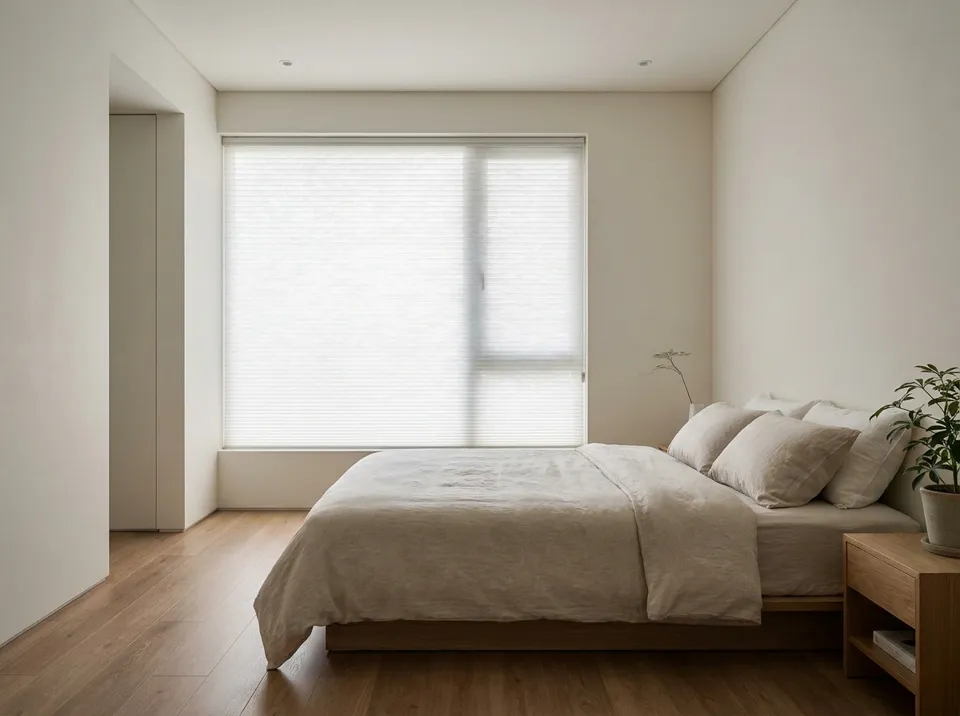
Cellular shades in Auburn, WA trap still air against the glass and cut heat loss through single-pane and older double-pane windows common across South King County. This 2026 guide covers cell size, single vs. double cell, opacity per room, top-down bottom-up hardware, motor options, and how a local crew that measures, has shades custom-made to your exact measurements, and installs keeps the fitting right on out-of-square frames.
TL;DR
- Double-cell cellular shades Auburn WA homes buy in 2026 win on insulation first.
- R-value lands roughly 4.0-5.0 for double-cell; single-cell sits nearer 3.0-3.5.
- Blackout cellular for bedrooms; light-filtering for living rooms, not one fabric house-wide.
- Rainier Blinds measures and installs with our own crew, with shades custom-made to your exact measurements.
Key numbers
Why this matters
Auburn’s housing stock runs from 1960s and 1970s ramblers to Lakeland Hills and newer Lea Hill construction. Older double-pane and remaining single-pane glass leak heat all winter. Industry figures widely cite honeycomb cellular shades reducing heat loss through a covered window by up to about 40% versus bare glass, a number that shows up on a PSE heating bill from November through March when the furnace runs every night.
South King County winter sun sits low. West- and south-facing rooms take hard afternoon glare even when the sky is gray. A shade that only looks right in a showroom without the air-pocket insulation is a miss for this climate. Big-box stock widths also gap at the edges on out-of-square frames. Custom cut-to-measure cellular is the fix that actually seals the light line and the thermal leak at the same time.
Humidity is the other half of the local problem. Daylight basements and secondary baths in Auburn stay damp for months. Paper-backed honeycomb that survives a dry Phoenix winter fails here by year two. Moisture-rated fabric is not an optional upsell in those rooms. It is the baseline that keeps the cells from swelling at the folds.
For a side-by-side with flat fabric on the same South King County windows, start with our roller shades vs cellular shades guide, then come back here for the cellular-specific specs.
Who this is for
Auburn and South King County homeowners replacing builder-grade mini coverings, finishing a remodel, or outfitting a new build who want real insulation on bedrooms and drafty living rooms. If you run cold glass in December, work nights and need dark sleep, or own a daylight basement that stays cool and damp half the year, this guide applies.
It is also for buyers who already know honeycomb exists but keep getting generic national advice that ignores out-of-square frames and Pacific Northwest moisture. It is not for renters looking for a temporary stick-on shade, and it is not a primer on products outside the shade and drapery range Rainier Blinds measures and installs.
What to look for in cellular shades for Auburn homes
Cell size and single vs. double cell
Cell size is the honeycomb pocket depth. Common residential sizes run 3/8 inch, 9/16 inch, and 3/4 inch floating. Larger cells hold more air and raise R-value, but they sit deeper off the glass and need more mounting depth on the frame. A slender casing that took mini furniture fine may not accept a 3/4 inch double-cell headrail without an outside mount.
Double-cell stacks two honeycomb layers and roughly doubles the trapped-air benefit of single-cell at similar width. Pick double-cell for bedrooms and primary living rooms on older Auburn glass. Pick single-cell where window depth is shallow or budget is tighter and you still want honeycomb insulation over a flat roller. In 2026, most whole-house packages mix both on purpose rather than forcing one cell architecture everywhere.
Fabric opacity per room
You are not picking one opacity for the whole house. Match fabric to what each room does:
- Light-filtering: cuts glare, holds daytime privacy, keeps the room bright. Best for living rooms, kitchens, and hallways that face the daytime street.
- Room-darkening: blocks most light with a soft glow at the edges. Good for guest rooms and offices where total blackout is not required.
- Blackout: blocks about 99% of light with proper side tracks or tight outside mount. Necessary for primary bedrooms, shift workers, and media rooms during Pacific Northwest summer sunrises after 5:00 AM.
A light-filtering living room plus blackout bedrooms is the standard 2026 package for South King County homes. Choosing one fabric house-wide is the most common mistake that ends in a remake.
Top-down / bottom-up operation
Top-down bottom-up lets the shade open from the top while the lower half stays down. You keep street-level privacy and still pull daylight over the top rail. That matters on front elevations along arterial streets in Auburn and Federal Way where neighbors sit close and living-room windows face the sidewalk.
Cordless lift is the 2026 baseline for child and pet safety on any new cellular shade. Corded honeycomb is a strangulation risk and is no longer the default from most suppliers. If you see a cord option still listed, treat it as a skip unless the opening is completely out of reach of kids and pets.
Mounting depth and out-of-square frames
Inside mount needs enough casing depth for the headrail plus the cell stack. Shallow casing forces an outside mount that sits on the wall or trim. Older Auburn frames settled over decades; one side can be 1/4 inch taller than the other. Stock sizes assume square openings. A measuring crew takes width at top, middle, and bottom and uses the tightest number so the shade does not bind.
Trim depth is the decision most self-measure kits skip. A casing that is 1.5 inches deep may take single-cell with difficulty and reject double-cell inside-mount completely. That choice needs to be made on the measure visit, not after fabric arrives.
Warranty on fabric and lift hardware
A cellular shade is a 10-to-15-year product with normal use. Ask what the warranty covers: fabric fade, cell rupture, and cordless lift failure are the three claims that matter. Confirm labor coverage separately from product coverage when a local crew does the install. Product-only coverage still leaves you paying for a second hang if the first motor fails.
Moisture-rated fabric for baths and basements
Daylight basements and secondary baths in South King County run humid for months. Standard paper-backed cellular warps. Moisture-rated or vinyl-backed honeycomb fabric holds shape through the same wet-dry cycles. Ask for that grade before settling on the same fabric used in a dry bedroom. Living-room samples and bath samples can look identical on a fan deck and behave completely differently after two wet winters.
Top picks for Auburn and South King County
The safe pick: double-cell blackout cellular for bedrooms
The energy pick. Double-cell blackout stops summer dawn light and adds the highest residential R-value in a shade form factor. Cell sizes from 3/8 inch to 3/4 inch trade depth for insulation. Larger cells trap more air and need more casing depth. Buy for primary bedrooms and any room used for daytime sleep after night shift. Custom-made to the nearest 1/8 inch after on-site measure, not from a stock chart.
Side light is the hidden variable. Even perfect blackout fabric bleeds morning glow at left and right edges if the shade is slightly narrow or the frame is crooked. Ask about side channels or a tight outside mount during the measure visit for rooms that truly need dark.
The all-room workhorse: light-filtering single- or double-cell day rooms
The comfort pick. Light-filtering honeycomb softens west afternoon glare without killing the room. Pair it with double-cell on rooms with older glass and single-cell where frames are shallow. Buy for living rooms, dens, and home offices that sit under low winter sun angles. Rooms that host video calls all day still benefit from the softer diffusion cellular gives versus bare glass. Without going full blackout during daylight work hours.
The privacy specialist: top-down bottom-up cellular
The street-facing pick. Open the upper third for daylight while the lower two-thirds hold privacy on together lots. Common on first-floor front windows across Auburn apartment-to-single-family mix and denser Federal Way streets. Consider anywhere people walk past the window at eye level. Skip it on second-story bedrooms where privacy is already high and the dual-rail hardware adds cost without a real job to do.
The smart-home upgrade: motorized cellular
The hard-to-reach pick. Battery motors hide in the headrail and last roughly 6-12 months between USB recharges depending on cycle count. Hardwired motors need an electrician and skip battery changes. Motorized dual or day/night cellular adds a second fabric layer on a second tube for rooms that want light-filter by day and blackout at night without two separate shades on the glass.
Consider for stairwell glass, tall great-room windows, and any window behind furniture. Motorization is an upgrade for access and scheduling, not a requirement for thermal performance. The honeycomb still does the insulating work when the shade is manual. See the full custom window treatments range for motor options.
The spa and laundry pick: moisture-rated cellular
The humidity pick. Moisture-rated honeycomb survives shower steam and laundry humidity that destroy paper-backed cells by year two. Buy for baths, laundry, and daylight basements. If humidity is extreme and insulation is secondary, a vinyl-backed roller can be the cleaner swap. Ask during the measure visit which fabric grade fits that specific room. Do not assume the bedroom fabric travels well into the bath.
What to avoid
Self-measure kits ordered online
Inside-mount vs. outside-mount changes the width by the bracket depth. Headrail depth for double-cell is often under-measured on a DIY tape job. A shade that is 1/4 inch too wide binds; too narrow leaves light gaps that kill both privacy and insulation. In 2026 the price gap between self-measure online and local measured-and-installed is often smaller than one remake fee.
Older Auburn windows land off-square more often than catalog charts admit. Three width measurements and the tightest number are the rule a local crew already follows. A single phone-app reading is not enough for a custom honeycomb order.
One opacity for every room
Blackout living rooms feel cave-like at noon. Light-filtering bedrooms wake you at 5:15 AM in June. Match fabric room by room. A 10-minute walk-through on what each room does saves a costly reorder. The cheapest whole-house package on paper becomes expensive when half the shades need fabric swaps three months later.
Paper-backed cellular in wet rooms
Showroom samples look identical. In a wet Auburn winter, paper-backed cells in a bath swell and soft at the folds. Moisture-rated fabric is not optional in those rooms. Blaming the brand when standard honeycomb fails in a steam shower is the wrong diagnosis. Moisture grade is a fabric decision you control at order time.
Forcing double-cell into shallow casing
Double-cell needs depth. Shoving a deep stack into a shallow inside mount causes binding, light gaps, or a headrail that sticks proud of the trim. Outside mount or single-cell is the correct answer when depth is the constraint. Bigger R-value on a bad mount is not a win.
Verdict comparison
| Option | Best for | Key spec | Verdict |
|---|---|---|---|
| Double-cell blackout cellular | Primary bedrooms | R-value ~4.0-5.0 range | Buy |
| Light-filtering cellular | Living rooms, offices | Glare cut, daylight kept | Buy |
| Top-down bottom-up cellular | Street-facing fronts | Privacy + upper light | Consider |
| Motorized cellular | Tall / hard-to-reach | Battery 6-12 mo cycle | Consider |
| Moisture-rated cellular | Baths, laundry, basements | Humidity-stable fabric | Buy |
| Stock self-measure online | Out-of-square frames | Fixed chart widths | Skip |
How local measure and install works
We bring fabric samples to your home and help you choose the weave, texture, and finish in your own light. Your shades are custom-made to your measurements, and our local crew handles measuring and installation.
- Consult and measure: on-site, room by room, noting mount type, depth, and obstacles (cranks, locks, deep casing).
- Quote on the spot: real pricing for fabric grade, cell size, cordless or motorized, and window count. No showroom visit required.
- Custom-made to your measurements: shades are custom-made to your exact measurements. Lead time is typically 2-4 weeks.
- Install: usually one visit. Motors get paired and limits set before the crew leaves.
That process is the opposite of a warehouse box and a smartphone measuring app. It is built for South King County window stock that does not match catalog widths. Details for coverage sit on the Auburn service area page. For broader treatment options beyond honeycomb, the earlier custom window treatments Auburn WA guide covers the full catalog side-by-side.
FAQ
What are the best cellular shades for Auburn WA homes in 2026?
Do cellular shades really save energy in South King County?
How much do cellular shades cost in Auburn, WA?
Is double-cell better than single-cell cellular?
Can cellular shades be motorized?
How long do custom cellular shades last?
Does Rainier Blinds make the shades in-house?
Are cellular shades good for bathrooms in humid Pacific Northwest homes?
One last thing
The detail most Auburn homeowners miss in 2026 is side light leak on inside mounts. A honeycomb shade that looks perfect from the middle of the room still bleeds morning light at the left and right edges if the shade is even 1/8 inch narrow or the frame shim is crooked. Optional side channels or a tight outside mount close that gap for true blackout bedrooms.
Ask about side light during the measure visit. It is cheaper to button down on order day than to fight a bright edge every June sunrise for the next decade. Insulation without real blackout on a shift-work bedroom is only half the job the shade was hired to do.