
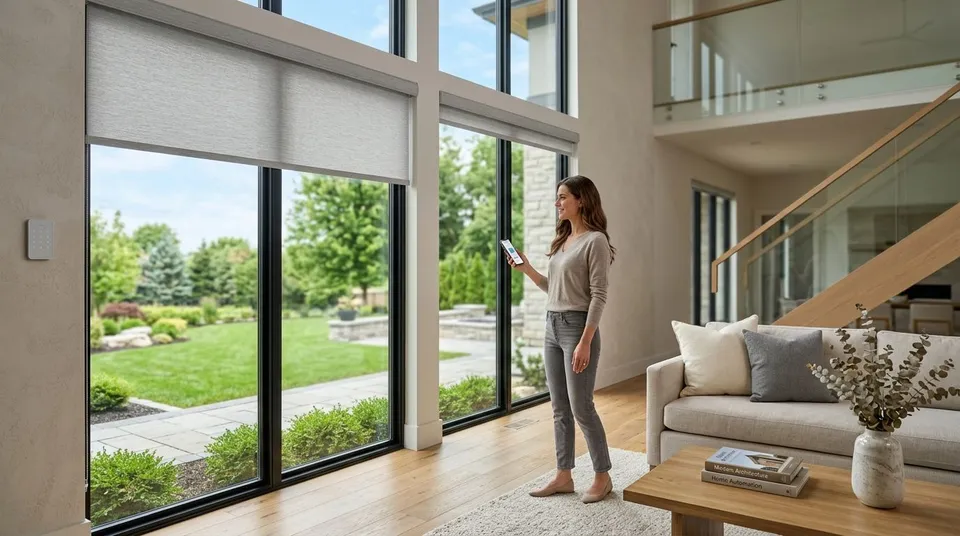
Smart shades for new construction homes are motorized window coverings planned and pre-wired during the build, so the shades arrive finished and ready to control the same week you get your keys. New construction changes the sequence: shades get ordered off blueprints instead of a finished window, and wiring for motorized lift systems has to go in before drywall closes the walls. Get that sequence wrong and you're either drilling into new paint or living with exposed cords for a year.
- Smart shades for new construction homes need pre-wiring before drywall, not after move-in.
- Order shades off blueprints during framing, then final-measure after drywall and paint for exact fit.
- Motorized roller and cellular shades pair with Google Home and Alexa once a hub is set up.
- Rainier Blinds measures and installs after your final measure appointment, once walls are finished.
- Budget shades as a build line item around framing, not a post-move-in add-on.
Why smart shades matter for new construction homes
A new build gives you one clean shot at hiding wiring, setting mount depth, and matching operation type to how each room actually gets used. Retrofit homes deal with existing trim, existing outlets, and existing drywall. New construction lets the shade plan and the electrical plan move together, which is the whole advantage.
The tradeoff is timing. Order too early off preliminary plans and window sizes shift with change orders. Order too late and you move in with bare glass while a 4-6 week production window runs. The fix is a two-stage process: preliminary order at framing, final measure after drywall and paint, install before your final walkthrough.
Time the shade order to the framing stage, not the punch list
Most homeowners wait until the punch list to think about window coverings. By then the crew has moved on and you're stuck with a bare-window house for a month or more.
- Get a rough shade count and room list locked in once framing is done and window rough openings are confirmed
- Flag any windows getting motorized lift so electrical can run low-voltage wire during that same framing pass
- Note skylights, transoms, and any arched or trapezoid windows separately since those need custom templates
- Confirm with your builder which rooms are getting drapery hardware instead of shades, since rod placement needs blocking behind the drywall
- Keep a running list of window treatment decisions inside your build folder so it doesn't get lost between the electrician and the framer
Pre-wire for motorized and smart shades before drywall
This is the step that separates a clean smart-shade install from a house full of visible cords and battery packs everywhere. Hardwired motors need power at the headrail; battery motors don't, but still benefit from a hidden low-voltage run if you want zero visible wiring.
- Run low-voltage line to the top of each window getting a hardwired motorized shade, before the electrician's rough-in inspection
- Decide per room whether you want hardwired power or rechargeable battery motors, since that decision changes what gets pulled through the wall
- Ask about concealed wiring solutions for motorized window shades if you want zero visible cord anywhere in the finished room
- Group wiring runs by hub location, not by window, so one Wi-Fi bridge can control an entire wing of the house
- Skip pre-wiring only on rooms you're certain will stay manual long-term, like closets or a laundry room
Choose operation tier by room, not by whole-house default
Every shade line comes in three tiers: manual, motorized, and smart. Builders often default the whole house to one tier to keep the spec simple, and that's usually the wrong call for a house with mixed room types.
- Put manual operation on low-traffic rooms: guest bedrooms, closets, laundry, secondary bathrooms
- Put motorized or smart operation on hard-to-reach windows: high transoms, skylights, stairwell windows, anything over 8 feet
- Use motorized on primary bedrooms and living rooms where daily schedule control (open at sunrise, close at sunset) actually gets used
- Reserve smart hub integration for rooms tied into a whole-home system, like a great room with existing Alexa or Google Home devices
- Treat kids' rooms and nurseries as cordless by default regardless of tier, for basic safety
Match shade type to window type across the build
A new construction floor plan usually mixes window shapes: standard double-hung, large picture windows, sliders, and at least one skylight or transom. One shade type rarely covers all of them well.
- Roller shades for standard and picture windows where a clean, low-profile look matters
- Cellular shades for bedrooms and offices where insulation and light control both matter
- Zebra shades for living areas where alternating sheer and solid bands give flexible light control
- Skylight shades for vaulted ceilings and roof windows, usually motorized since they're out of manual reach
- Outdoor shades for covered patios and decks if the build includes an outdoor living space
Set up the smart home hub before move-in day
Smart shades only behave like smart shades once they're actually paired to a hub. Doing this before move-in means the house works on day one instead of week three.
- Confirm which shades are getting smart shades compatible with Google Home and Alexa versus a standalone remote
- Set up pairing motorized shades with a smart home hub as one of the final pre-move-in tasks, alongside Wi-Fi and thermostat setup
- Test scheduled open/close routines for at least one full day-night cycle before the final walkthrough
- Label each shade in the app by room name, not by a default device number, so remote control actually stays usable
- Keep the hub on the same network segment as other smart home devices to avoid pairing dropouts
Budget for shades as a build line item, not an afterthought
Window coverings routinely get left off the initial build budget and then become a scramble once the house is framed. Treat it as its own line item from the start.
- Estimate room count and rough window count early, even before final elevations are locked
- Separate manual, motorized, and smart tiers in the budget since they carry different equipment costs
- Build in a buffer for change orders that add or resize windows mid-build
- Loop in your general contractor or the new construction builders process early so the shade timeline lines up with the electrical rough-in, not after it
Schedule the final measure after drywall and paint
A preliminary order gets the production clock started. The final measure locks the exact dimensions once walls are actually finished, which is the only way to guarantee a correct fit.
- Book the final measure appointment once paint is dry and trim is installed, never before
- Confirm mount type (inside vs outside) at this appointment since drywall thickness and trim depth affect it
- Walk through every room on the shade list, not just the ones you remember
- Reconfirm which rooms are getting motorized versus manual, since plans sometimes shift mid-build
- Set install for after final measure but before your closing walkthrough whenever the build schedule allows it
Comparison: shade options for new construction homes
| Option | Best for | Key limitation |
|---|---|---|
| Manual shades | Closets, guest rooms, low-traffic spaces | No scheduling, no remote or app control |
| Battery motorized shades | Rooms without a hardwired pre-run | Needs periodic battery charging or replacement |
| Hardwired motorized shades | Primary living spaces, skylights, high windows | Requires pre-wiring before drywall closes |
| Smart hub-integrated shades | Whole-home automation, voice control rooms | Needs a hub and stable Wi-Fi to function fully |
Verdict: for a 2026 new construction build, motorized shades on primary living spaces and skylights, manual on low-traffic rooms, is the setup that avoids both wasted wiring and wasted budget.
Plan shades before drywall closes
Free in-home consult and measure for new builds across South King County.
Common mistakes builders and homeowners make
- Ordering off preliminary plans without a buffer: window sizes shift with change orders, and a locked order can't flex once production starts
- Skipping the pre-wire step entirely: retrofitting power to a motorized headrail after drywall means patching walls, not just installing shades
- Defaulting the whole house to one operation tier: motorizing every window in a house adds cost to rooms that never needed it, like closets
- Measuring before drywall and paint are finished: drywall thickness and trim depth change the actual window opening, so early measurements go stale
- Forgetting the hub setup until move-in week: smart shades that aren't paired yet just sit as expensive manual shades for the first few weeks
FAQ
When should shades get ordered during a new construction build?
Order a preliminary count once framing is done and window rough openings are locked, then confirm exact dimensions with a final measure after drywall and paint. Ordering too early risks a mismatch if window sizes shift with change orders.
Do smart shades need special wiring in a new build?
Hardwired motorized shades need low-voltage wire run to the headrail before drywall closes, while battery motorized shades don't need wiring at all. Decide per room during the framing stage since retrofitting wire later means opening finished walls.
Can smart shades work with Google Home and Alexa in a new construction house?
Yes, once shades are paired to a compatible hub they work with both systems for scheduling and voice control. The pairing step needs to happen before move-in so the house works on day one.
Should every room in a new build get motorized shades?
No. Motorized and smart tiers make sense for primary living spaces, skylights, and hard-to-reach windows, while manual shades cover closets, guest rooms, and other low-traffic spaces. Matching tier to room use keeps the budget in line.
What's the difference between the preliminary order and the final measure?
The preliminary order gets production started based on early plans, while the final measure locks exact dimensions once drywall and paint are finished. Skipping the final measure is the most common cause of a shade that doesn't fit the finished opening.
Are outdoor shades an option for new construction patios?
Yes, outdoor roller shades in steel wire or zipper track styles work on covered patios and decks included in a new build. They get specified and measured the same way interior shades do, once the structure is finished.
How far in advance of move-in should the smart hub get set up?
Set the hub up during final pre-move-in tasks, alongside Wi-Fi and thermostat setup, so scheduled routines are tested through at least one full day-night cycle before you move in.
Who installs the shades after the final measure?
Rainier Blinds measures and installs with its own crew, scheduled after drywall and paint are finished and before the final walkthrough whenever the build timeline allows it.
One last thing
The single biggest timing mistake in 2026 new construction builds isn't the shade order, it's the electrical rough-in. Once drywall goes up, adding power to a headrail means cutting into finished walls, so the pre-wire decision has to happen at framing, not after the fact. If you're unsure which rooms will end up motorized, run the wire anyway. A battery-only shade with an unused wire run costs nothing extra; a hardwired shade with no wire run costs a wall patch.