
Our available controls: Rainier Blinds offers Roman and woven wood shades with motorized operation only. All other shade styles are available with manual, motorized, or smart control. Your consultation confirms the controls and power options for your product.
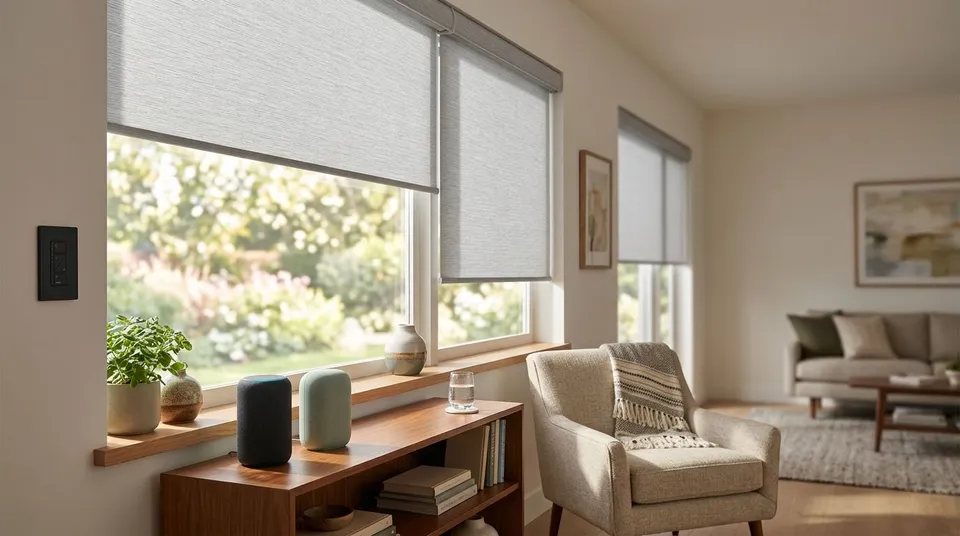
Motorized roller shades are the easiest smart shade to run through Google Home and Alexa in 2026, cellular shades win on energy savings, and zebra shades win on flexible privacy control. If you're picking a single category to start a smart window setup this year, start with roller shades in the main living space and expand from there.
- Motorized roller shades are the best overall smart shades for Google Home and Alexa compatibility in 2026.
- Smart cellular shades cut winter heat loss through windows by up to 40%, per U.S. Department of Energy data.
- Battery-powered retrofit shades let you add smart shades google home alexa control without rewiring existing windows.
- Outdoor shades and drapery need more planning for hub placement and power, so budget extra lead time.
- Wi-Fi signal strength at the window matters more than the shade brand for reliable voice control.
Why this matters
Smart shades that connect to Google Home and Alexa aren't a novelty anymore in 2026, they're a normal ask on most consultations across the Greater Seattle Area. The problem is that most buying guides online compare brand-name automation kits without ever mentioning that the shade type underneath the motor matters just as much as the app it connects to.
Before you pick a hub or a voice assistant, you need to know which shade category actually fits the window and the room. Pairing motorized shades with a smart home hub is the easy part. Choosing between roller, cellular, zebra, woven wood, outdoor, and drapery is where most homeowners get stuck.
What makes the best smart shades for Google Home and Alexa
- Hub or native compatibility with both Google Home and Amazon Alexa, not just one platform
- Stable Wi-Fi or hub connection at the window location, since dead zones cause more failures than the shade itself
- Power flexibility: rechargeable battery, hardwired, or solar options depending on the window
- Quiet motor operation for bedrooms and home offices where voice commands run early or late
- Group and scene support so one voice command moves several shades at once
- Manual override available if Wi-Fi drops or the hub needs a reset
Smart shades for Google Home and Alexa at a glance
| Shade type | Best for | Standout feature | Key limitation |
|---|---|---|---|
| Motorized Roller Shades | Whole-home smart control | Simple flat fabric, easiest retrofit for voice automation | Less insulating than cellular construction |
| Smart Cellular Shades | Energy efficiency | Honeycomb pockets trap air for insulation | Bulkier profile than roller shades on shallow windows |
| Smart Zebra Shades | Adjustable privacy and light | Alternating sheer and solid bands controlled by voice | Sheer bands show more wear over years than solid fabric |
| Motorized Woven Wood Roman Shades | Natural texture with automation | Real woven material with a smart lift built in | Heavier fabric means slower lift speed |
| Smart Outdoor Shades | Patios and decks | Weather-resistant fabric with steel wire or zipper track | Exposed hardware needs more frequent maintenance checks |
| Motorized Drapery | Large window walls, great rooms | Traverse track moves full panels on command | Longer install lead time and more hardware to plan for |
1. Motorized Roller Shades: best smart shade for whole-home Google Home and Alexa control
Roller shades use a single flat fabric panel on a motorized tube, which makes them the simplest shade to automate and the fastest to retrofit into an existing smart home in 2026. They pair cleanly with a hub for Google Home and Alexa voice commands and handle most window sizes without special hardware.
Motorized roller shades pros:
- Fastest and most straightforward smart retrofit of any shade type
- Works across bedrooms, living rooms, kitchens, and home offices
- Wide range of light-filtering and blackout fabric options
Motorized roller shades cons:
- Offers less insulation than cellular construction
- Flat fabric shows more visible fold lines over time than pleated shades
Motorized roller shades pricing: quoted at a free in-home consultation, since fabric, width, and motorization tier all affect the total.
Best for: homeowners starting their first smart shade room and wanting the most reliable Google Home and Alexa response.
Verdict: Buy.
2. Smart Cellular Shades: best smart shade for energy efficiency
Cellular shades use a honeycomb-shaped pocket that traps air against the glass, which is why the U.S. Department of Energy credits properly installed cellular shades with cutting winter heat loss through windows by up to 40% and summer heat gain by up to 60%. Add smart motorization and you get a shade that closes automatically on a schedule when the sun hits west-facing glass hardest.
Smart cellular shades pros:
- Real insulation value backed by DOE guidance, not just a marketing claim
- Scheduling through Google Home or Alexa reduces manual adjustment during temperature swings
- Works well in bedrooms, home offices, and rooms with big south- or west-facing glass
Smart cellular shades cons:
- Thicker profile than roller shades, which matters on shallow window wells
- Pleated fabric can trap dust in the honeycomb pockets over years of use
Best for: rooms where energy savings matter as much as light control, especially west-facing living rooms in the Pacific Northwest.
Verdict: Buy.
3. Smart Zebra Shades: best smart shade for adjustable privacy and light
Zebra shades alternate sheer and solid fabric bands on one roll, so a single voice command through Google Home or Alexa can shift the room from filtered daylight to full privacy without swapping shades. That flexibility makes them a strong pick for rooms that serve more than one purpose during the day.
Smart zebra shades pros:
- One shade handles both daytime light filtering and nighttime privacy
- Popular for living rooms and home offices with mixed-use lighting needs
- Motorized versions align the bands more precisely than manual pull cords
Smart zebra shades cons:
- Sheer bands show wear faster than solid fabric over several years
- Alignment can drift slightly on very wide windows without regular calibration
Best for: multi-purpose rooms where the same window needs to go from bright to private on command.
Verdict: Buy.
4. Motorized Woven Wood Roman Shades: best smart shade for a natural look with automation
Woven wood roman shades bring real natural material (grasses, reeds, or wood fibers woven into a roman fold) into a room that still wants voice-controlled convenience. The lift is built into the headrail, so the natural texture stays intact while the shade responds to Google Home or Alexa commands.
Motorized woven wood roman shades pros:
- Natural material look that flat roller fabric can't replicate
- Roman fold adds texture and depth to a room's design
- Smart lift removes the need for a pull cord on a heavier fabric
Motorized woven wood roman shades cons:
- Heavier fabric means a slower lift cycle than roller shades
- Not the first choice if energy efficiency is the main goal
Best for: rooms where the design calls for natural texture and automation is a secondary want, not the main driver.
Verdict: Hold if a flat roller or cellular shade would meet the room's function just as well; choose this one when the woven look is the priority.
5. Smart Outdoor Shades: best smart shade for decks and patios
Outdoor shades built on steel wire or zipper track systems extend voice control past the interior of the house, letting Google Home or Alexa close a patio shade before a storm rolls in off the Sound. These shades use weather-resistant fabric designed to handle direct sun and moisture exposure that indoor fabrics aren't built for.
Smart outdoor shades pros:
- Extends smart home control to decks, patios, and covered outdoor spaces
- Zipper track designs resist wind better than open-sided panels
- Voice scheduling works well for shading a patio during peak afternoon sun
Smart outdoor shades cons:
- Exposed hardware needs more frequent maintenance checks than interior shades
- Power source planning (hardwired vs. battery) takes more upfront thought outdoors
Best for: homeowners who want the same voice control on the patio that they already run inside the house.
Verdict: Buy for covered patios and decks with reliable Wi-Fi reach; confirm signal strength at the location first.
6. Motorized Drapery: best smart shade for large window walls and great rooms
Drapery on a motorized traverse track moves full fabric panels across a wide opening on command, which makes it the right fit for great rooms and floor-to-ceiling glass rather than a standard single window. It's the heaviest install of the group and typically needs more planning around the track and power source.
Motorized drapery pros:
- Handles wide window walls that roller or cellular shades aren't built to cover
- Full fabric panels add a layered, finished look to a great room
- Traverse track opens and closes evenly across long spans on one command
Motorized drapery cons:
- Longer lead time than a standard motorized shade order
- More hardware and planning required than a single-window shade
Best for: great rooms, large window walls, and formal living spaces where a full drapery treatment is already the design plan.
Verdict: Hold for standard-sized windows; Buy when the room genuinely calls for full traverse drapery.
How this list was ranked
Each shade type above was ranked against the same six criteria: hub compatibility, connection reliability, power flexibility, motor noise, group/scene support, and manual override. Categories that only win on style but add real complexity to a smart setup, like drapery and woven wood, were marked with a Hold rather than a blanket Buy so the ranking stays honest instead of promotional.
“Most smart shade complaints trace back to a weak Wi-Fi signal at the window, not the shade motor itself.”
Which smart shade should you choose?
If you're automating one room in 2026 and want the most reliable result with Google Home or Alexa, start with motorized roller shades. If energy savings matter more than style flexibility, move to smart cellular shades and let the DOE-backed insulation numbers do the work in your utility bill. Everyone else should match the shade type to the room's actual function first, then layer in the smart tier, not the other way around.
Smart shades for Google Home and Alexa work best when the shade type is right for the window before the automation is even considered.
Get a free in-home consultation
Real pricing on the spot for smart shades that fit your windows and your hub.
FAQ
What's the best smart shade for Google Home and Alexa in 2026?
Motorized roller shades are the easiest to set up and the most reliable for daily voice commands through Google Home or Alexa. Cellular shades are the better pick if energy savings matter more than setup simplicity.
Do smart shades need a separate hub to work with Google Home or Alexa?
Most motorized shade systems need a small hub or bridge to translate commands between the shade motor and your voice assistant. The hub typically connects to your home Wi-Fi and pairs with both platforms at once.
Can I control multiple smart shades with one voice command?
Yes, most smart shade hubs support grouping so one command like "close the living room shades" moves several shades at once. Set the group up once in the hub app and it stays saved for both Google Home and Alexa.
Are battery-powered smart shades reliable for daily use?
Battery-powered shades work reliably for daily use and avoid the need to run new wiring, which makes them a common retrofit choice. Placement near a window with good Wi-Fi reach matters more for reliability than the battery itself.
How much does it cost to add motorization to existing shades?
Cost depends on the shade type, width, and motor tier, and it's quoted during a free in-home consultation rather than online. Get exact numbers for your windows before comparing options.
Can outdoor shades connect to Google Home and Alexa?
Yes, steel wire and zipper track outdoor shades can run on the same smart hub as indoor shades, extending voice control to a patio or deck. Power source and outdoor Wi-Fi reach need more planning than an indoor install.
Is Wi-Fi required for smart shades, or can they run on other protocols?
Some smart shade hubs use Wi-Fi directly while others use a low-power protocol that then bridges to your home network. Either way, the hub itself typically needs a Wi-Fi connection to talk to Google Home and Alexa.
What's the difference between motorized and smart shades?
Motorized shades move on a remote or wall switch, while smart shades add hub connectivity so they respond to voice commands and app schedules. Every shade type on this list is available in both a motorized-only and a full smart tier.
One last thing
Before ordering any smart shade in 2026, stand at the window with your phone and check the Wi-Fi signal strength, not the shade catalog. A shade motor with a weak connection behaves exactly like a broken one from the homeowner's side, and swapping shade brands never fixes a dead zone. Fix the signal first, then pick the shade type that actually fits the room.