
Our available controls: Rainier Blinds offers Roman and woven wood shades with motorized operation only. All other shade styles are available with manual, motorized, or smart control. Your consultation confirms the controls and power options for your product.
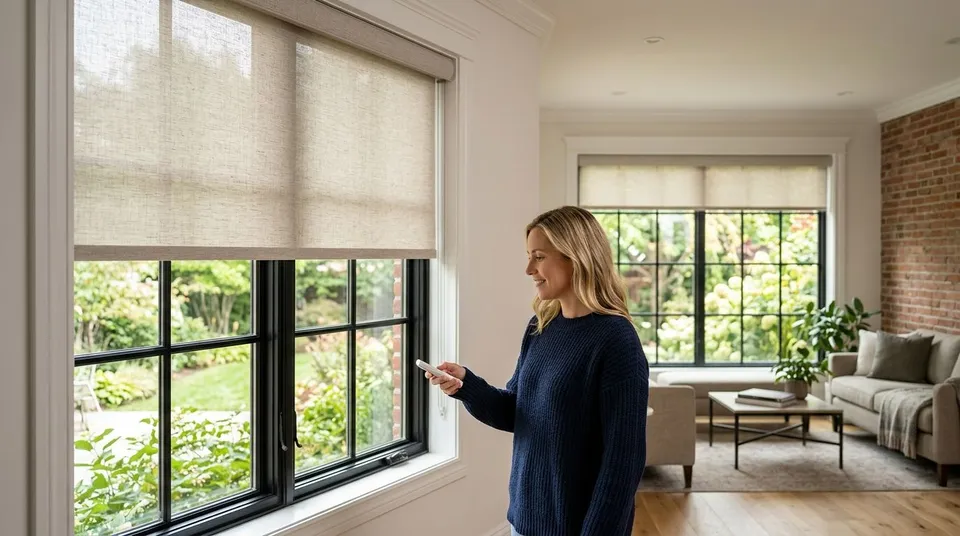
Battery-powered motorized shades solve one problem better than any hardwired system: they go into a retrofit home without an electrician, without cutting drywall, and without running low-voltage wire behind old plaster. For homeowners in Auburn, Bellevue, and Tacoma dealing with 1960s-1990s wiring, that difference decides whether a motorization project happens this year or gets shelved.
- Battery-powered roller shades win overall for retrofit homes because they mount without rewiring and pair with existing smart hubs.
- Cellular shades are the pick when the retrofit goal is insulation and noise reduction, not just automation.
- Outdoor steel wire and zipper track shades are the only battery option built for exterior patio and deck retrofits.
- Every battery-powered shade eventually needs a recharge or battery swap, budget for that step before you buy.
Why this matters
A retrofit home was not built with motorized shades in mind. There is no low-voltage line behind the header, no outlet near the top of the window, and often no interest in opening a wall to add one. Battery-powered shade motors get around that entirely: a rechargeable lithium-ion pack sits inside the roller tube or headrail, and the shade mounts the same way a manual one would.
The tradeoff is maintenance. A hardwired shade never needs attention once it is installed in 2026; a battery-powered one needs a recharge or a swap on a schedule, and that schedule depends on how often the shade runs and how much sun the battery pack sees through the fabric. Programming the shade to a remote or an app takes a few minutes once it is mounted; the full pairing steps are covered in how to program motorized window shades if you want the remote-to-motor sequence before your consultation.
What makes the best battery-powered motorized shades
- Battery life between charges under typical daily use, not just marketing claims
- Retrofit-friendly mounting that skips wiring, conduit, or drywall work
- Smart hub and app compatibility for scheduling and voice control
- Fabric and opacity range available in that shade category's motorized tier
- Motor noise level, since a loud motor defeats the point in a bedroom or home office
- Local troubleshooting support for a motor that stalls or stops responding
Battery-powered motorized shades at a glance
| Shade type | Best for | Standout feature | Key limitation |
|---|---|---|---|
| Battery-powered roller shades | Retrofit homes overall | Widest fabric and opacity range in a single flat profile | Least insulating of the group |
| Battery-powered cellular shades | Energy-focused retrofits | Honeycomb pockets trap air at the glass | Bulkier headrail than roller shades |
| Battery-powered zebra shades | Rooms needing light control flexibility | Alternating sheer and solid bands adjust without full closure | Stripe pattern is not ideal in every room style |
| Battery-powered woven wood roman shades | A textured, natural retrofit look | Natural material with a soft fold on lift | Fewer blackout-grade liner options |
| Battery-powered outdoor shades (steel wire and zipper track) | Patio and deck retrofits | Zipper track resists wind flutter | Not suited to interior windows |
1. Battery-powered roller shades: best overall for retrofit homes
A roller shade wraps fabric around a single tube and raises or lowers it in a flat, minimal profile that fits almost any window opening a retrofit home has. The battery pack sits inside the roller tube itself, so the mounting brackets are the only hardware visible. This is the category most installers reach for first because it works on standard, bay, and picture windows without a custom motor housing.
Roller shades pros:
- Fits the broadest range of window sizes and shapes in a retrofit home
- Available in light-filtering, blackout, and solar fabrics within the same motorized platform
- Slimmest profile of any motorized option, so it clears window trim that other shades might catch on
Roller shades cons:
- Offers the least insulation value of the five categories here
- A single fabric layer means no built-in light-control banding like a zebra shade
Roller shades best for: homeowners retrofitting standard living room, kitchen, or bedroom windows who want one motorized system across the whole house.
Verdict: Buy. For a first motorization project in a retrofit home, roller shades are the lowest-friction entry point in 2026.
2. Battery-powered cellular shades: best for retrofit energy efficiency
Cellular shades trap air inside honeycomb-shaped pockets that sit directly against the glass, cutting heat transfer in older, single-pane or thin double-pane retrofit windows. The battery motor drives the same lift mechanism as a manual cellular shade, just without the cord.
Retrofit homes carry years of buildup on the glass itself, and a light-filtering or blackout fabric only performs as advertised when the window behind it is clean. The same logic that drives regular exterior upkeep, like the professional window cleaning routines homeowners rely on to keep glass clear year-round, applies indoors too: a film of dust or grease on the pane cuts into how much heat a cellular shade actually blocks. Battery life on these shades tends to hold up better; the honeycomb cells add weight, but the motor only cycles the lift, not a heavy fabric fold like drapery would need. Details on keeping the battery itself healthy are in how to maintain motorized window shade batteries.
Cellular shades pros:
- Best insulation value of any shade on this list
- Reduces outside noise more than a flat roller shade
- Available in top-down/bottom-up configurations for layered privacy
Cellular shades cons:
- Deeper headrail than a roller shade, which matters on shallow retrofit window frames
- Pleated fabric is harder to clean than a flat roller shade surface
Cellular shades best for: retrofit bedrooms, home offices, and older single-pane windows where the goal is comfort, not just convenience.
Verdict: Buy. If the retrofit motive is a cold room or a noisy street, cellular shades earn the headrail depth.
3. Battery-powered zebra shades: best for adjustable light control in retrofit rooms
Zebra shades alternate sheer and solid fabric bands on a single roll, so shifting the shade a few inches changes the room from filtered daylight to full privacy without raising or lowering the whole panel. The battery motor handles that fine positioning better than a manual chain, since app control lets you save a preferred stripe alignment.
Zebra shades pros:
- Adjusts light without a full open or close cycle
- App and remote control makes fine positioning far easier than a manual chain
- Works well paired to a smart hub for daylight scheduling
Zebra shades cons:
- Banded pattern reads more modern, which does not suit every retrofit interior
- Fewer blackout-grade fabric options than a straight roller shade
Zebra shades best for: home offices and living rooms where the same window needs to go from bright to private multiple times a day. Pairing the motor to an existing hub is covered in how to pair motorized shades with a smart home hub.
Verdict: Buy. For a room used at different times of day, zebra shades earn their spot over a plain roller.
4. Battery-powered woven wood roman shades: best for a textured, natural retrofit look
Woven wood roman shades fold in soft horizontal pleats and use natural materials like reed, bamboo, or grass cloth instead of a flat fabric surface. The battery motor lifts the shade the same way a manual roman shade would, cord-free, which matters more here since roman shades fold rather than roll and can bind a manual cord over time.
Woven wood roman shades pros:
- Natural texture that flat roller or cellular fabrics cannot match
- Motorization removes the cord-binding issue that plagues manual roman shades
- Pairs well with drapery for a layered retrofit look
Woven wood roman shades cons:
- Fewer blackout liner options than roller or cellular categories
- Folded fabric holds more dust than a flat roller shade, so it needs more frequent cleaning
Woven wood roman shades best for: living rooms and dining rooms in a retrofit home where the goal is texture and warmth, not maximum blackout.
Verdict: Hold. Great for the right room, but skip it if blackout performance is the primary requirement.
5. Battery-powered outdoor shades: best for patio and deck retrofits
Outdoor shades built on steel wire or zipper track systems are the only category here designed to run outside a window entirely, on a covered patio, deck, or porch opening. The zipper track version locks the fabric edges into a channel so wind does not billow the panel, while the steel wire version gives a lighter-duty option for smaller openings. Battery motors on outdoor shades typically use a higher-capacity pack since these panels are larger and run in direct weather exposure more than indoor shades do.
Outdoor shades pros:
- Only option on this list built for exterior weather exposure
- Zipper track resists wind flutter better than steel wire on wide openings
- Extends usable patio time by cutting direct sun and wind
Outdoor shades cons:
- Not usable on interior windows, this is a single-purpose retrofit product
- Larger battery packs need a longer recharge cycle than an indoor roller shade
Outdoor shades best for: homeowners retrofitting a covered patio or deck who never had exterior shade coverage before. See motorized shades for large picture windows if the retrofit also includes a big interior opening near the same patio door.
Verdict: Buy. For exterior retrofits specifically, there is no substitute in this lineup.
How we ranked these
Each category was weighed against the six criteria above: battery life, retrofit-friendly mounting, smart hub compatibility, fabric range, motor noise, and whether local support exists for a motor that stops responding. Roller shades ranked highest overall because they clear the most criteria at once without a specialized use case; the other four earn their spots by solving a specific retrofit problem the roller shade does not.
Which battery-powered motorized shade should you choose?
If you are motorizing a retrofit home for the first time in 2026 and have no specific insulation, exterior, or texture requirement, start with battery-powered roller shades. They fit the most windows, carry the widest fabric range, and give you a working baseline before you decide whether a second room needs cellular insulation or zebra-style light control. Save the outdoor category for the patio door and the woven wood category for the room where you actually want the texture.
Get a retrofit consultation
A free in-home visit gets you real measurements and real pricing on the spot.
FAQ
What is the best battery powered motorized shade for retrofit homes?
Battery-powered roller shades are the best overall pick for retrofit homes in 2026 because they mount without wiring and fit the widest range of window sizes. Cellular and zebra shades outperform them for insulation and light-control needs specifically.
How long does a battery last in a motorized shade?
Battery life depends on how often the shade cycles and how much direct sun the battery pack sees, and it varies by category and usage. Recharging or swapping the pack is a routine maintenance step, not a one-time setup.
Can you retrofit motorized shades without an electrician?
Yes, that is the entire point of a battery-powered motor. It skips the low-voltage wiring a hardwired system needs, so installation is closer to hanging a manual shade.
Are battery powered shades as reliable as hardwired shades?
Battery-powered shades run the same motor technology as hardwired versions, the difference is the power source, not the mechanism. The tradeoff is a recharge schedule instead of a permanent wire.
Do battery powered shades work with smart home hubs?
Most battery-powered motorized shades pair with a smart hub for app control and scheduling. Pairing steps vary by hub and shade brand, so confirm compatibility before ordering.
What happens if a motorized shade motor stops responding?
A motor that will not respond is usually a battery, pairing, or reset issue rather than a mechanical failure. Troubleshooting the remote connection first resolves most cases before a technician visit is needed.
Are outdoor battery powered shades different from indoor ones?
Yes, outdoor shades built on steel wire or zipper track systems use larger battery packs and weather-rated components since they run in direct exposure. They are not designed to be used on interior windows.
Is a zebra shade better than a roller shade for light control?
Zebra shades give finer light control because the sheer and solid bands adjust without a full open or close, which a single-layer roller shade cannot replicate. Roller shades still win on fabric range and simplicity.
One last thing
The category most retrofit homeowners skip, and shouldn't, is outdoor shades. Interior automation gets all the attention, but a zipper track shade on an uncovered patio door in a Pacific Northwest retrofit does more for daily comfort than another indoor roller shade ever will.