
Our available controls: Rainier Blinds offers Roman and woven wood shades with motorized operation only. Available controls and power options for other products are confirmed at your consultation.
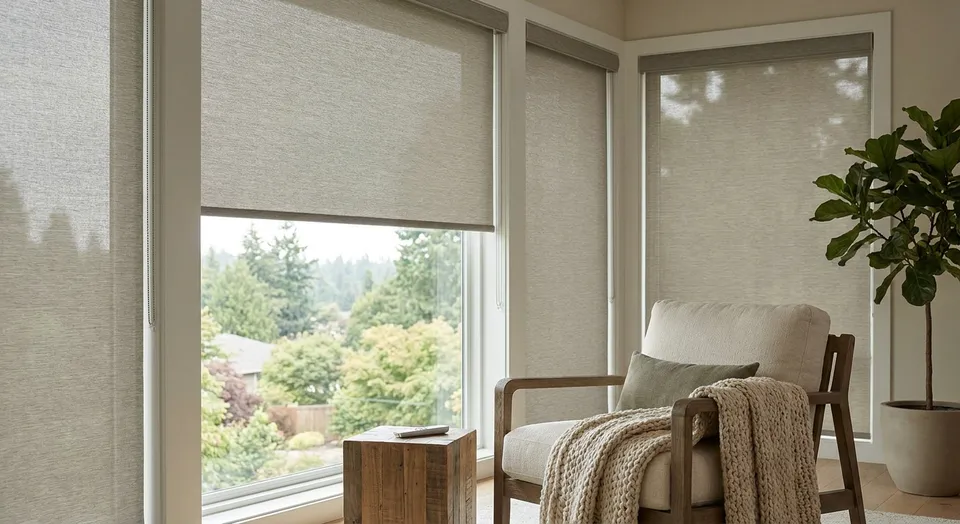
South King County homeowners in Auburn, Kent, Renton, and Federal Way are swapping cordless blinds for full motorization faster than any other window covering upgrade in 2026, and the systems that hold up against Pacific Northwest rain, gray skies, and Seattle-area smart home setups aren't the ones getting the most Instagram attention.
- The best motorized shades for South King County homeowners in 2026 are hardwired roller shades, no battery swaps, no rain interference.
- New battery-powered motorized shades can suit existing homes without new wiring at each window. Recharge intervals depend on the selected motor, battery, shade size, use, and conditions. We confirm the charging method and access before ordering.
- Solar-charged outdoor shades struggle under Seattle's cloud cover, pair them with a rechargeable battery pack instead.
- Smart-home support depends on the exact motor, controller, protocol, and hub. We confirm support for your preferred platform and the available features before ordering.
- Plug-in motorized kits suit renters, not homeowners. Skip them for a permanent Auburn or Kent install.
Why this matters
Motorization isn't a luxury upgrade anymore. It's how homeowners in two-story houses, over-the-sink kitchens, and skylight-heavy great rooms in Kent and Renton actually operate their shades day to day. The difference between a system that works in 2026 and one that's back in a drawer by spring usually comes down to power source and how it handles Northwest humidity, not the fabric pattern.
If you're still deciding between roller and cellular styles before motorizing anything, the breakdown in roller shades vs cellular shades for South King County is worth reading first. It changes which motor type makes sense.
How this list is ranked
Each system below is ranked on four things that matter specifically for South King County homes: how it handles rain and humidity, battery or wiring reliability over a Northwest winter, compatibility with the smart home platforms homeowners here already use, and how well local installers can actually service it after the sale. Systems that look good on a spec sheet but fail on local install logistics get marked down. Verdicts are Buy, Consider, Hold, or Skip, no soft middle ground.
The ranked list
1. Hardwired motorized roller shades: the no-fuss pick
These run off household wiring, not batteries, which matters in a region where a shade six feet up a stairwell in Auburn doesn't get touched for months at a time. No recharge schedule, no dead-battery surprise mid-winter.
A wired motor needs a compatible power supply and an agreed electrical plan. Confirm those requirements before installation; costs and wiring routes depend on the existing building and project scope.
Verdict: Buy, the most reliable option for a primary living space in a rainy market.
2. Battery-powered motorized cellular shades: the retrofit favorite
No wiring required, which is why this is the default recommendation for existing homes in Kent that aren't mid-remodel. The cellular pocket also adds insulation value, which matters through a South King County winter.
Battery packs recharge on a rechargeable lithium cell rather than disposable AAs in most 2026 installs, cutting the maintenance interval way down. The Kent WA motorized shades guide covers which rooms in a typical Kent home are worth motorizing first and which can wait.
Verdict: Buy, the practical choice when rewiring isn't on the table.
3. Solar-charged outdoor motorized shades: the patio fix, with a catch
Outdoor motorized shades solve the west-facing patio glare problem in Renton and Tacoma backyards, but solar charging alone underperforms under Seattle's cloud cover for a meaningful chunk of the year.
What it does: a small solar panel trickle-charges an internal battery to run the motor without an outdoor outlet. Why now: pairing the solar panel with a rechargeable backup battery, rather than relying on solar alone, is becoming the standard 2026 spec for Northwest installs specifically because direct sun hours run short from November through February.
Verdict: Consider, fine with a battery backup, weak without one.
4. Smart-hub integrated zebra shades: the tech-forward pick
Smart-home support depends on the exact motor, controller, protocol, and hub. We confirm support for your preferred platform and the available features before ordering.
A living room in Renton with mixed light needs, bright morning sun, dim evening TV watching. Is the use case this system is built for. The motorized window shades for Renton living rooms guide walks through scheduling and scene setup for exactly this room type.
Verdict: Consider, worth the setup time if you already run a smart home hub.
5. Motorized roman shades: the formal room upgrade
Roman shades motorize less cleanly than roller or cellular because the fold mechanism adds friction the motor has to work against. That means a slightly higher failure rate on cheaper motor kits and a real difference between a properly matched motor and a bolted-on aftermarket one.
They still make sense in a formal dining room or office where the fabric look matters more than daily cycling. Cycle count expectations should be lower here than for a roller shade doing double duty every morning and night.
Verdict: Hold. Choose it for looks, not for heavy daily use.
6. Plug-in motorized shade kits: the rental workaround
These clip onto an existing shade and run off a rechargeable battery with no hardwiring and no permanent mount, which is exactly why they suit renters and exactly why they're the wrong call for a homeowner making a permanent upgrade in 2026.
Build quality on these kits varies widely, and none of them integrate cleanly with a whole-home smart hub the way a purpose-built motorized shade does.
Verdict: Skip, fine for an apartment, not for a house you own.
Get a motorized shade quote
Book an in-home consultation to compare samples and get a measured quote.
“If you need more than a stepladder to reach the batteries, hardwire it instead.”
Comparison table
| System | Power source | Verdict |
|---|---|---|
| Hardwired roller shades | Household wiring | Buy |
| Battery cellular shades | Rechargeable battery | Buy |
| Solar outdoor shades | Solar + backup battery | Consider |
| Smart-hub zebra shades | Battery or hardwired | Consider |
| Motorized roman shades | Battery or hardwired | Hold |
| Plug-in kits | Rechargeable battery | Skip |
Where to source motorized shades in South King County
- Get a firm measure before you order anything. A quarter-inch off on a motorized roller shade jams the tube against the frame. This isn't a manual-shade tolerance.
- Ask for the safety instructions and any relevant test documentation for the exact motorized shade and controls. A general article cannot certify a product or installation for a particular room.
- Ask who services the motor after install. A big-box or online order with no local installer means a dead motor is a mail-in repair, not a house call. Rainier Blinds runs its own install crew rather than a subcontractor network, which is the difference between a same-week fix and a shipped-back unit.
Homeowners in Federal Way weighing motorized shades against standard custom blinds should read custom blinds for Federal Way WA homes before committing to a whole-house motorized order. Not every room needs it.
FAQ
What are the best motorized shades for South King County homeowners in 2026?
Compare supported wired and battery-powered shades for the actual windows. Wired power can avoid routine motor-battery charging; battery power may reduce wiring work. Confirm suitability and maintenance for the selected product.
Do motorized shades work well in a rainy climate like Seattle?
Indoor motorized shades aren't affected by rain since the motor sits inside the home, but outdoor solar-charged shades need a backup battery to handle the reduced sun hours common from November through February. Hardwired indoor systems have no weather-related reliability issues.
Are battery-powered motorized shades reliable long-term?
Battery-powered motorized cellular shades hold up well with a rechargeable lithium battery pack and periodic recharging, typically every few months depending on usage. They're less reliable than hardwired systems for shades that cycle multiple times a day.
Can motorized shades connect to Alexa or Google Home?
Smart-home support depends on the exact motor, controller, protocol, and hub. We confirm support for your preferred platform and the available features before ordering.
Should I hardwire or battery-power my motorized shades?
Hardwire shades in rooms you cycle daily, like a primary living room or kitchen, and use battery power for hard-to-reach or occasional-use windows like stairwells. The choice mostly comes down to install access and how often the shade actually moves.
Are plug-in motorized shade kits worth it for a house I own?
No, plug-in motorized shade kits are better suited to renters since they clip onto existing shades without a permanent mount. Homeowners get better reliability and smart-hub integration from a purpose-built motorized system.
What's the difference between motorized roller shades and motorized cellular shades?
Roller and cellular shades differ in fabric structure and light-control options. Cellular fabric can add insulating air pockets. Motor durability, supported load, and power depend on the exact product rather than the shade category alone.
Do motorized roman shades work as well as motorized roller shades?
Motorized roman shades work fine for lower-cycle rooms like a formal dining room or office, but the fold mechanism adds friction that increases wear on cheaper motor kits. Roller shades handle frequent daily cycling more reliably.
One last thing
The motor isn't usually what fails first on a cheap motorized shade kit. The mounting bracket is. A shade that's a quarter-inch out of square puts sideways load on the motor housing every single cycle, and that's what burns it out inside a year, not battery age or weather. Get the measure right and the rest of the system holds up.