
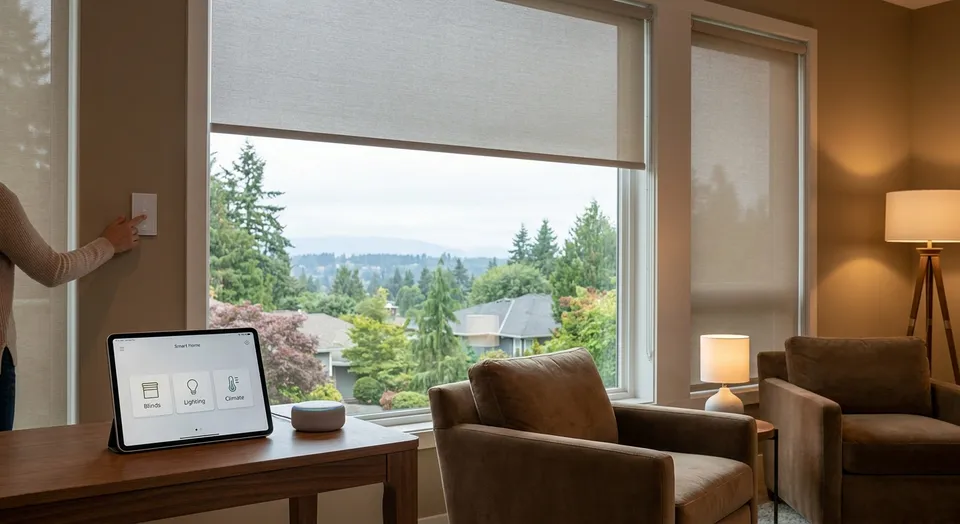
For a smart home in South King County, start with the windows and the controls you want to use. The selected motor, controller, protocol, and platform determine compatibility; a shade style alone cannot tell you whether it joins an existing system.
- Motorized roller shades win for daily-use smart home automation in South King County homes. Buy.
- Skip battery-only kits in unheated garages or sunrooms; cold cuts charge cycles fast.
- Choose a motor and controller confirmed to support your platform, room layout, and required features.
- Outdoor motors, wiring, and controls must be suitable for the actual exposure and the complete shade system.
- Cellular fabric can add insulating air pockets; the motor provides control rather than insulation. Confirm the selected shade's performance data.
Why this matters
Motorized blinds for smart homes are not one product. They're four or five different motor and fabric combinations, each solving a different problem, privacy, glare, insulation, or weather exposure on a covered patio. Buy the wrong one and you get a shade that connects to your app fine but never actually gets used, because it's noisy, slow to charge, or wrong for the room.
At consultation, confirm the proposed equipment and the coverage at the actual windows. Our team measures and installs Rainier-supplied shades and confirms the included controls and setup before ordering.
Who this is for
This guide is for homeowners in South King County who already run a smart home hub, Google Home, Amazon Alexa, Apple HomeKit, or a Zigbee/Z-Wave bridge like SmartThings, and want motorized blinds that join that system instead of running their own separate app. It's built for people automating more than a single window: living rooms, primary bedrooms, home offices, and covered outdoor living spaces where a remote alone isn't worth the install.
What to look for in motorized blinds for smart homes
Hub protocol compatibility
Start with the exact motor, supported protocol, controller, and platform requirements. Network layout and device placement affect reliability; no protocol is automatically best at a fixed number of windows.
Battery life and charging cycles
Recharge intervals depend on the selected motor, battery, shade size, use, and conditions. We confirm the charging method and access before ordering.
Weather and moisture resistance
A covered patio still exposes equipment to moisture and temperature changes. Confirm that the complete shade, motor, power supply, and controls are approved for the intended location; a cover alone does not make indoor equipment suitable outdoors.
Voice assistant and app integration
Confirm whether the exact selected system supports the features you need in Alexa, Google Home, Apple Home, or another platform. A standalone app may be sufficient for some users; compare actual features and required hardware before ordering.
Motor noise
Motor sound depends on the exact motor, shade load, installation, and room acoustics. Ask for product noise data and a demonstration under comparable conditions; a generic decibel value cannot establish how it will sound in your room.
Local calibration and support
If a motorized shade binds or stops unexpectedly, stop operating it and contact the installer. Adjustment and service depend on the product and cause; do not assume it is only a calibration issue or can always be fixed in one visit.
Top picks by shade type
Motorized roller shades: the daily driver
Roller shades offer a simple fabric face and can be a useful first automation project. Confirm the actual tube, supported width, fabric load, motor, and controller; a generic tube diameter does not establish the span or hub compatibility.
See the full breakdown in Rainier Blinds' roller shades vs. cellular shades comparison for South King County homes. Verdict: Buy for living rooms, home offices, and any single-window automation start.
Motorized cellular shades: the insulation play
Cellular fabric adds insulating air pockets. The required motor load depends on the selected dimensions and construction, so compare the supplier's specifications rather than assuming every cellular shade needs more torque than a roller.
Check the motorized shades guide for Kent, WA homes for room-by-room fit. Verdict: Consider for bedrooms and rooms where energy loss through glass is the main complaint.
Motorized drapery and zebra shades: the light-control specialist
Zebra shades adjust alternating fabric bands; drapery systems move fabric panels along a track. Choose between those different light-control and decorative effects, then confirm the supported motor, power, and controls for the selected product.
See it applied in motorized window shades for Renton, WA living rooms. Verdict: Buy for main living spaces where light control matters more than blackout.
Outdoor motorized shades: the covered patio fix
For outdoor shades, confirm mounting and the manufacturer's operating limits before ordering. A supported wind sensor can assist retraction, but it does not replace the instructions or make the shade storm protection.
Outdoor shades may suit a covered living space when the exact system is approved for the exposure. Ask about mounting, operation, and seasonal care before deciding.
What to avoid
- Our automation service is for Rainier-supplied shades. We confirm whether the exact product supports the requested controls; we do not promise motor or cordless conversions for customer-owned shades.
- Choosing controls without checking coverage and integration. Test the proposed controller locations and verify the exact motor's supported network and features before ordering a whole-home system.
- Indoor-only equipment used outdoors. Confirm the intended-use and exposure limits of every part of the selected outdoor system.
Verdict comparison
| Shade type | Where it may fit | What to confirm |
|---|---|---|
| Roller shades | Living rooms and offices | Fabric, shade size, motor power and desired controls |
| Cellular shades | Rooms where insulation and light control matter | Cell construction, mounting clearance and available motor options |
| Zebra shades | Rooms where adjustable bands suit the light and privacy needs | Privacy when lit at night, selected motor and control support |
| Motorized drapery | Large openings where a fabric stack fits the room | Track layout, fabric weight, stack space and power requirements |
| Outdoor shades | Patios and exterior openings suited to the selected system | Approved exposure, mounting, power supply and manufacturer wind limits |
FAQ
What's the best motorized blinds for a smart home in 2026?
Start by selecting a shade suited to the window and then confirm a compatible motor, power supply, and controls. Roller, cellular, zebra, and drapery systems have different hardware needs; the room and actual product specifications determine the choice.
Is Zigbee better than Wi-Fi for motorized blinds?
Neither is universally better. Reliability depends on the exact motor, controller, network, placement, and required features. Compare supported integrations and assess coverage in the actual home before selecting a system.
How much does motorized blinds installation cost in South King County?
Pricing varies by shade type, window count, and motor choice, so get a measured, on-site quote rather than relying on a national average. A local installer can price roller, cellular, drapery, and outdoor motors separately during the same visit.
Do motorized blinds work with Alexa and Google Home?
Smart-home support depends on the exact motor, controller, protocol, and hub. We confirm support for your preferred platform and the available features before ordering.
How long do motorized blind batteries last?
Recharge intervals depend on the selected motor, battery, shade size, use, and conditions. We confirm the charging method and access before ordering.
Can motorized shades go outdoors on a covered patio?
Only if the exact shade, motor, controls, and power supply are suitable for the intended outdoor location. Confirm exposure limits and follow the manufacturer's operating and retraction instructions.
Are cellular shades worth it for insulation?
Cellular shades trap insulating air, while a roller offers a flat fabric face. Compare the selected products' thermal data, light control, mounting, motor load, and complete quote for your room.
What's the difference between roller shades and drapery motors for smart homes?
Roller and cellular motors move shade fabric; drapery motors move panels along a suitable track. Zebra shades adjust alternating bands and do not use a drapery track. Confirm motor load, size limits, power, and supported controls for the exact product.
One last thing
Where supported, sunrise or sunset scheduling can adjust with seasonal daylight. Confirm that feature in the selected controller and platform, then test the routine at your windows. A simple fixed schedule may be enough if it matches how the room is used.