
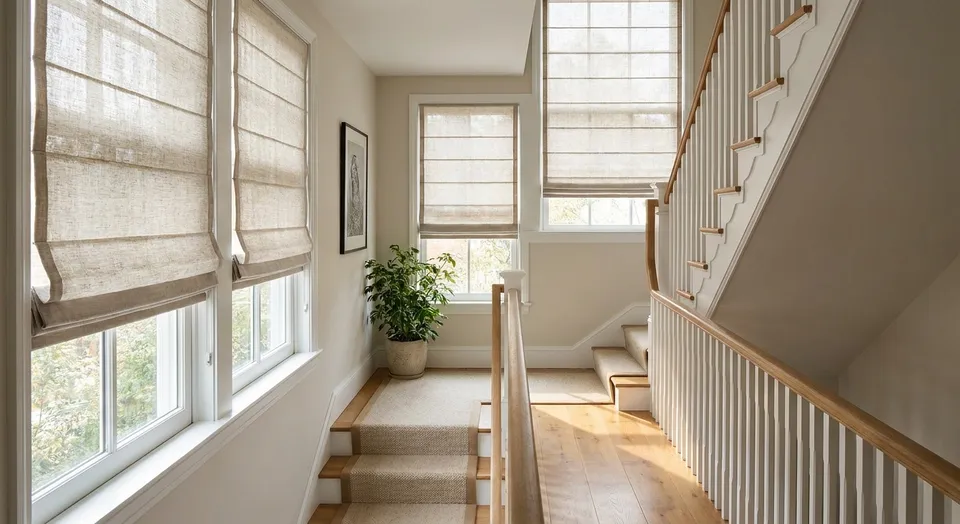
Stairwell and landing windows usually sit twelve to twenty feet above the nearest floor in two-story homes across Auburn, Bellevue, Tacoma, and Seattle, and that height dictates almost every choice for shades for stairwell and landing windows. From how the shade opens to whether you can safely reach it at all.
- Motorized roller shades win for stairwell and landing windows over 10 feet high, no ladder required. Buy.
- Skylight shades handle vaulted stairwell glass that a standard shade cannot reach. Consider.
- Motorized cellular shades cut heat loss along tall stairwell glass runs in Seattle-area homes. Buy.
- Drapery panels are the wrong call on a landing window you cannot reach safely. Skip.
- Zebra shades work fine on lower landing windows within arm's reach, six to nine feet up.
Why this matters
A stairwell window is not a bedroom window. You cannot stand on a chair next to an open staircase to pull a cord, and most homeowners in Auburn and the wider South King County area know it after one close call. Shades for stairwell and landing windows have to solve a reach problem before they solve a light problem.
That's why motorized shades for South King County homeowners show up so often on stairwell jobs, the motor removes the ladder from the equation entirely. Rainier Blinds measures and installs these with its own crew, not a subcontractor, which matters when a shade has to hang plumb over an open stairwell.
Who this is for
This guide is for homeowners in Auburn, Bellevue, Tacoma, or Seattle with a two-story or split-level layout where a window sits above or beside the staircase, a stairwell window that runs the full height of the wall, or a smaller landing window at the turn of the stairs. If you've been avoiding that window because reaching it means a ladder next to open stairs, this is the fix.
What to look for in shades for stairwell and landing windows
Motorization or extended-reach operation
Anything above nine or ten feet needs a motor, not a wand or a cord. A battery-powered or hardwired motor lets you raise and lower the shade from a remote or a wall switch, so nobody stands near the stairs to operate it.
Light filtering versus blackout
Stairwells often rely on that window for daytime light in a hallway with no other source. Full blackout fabric can turn a stairwell into a dark shaft during the day, so light-filtering fabric usually wins unless the window faces direct afternoon sun into a living space below.
UV-resistant fabric
Landing windows that face south or west take direct sun for hours with nothing to interrupt it. Fabric without UV protection fades and yellows within a couple of years on that kind of exposure. 2026 fabric lines from most manufacturers now build UV resistance into the base weave rather than as an add-on.
Correct mount type
Stairwell windows are frequently recessed, angled, or oddly proportioned compared to a standard bedroom window. An inside mount that works on a normal window can bind or gap on a stairwell frame that's out of square, which is common in homes built before the 1990s across South King County.
Smart home and remote compatibility
If you're already running a smart home hub, the shade should join it rather than operate as an island. Learning how to pair motorized shades with a smart home hub means the stairwell shade can open on a schedule or a voice command, which matters more here than on a window you walk past every day.
Energy loss at height
Tall glass panes lose heat fast, and a stairwell often sits against an exterior wall with less insulation than the rest of the house. A shade that traps a layer of air against the glass does more work here than a flat fabric panel.
Get a stairwell shade quote
Rainier Blinds measures tall and awkward windows in person before you buy.
Top picks for stairwell and landing windows
Motorized roller shades, the safe pick. A battery-powered or hardwired motor lifts the shade with a remote or a wall switch, which means nobody climbs a ladder twelve to twenty feet up next to open stairs. Roller shades also fold flat, so they don't add bulk to a narrow stairwell wall. Verdict: Buy.
Motorized cellular shades, the energy saver. The honeycomb cell structure traps a pocket of air directly against tall glass, which cuts the heat loss that stairwell windows are prone to during Puget Sound winters. Pair with the motorized lift and you get insulation without ever touching the shade by hand. Verdict: Buy.
Skylight shades for vaulted stairwells, the specialty pick. If the stairwell has a vaulted ceiling with glass set into the roofline rather than a wall, standard shades don't fit the geometry. Skylight shades for vaulted ceilings are built for angled tracks and motorized operation at heights a pole system can't reach. Verdict: Consider.
Zebra shades on lower landing windows, the wildcard. For a landing window at six to nine feet, still within reach with a wand, zebra shades let you alternate between sheer and opaque bands without a motor. They're a lower-cost option when the window isn't at full stairwell height. Verdict: Consider.
Drapery panels. The one to skip. Drapery needs a rod mounted at the top of the window and cords or a wand to draw the panels, both of which are impractical to install or operate safely on a window you can't reach without a ladder. Save drapery for windows at normal reach height. Verdict: Skip.
What to avoid
- Manual cord shades marketed as "long reach." A ten-foot extension pole on a stairwell window still means leaning over a staircase to hook the cord. It looks like a fix; it isn't one.
- Full blackout on a window that's your only daylight source. Blocking every bit of light in a stairwell with no other window makes the hallway dark all day, not just at night.
- Any shade sized without an in-person measurement. Stairwell frames are rarely perfectly square, and a shade ordered to a rough online estimate often binds or gaps at the edges once it's up twelve feet in the air.
Verdict comparison
| Product | Reach solution | Light control | Energy value | Verdict |
|---|---|---|---|---|
| Motorized roller shades | Remote/wall switch | Light-filtering to blackout options | Moderate | Buy |
| Motorized cellular shades | Remote/wall switch | Light-filtering, insulating | High | Buy |
| Skylight shades (vaulted) | Motorized, angled track | Light-filtering | Moderate | Consider |
| Zebra shades (landing) | Manual wand, arm's reach | Alternating sheer/opaque | Low | Consider |
| Drapery panels | Manual rod/cord | Blackout available | Low | Skip |
FAQ
What's the best shade for a stairwell window?
Motorized roller shades or motorized cellular shades are the best shades for stairwell windows in 2026 because a remote or wall switch removes the need to reach the window by hand. Cellular shades add an insulation benefit on tall glass that roller shades don't.
Should stairwell windows be motorized?
Yes, if the window sits above nine or ten feet, motorization is the practical answer since manual cords and wands require a ladder near open stairs. Below that height, a manual wand system on cellular or zebra shades works fine.
Are cordless shades safe for stairwell windows?
A manual cordless shade still requires reach. Motorization may make a high stairwell window easier to operate, but safe installation and maintenance access must also be planned.
Can skylight shades work on a stairwell with a vaulted ceiling?
Yes, skylight shades are built with angled tracks specifically for glass set into a vaulted roofline, which is common on open stairwells in newer South King County construction. They run on a motorized system since the glass is too high to reach with a pole.
How much light control do landing windows need?
Most landing windows do better with light-filtering fabric rather than full blackout, since the window often provides the only daylight in that part of the hallway. Full blackout makes sense only when the window faces direct afternoon sun into an adjoining room.
What mount type works best for angled stairwell windows?
Outside mount usually works better than inside mount on stairwell frames that are out of square, which is common in homes built before the 1990s. An in-person measurement settles this faster than guessing from a tape measure alone.
Do cellular shades help with heat loss near stairwell windows?
Yes, the honeycomb cell structure traps a layer of air against tall glass, which reduces the heat loss that stairwells are prone to in Puget Sound winters. This matters more on stairwell windows than standard windows because the glass area is often larger.
Is drapery a good option for stairwell windows?
No, drapery requires a rod and manual cords or a wand at the top of the window, which is impractical to reach safely on a true stairwell window. Drapery works better on landing windows at normal reach height.
One last thing
Most homeowners default to blackout fabric on a stairwell window because it feels like the "complete" option, but a landing window facing a shared side yard rarely needs it. Light-filtering fabric keeps the stairwell from going dark during the day while still killing the glare. Measure the actual sun exposure before picking the fabric, not the window's location in the house.