
Our available controls: Rainier Blinds offers Roman and woven wood shades with motorized operation only. All other shade styles are available with manual, motorized, or smart control. Your consultation confirms the controls and power options for your product.
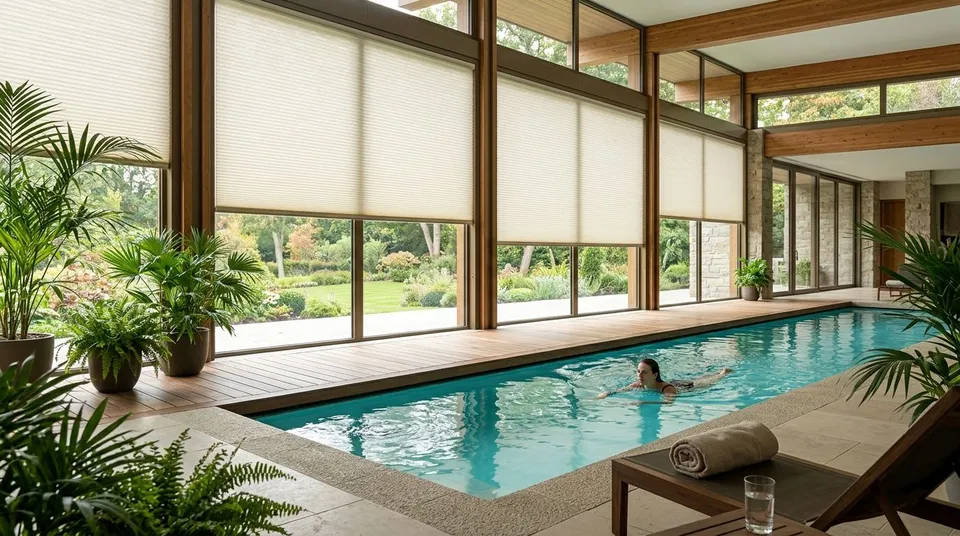
Indoor pool room shades are window coverings built to survive constant humidity, condensation, and chlorine vapor without warping, molding, or corroding within a year or two of installation. The difference between an indoor pool enclosure and a regular Seattle-area living room isn't occasional steam from a shower; it's sustained relative humidity that ASHRAE guidance for natatoriums pegs at 50-60% year-round, compared with the 30-50% typical in the rest of a home. That gap is why fabric roman shades and standard drapery fail fast in these rooms while other materials hold up for years.
- Vinyl-backed roller shades are the top pick for humidity resistant shades for indoor pools in 2026.
- Zebra shades in polyester weaves control glare off the water without absorbing pool room moisture.
- Skip fabric roman shades and standard drapery on pool-facing glass; sustained humidity warps natural and blended fibers.
- Skylight shades handle overhead glare in vaulted pool enclosures where fabric shades sag and stain.
- Rainier Blinds measures and installs moisture-rated shades across the Greater Seattle Area, manual through smart-motorized.
Why humidity resistant shades matter for indoor pool rooms
A regular bedroom or living room shade deals with occasional condensation on a cold morning. An indoor pool room deals with it constantly, plus chlorine off-gas that pits untreated metal hardware and a splash zone that soaks anything hanging within a few feet of the water. Materials that are fine everywhere else in the house are the wrong choice here.
The shades for pool house and cabana windows guide covers outdoor-adjacent pool structures; indoor enclosures have it worse because the humidity never gets a chance to vent outside. Wood and fabric-heavy treatments absorb moisture on a loop that eventually shows as cupping, discoloration, or mildew smell, even in a well-ventilated room.
Rule out moisture-trap materials first
Before shopping for anything, figure out what is already failing on the windows you have. This step is free and takes ten minutes with the shades already installed.
- Run a hand along the bottom rail of any fabric shade; tackiness or a musty smell means moisture has already worked in
- Check any slatted product for cupping, a warning sign that shows up before visible mold does
- Look at metal headrails and brackets for white or green corrosion spots, a chlorine off-gas signature
- Note which windows sit closest to the water line; those need the most moisture-resistant material regardless of the rest of the room
- Photograph anything already discolored so you have a baseline after a swap
Choose a vinyl-backed roller shade for splash zones
Vinyl and PVC-laminated roller shade fabrics are the standard answer for constant-humidity rooms because they do not wick water the way woven textiles do. In 2026 this is still the most reliable material on glass within splash range of an indoor pool.
- Wipe the fabric down weekly with a damp cloth instead of relying on airflow to dry it
- Pick a light-filtering or blackout vinyl weave depending on whether the room doubles as a media space at night
- Confirm the roller tube and brackets are rated for humid environments before installing over glass that fogs regularly
- Have Rainier Blinds measure during a free in-home consultation so shade width accounts for any swelling in the window frame itself, common in older Auburn and Kent-area additions
- Choose motorized operation if the shade sits over water and a manual chain would mean reaching across a wet deck
Add zebra shades for adjustable glare control
Zebra shades use alternating sheer and solid polyester bands, which gives pool rooms glare control without a fabric that holds humidity the way a heavier weave would.
- Test polyester swatches against the room's actual light angle, since pool rooms often have unusual glass orientation
- Use the sheer bands during swim hours for visibility across the water and the solid bands after dark for privacy
- Skip natural-fiber blends marketed as zebra shades; the polyester-only versions are the ones built for sustained humidity
- Pair zebra shades on one remote channel if the room has multiple large windows that should move together
Handle skylights and vaulted glass separately
Pool rooms with vaulted ceilings need a different approach than side windows because heat and glare stack from above.
- Check whether the skylight opens for ventilation, since that changes which shade track works
- Rule out exposed wood components overhead, because drips and condensation run downward first
- Review the skylight shades for vaulted ceilings guide before assuming a standard shade will reach a 12-15 foot pitch
- Choose remote or app-controlled lift for anything overhead; manual poles over a wet pool deck are a fall risk
- Confirm the fabric is rated for both UV exposure and humidity, since south-facing skylights over pools get both at once
Automate lift for wet-hands convenience
Manual shades near a pool mean pulling a cord or wand with wet, chlorine-covered hands, which shortens hardware life fast.
- Start with battery-powered motorization on the windows closest to the water before wiring the whole room
- Group multiple windows on one remote channel so a swim session does not turn into a five-minute shade routine
- Add a smart hub connection if the household already runs Google Home or Alexa elsewhere
- Set a schedule that closes shades automatically after dark instead of relying on someone to remember with wet hands
Protect hardware from chlorine corrosion
Chlorine vapor pits standard plated steel over time, and hardware is the part most homeowners forget to ask about.
- Ask directly about hardware material during the consultation; stainless and sealed composite brackets hold up far longer in chlorine air than standard plated steel
- Avoid exposed cord locks and metal chains directly over the water; choose cordless or motorized lift instead
- Rinse hardware with plain water monthly if the room is not well ventilated
- Have Rainier Blinds flag any bracket or bead chain that is not corrosion-rated before installation, not after rust appears
Comparison table: shade options for indoor pool rooms
| Option | Best for | Key limitation |
|---|---|---|
| Vinyl-backed roller shades | Splash zones and windows closest to the water | Fewer decorative patterns than standard roller fabrics |
| Zebra shades (polyester) | Adjustable glare control across the pool deck | Not ideal in direct splash range without a vinyl face |
| Moisture-resistant cellular shades | Insulating pool-adjacent windows against condensation | Honeycomb pockets trap moisture if never wiped down |
| Skylight shades | Overhead glass on vaulted pool enclosures | Requires motorized lift at height |
| Drapery or fabric roman shades | Sitting areas adjoining but outside the enclosure | Not recommended on pool-facing glass; absorbs ambient humidity |
The roller shades vs cellular shades comparison breaks the tradeoff down further if the room splits between a true splash zone and a drier lounge area.
“If a shade fabric feels damp an hour after pool use, it is the wrong material for that window.”
Common mistakes indoor pool room owners make
- Reusing fabric roman shades from another room. A shade that lasted a decade in a bedroom fails in a pool enclosure within a season because it was never rated for sustained 50-60% relative humidity.
- Ignoring the hardware spec. Homeowners compare fabrics carefully, then accept whatever bracket and chain comes standard, which is usually the first thing to corrode.
- Treating the shade as the ventilation plan. Even moisture-resistant material lasts longer with real air movement in the room.
- Running drapery wall to wall. Drapery belongs in an adjoining lounge; heavy panels soaking over a pool deck invite mildew faster than any shade material.
- Waiting for visible mold before replacing anything. By the time discoloration shows, the fabric backing and hardware have absorbed months of moisture.
Get a pool room shade consultation
Free in-home measure with real pricing on the spot, from our own crew.
FAQ
What are the best humidity resistant shades for indoor pools?
Vinyl-backed roller shades and polyester zebra shades hold up best in indoor pool rooms because they do not absorb moisture the way fabric roman shades or drapery do. Both work in 2026-built and older enclosures alike, as long as the hardware is corrosion-rated too.
Can I use regular fabric roman shades in a pool room?
Regular fabric roman shades are not recommended on pool-facing glass because sustained humidity near 50-60% causes warping and mildew over time. They work fine in an adjoining sitting area outside the enclosure.
Do motorized shades make sense for pool rooms?
Yes, motorized and smart shades cut the wear that comes from wet, chlorine-covered hands on manual cords and chains. They matter most on skylights and overhead glass where a manual pole over water is a fall risk.
What hardware resists chlorine corrosion best?
Stainless steel and sealed composite brackets resist chlorine vapor far better than standard plated steel. Ask specifically about hardware material during the consultation, not just fabric.
How is an indoor pool room different from a bathroom?
Bathrooms see humidity spikes that clear within an hour, while indoor pool rooms hold 50-60% relative humidity continuously. That constant exposure rules out several materials that perform fine in bathrooms.
Do zebra shades work well over a pool?
Polyester zebra shades work well for glare control across a pool deck because the material does not wick moisture the way natural-fiber blends do. Keep them out of direct splash range.
Can skylight shades handle pool room humidity?
Purpose-built skylight shades in moisture-resistant fabric handle vaulted pool enclosures, but they need motorized lift since manual reach over water is not practical. Confirm the fabric is UV-rated if the skylight faces south.
How often should pool room shades be cleaned?
Wipe vinyl or polyester shade fabric weekly to prevent the chlorine and moisture buildup that shortens fabric and hardware life. Rooms with weak ventilation need monthly hardware rinses as well.
One last thing
The detail most homeowners miss is not fabric, it is hardware: a shade rated for humidity hung on standard plated steel brackets will streak rust down the wall long before the fabric ever fails. Ask about bracket and chain material in the same breath as fabric during any 2026 consultation, not after the sale.