
Our available controls: Rainier Blinds offers Roman and woven wood shades with motorized operation only. All other shade styles are available with manual, motorized, or smart control. Your consultation confirms the controls and power options for your product.
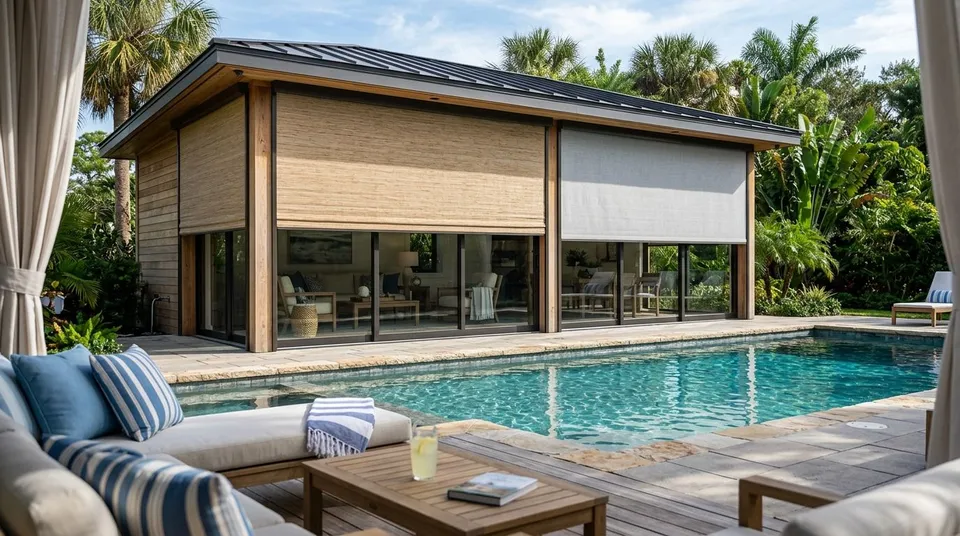
Shades for pool house windows in 2026 need to survive chlorine, standing humidity, and direct sun for months at a stretch without warping, staining, or seizing up on their tracks. A cabana or pool house is not a spare bedroom with a view of the yard: it is an exposed structure that gets wet, gets hot, and often sits open on one or two sides. The right shade choice depends on whether the space is fully enclosed with glass or open-air with screens, and on how much privacy the changing or shower area actually needs.
- Outdoor steel wire and zipper track shades hold up best on open-air cabana walls and sliding glass openings in 2026.
- Cellular shades are the right call only in a fully enclosed, climate-controlled pool house, never on an open-air structure.
- Solar and light-filtering roller shades are the default for pool house windows that need glare control without total blackout.
- Rainier Blinds measures and installs these lines across the Greater Seattle Area; it does not manufacture the shades itself.
Why this matters for pool house and cabana owners
A standard interior shade fabric will mildew, fade, or delaminate faster in a pool house than almost anywhere else in a home. Chlorinated pools are typically kept at 1 to 3 parts per million of free chlorine, and that chemical load lingers in the air around an enclosed cabana far longer than it does poolside outdoors. Add in outdoor roller shades rated for moisture exposure and you avoid the cupped, brittle fabric that shows up on indoor-grade shades within a season or two.
Heat is the other problem. Pool water is usually held between 78 and 82 degrees Fahrenheit for comfortable swimming, and an unshaded pool house glass wall facing west will run hotter than that by mid-afternoon most summer days. Summer UV index readings in Western Washington regularly hit 6 to 8 on July and August afternoons, enough to fade upholstery and warp wood trim inside an enclosed structure within a couple of seasons.
The build-out spine
The steps below run in the order that actually matters: structure type first, fabric second, operation third. Skipping ahead to motorization before nailing down fabric and mount just means redoing the work later.
Match the shade type to how open the structure is
A fully enclosed pool house with glass slider walls behaves like a sunroom. An open-air cabana with three sides screened or louvered behaves like a covered patio, and it needs a shade rated for direct weather exposure, not one built for indoor humidity tolerance.
- Open-air cabana with screened or open sides: steel wire or zipper track outdoor shades
- Enclosed pool house with insulated glass: cellular or solar roller shades
- Mixed structure with a covered lounge area and an enclosed changing room: different shade types for each zone, not one blanket choice
- Structure with a sliding glass door to the yard: a wider-format shade or drapery track sized for the full opening
- Structure under a deep roof overhang: lighter opacity fabric since direct sun exposure is already reduced
Choose fabric for chlorine, humidity, and UV exposure
Fabric choice is where most pool house shade projects succeed or fail. Vinyl-coated and solution-dyed fabrics resist the humidity swings and chemical residue that break down cotton-blend or paper-based shades within a year.
- Solution-dyed acrylic or vinyl mesh for outdoor-facing walls
- PVC-coated polyester for zipper track systems exposed to direct rain
- Mildew-resistant light-filtering fabric for enclosed pool house glass
- Avoid natural fiber woven wood shades on any wall that takes direct pool splash
- Ask specifically about a mildew-resistant or outdoor-rated fabric line before ordering, since not every supplier stocks one
A free in-home consultation is the fastest way to confirm which fabric options actually hold up in a specific structure's exposure. Rainier Blinds measures the space, walks through fabric samples rated for outdoor or high-humidity use, and gives real pricing on the spot rather than a mailed quote based on guesswork.
Decide between manual, motorized, and smart operation
Every product line here comes in three operation tiers: manual, motorized, and smart. Manual works fine for a low, easily reached window. Motorized and smart operation earn their keep on cabana walls that are 10 or 12 feet up, or on openings you want closed before a storm rolls in without walking outside.
- Manual chain or cordless lift for reachable, low openings
- Motorized shades for high transom windows or vaulted cabana ceilings
- Smart shades paired with a phone app or voice assistant for scheduling around pool hours
- Battery-powered motorized units where running new wiring to an outbuilding is impractical
- Wired motorized systems for a pool house already getting an electrical run for lighting or a heater
For a fully enclosed pool house that doubles as a home gym or lounge space, insulated cellular shades cut down on the heat gain that makes an all-glass room unusable by early afternoon in July and August.
Size shades for oversized cabana openings and slider doors
Pool houses and cabanas tend to have wider openings than a typical bedroom window: full glass walls, triple sliders, and transom windows above the door. Standard residential shade widths sometimes don't cover the full span without a center seam or a second unit.
- Measure the full slider track, not just the visible glass panel
- Confirm whether a single wide shade or two overlapping units suits the opening better
- Check headroom above transom windows before ordering a motorized headrail
- Account for exterior mounting brackets on open-air structures where there's no interior wall to fasten to
- Verify door swing clearance so a lowered shade doesn't catch on a hinge
Control privacy in a changing area or outdoor shower
A cabana with a changing nook or an attached outdoor shower needs opacity control that a living room shade doesn't. Shade opacity choices run from sheer light-filtering to full blackout, and picking the wrong end of that range either kills the daylight or leaves the space exposed to the yard.
- Blackout fabric for a changing room with a direct sightline from a neighboring yard
- Light-filtering fabric for a lounge area that just needs glare reduction
- Top-down bottom-up shades to keep the top open for light while covering the lower half for privacy
- Zebra shades for a room that needs to switch between open and closed multiple times a day
- Dual-layer setups for a space used both during the day and after dark
Protect furniture, flooring, and finishes from sun fade
Rattan furniture, teak trim, and painted siding all fade at different rates depending on UV exposure and material choice. The same logic that pushes homeowners toward UV-rated exterior finishes for a cabana's siding applies to the fabric on its windows: material picked for UV and moisture resistance outlasts material picked for looks alone.
- Solar shades with a tighter weave for direct south or west exposure
- Light-filtering fabric where some UV cut is enough but full blackout isn't needed
- Awning-style coverage on any wall with unshaded wicker or upholstered furniture
- Rotating or replacing high-exposure fabric panels every few seasons rather than the whole system
Plan for winterizing and off-season care
A pool house sits unused for stretches of the year in the Pacific Northwest, and shades left extended through wind and rain wear faster than ones retracted between uses.
- Retract outdoor shades fully during off-season months rather than leaving them extended
- Check motorized battery levels before the first warm weekend of the season
- Inspect zipper track channels for debris before the pool reopens each year
- Wipe down vinyl-coated fabric before storage to prevent mildew spots from setting in
Get a real quote for your pool house
Free in-home measure and consultation across the Greater Seattle Area.
Comparison: shade options for pool houses and cabanas
| Option | Best For | Key Limitation |
|---|---|---|
| Steel wire outdoor shades | Open-air cabana walls exposed to wind and splash | Not built for fully enclosed, climate-controlled rooms |
| Zipper track outdoor shades | Sliding glass openings that need a sealed edge | Requires solid mounting surface on both sides of the track |
| Solar roller shades | Enclosed pool house glass with glare and fade control | Doesn't fully block visibility from outside at night |
| Cellular shades | Insulated, climate-controlled pool house lounges | Poor choice for direct splash or open-air exposure |
| Woven wood roman shades | Enclosed, low-humidity cabana lounge areas away from splash | Natural fiber degrades faster near direct moisture |
Common mistakes pool house and cabana owners make
- Using indoor-rated fabric outdoors. A shade rated for a living room fades and stiffens within one Pacific Northwest wet season on an open cabana wall.
- Skipping motorization on hard-to-reach openings. A 12-foot vaulted cabana window with a manual chain lift often just gets left down all season because reaching it is a hassle.
- Choosing full blackout everywhere. A pool house lounge doesn't need the same opacity as a changing room, and full blackout on every window kills the daylight that makes the space usable.
- Ignoring the mount surface on open-air structures. Steel wire and zipper track systems need a solid frame to anchor to, and retrofitting that after the shade order goes in adds delay.
- Forgetting winterization. Shades left extended through fall storms wear out faster than ones retracted when the pool closes for the season.
FAQ
What's the best shade for pool house windows in 2026?
Outdoor-rated steel wire or zipper track roller shades are the best fit for open-air cabana walls in 2026, while solar or cellular shades work better on fully enclosed pool house glass. The right choice depends on how exposed the structure is to wind, splash, and direct sun.
Are cellular shades good for a pool house?
Cellular shades work well in a fully enclosed, climate-controlled pool house but are a poor fit for an open-air cabana exposed to splash and humidity. Their honeycomb structure traps air for insulation, which only pays off in a sealed room.
Do outdoor shades hold up against chlorine and humidity?
Vinyl-coated and solution-dyed outdoor fabrics resist chlorine residue and humidity swings far better than indoor-grade materials. Untreated natural fiber shades like standard woven wood degrade faster near direct pool splash.
Should pool house shades be motorized?
Motorized or smart shades make sense on high transom windows, vaulted cabana ceilings, or any opening you want to close before weather rolls in without stepping outside. A low, easily reached window can stay manual without losing much convenience.
What opacity should a pool house changing area use?
A changing area or attached outdoor shower typically needs blackout or near-blackout fabric for privacy, while a lounge area does better with light-filtering fabric that keeps daylight in. Top-down bottom-up shades let one window do both jobs.
Can the same shade fabric work on both an open cabana and an enclosed pool house?
No. Open-air structures need outdoor-rated fabric built for direct weather exposure, while enclosed pool house glass can use standard solar or cellular fabric meant for indoor humidity levels, not direct splash.
How often should pool house shades be replaced?
There's no fixed replacement schedule, but high-exposure fabric on south or west-facing walls typically shows fade and wear well before shaded or interior-facing panels do, so inspect those first each season.
Does Rainier Blinds install shades on pool houses and cabanas?
Rainier Blinds measures and installs outdoor and interior shade lines on pool houses and cabanas across the Greater Seattle Area, using its own installation crew rather than a subcontractor.
One last thing
The detail most pool house owners miss until year two: the fabric on a west-facing cabana wall wears out roughly twice as fast as the exact same fabric on a shaded east wall, because it takes the harshest UV window of the day, the late afternoon, at full strength. If the budget only stretches to upgrading one wall's fabric first in 2026, put it on the side that gets the most direct afternoon sun, not the side you happen to see first when you walk out to the pool.