
Our available controls: Rainier Blinds offers Roman and woven wood shades with motorized operation only. Available controls and power options for other products are confirmed at your consultation.
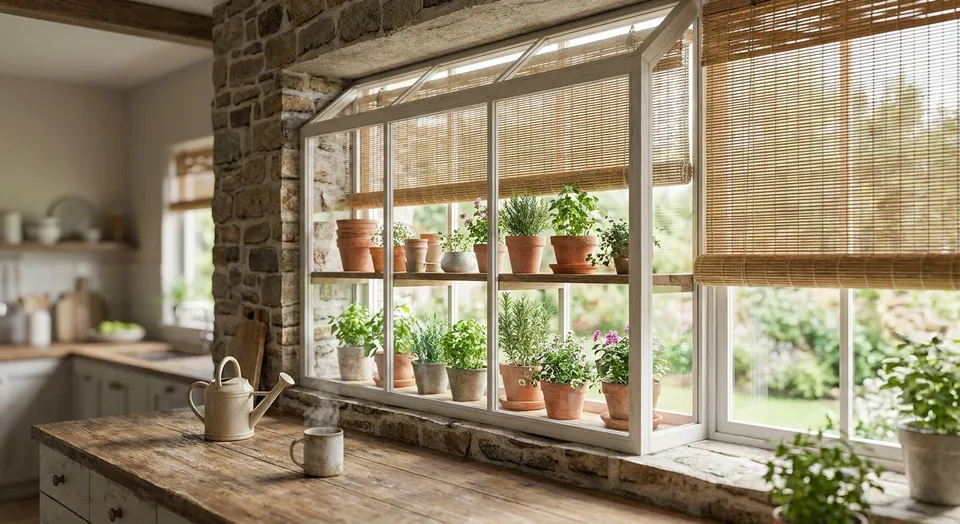
A garden window turns a kitchen sill into a mini greenhouse, three panes, a glass shelf, and full sun most of the day. Which means standard blinds either cook your herbs or fog up from the humidity. This guide breaks down which garden window treatments kitchen greenhouses actually need, and which ones will warp, mildew, or block light your plants need to survive.
- Cellular shades win for garden window treatments kitchen setups needing insulation without blocking plant light. Buy for north- and east-facing sills.
- Zebra shades are the pick when you need to toggle between full sun and filtered light throughout the day, best for south-facing greenhouse windows.
- Skip fabric roman shades and any wood-look blind on a garden window in 2026. Condensation from plants warps slats and mildews fabric within a season.
- Roller shades in a light-filtering fabric are the budget-friendly default for garden windows that just need glare control, not humidity management.
Why this matters
Garden windows sit closer to the glass than a standard double-hung window, and most have a depth of 12 to 18 inches with a shelf that holds pots directly against the pane. That proximity means whatever covers the window deals with condensation, soil splash, and direct heat all day, not just light control.
In 2026, more Seattle-area kitchen remodels are adding garden windows specifically for herb and succulent growing, and the treatments people default to, leftover mini blinds, fabric valances, aren't built for that environment. The material and mount decision matters more here than on any other window in the house.
Who this is for
This guide is for homeowners with a working garden window kitchen greenhouse. You're growing basil, tomatoes starts, or a windowsill succulent collection, and you need light control that doesn't fight the plants or fall apart from moisture. If your garden window is purely decorative with no live plants, standard kitchen window guidance applies and you have more flexibility on fabric weight.
What to look for in garden window treatments for kitchens
Moisture and condensation resistance
A garden window can combine sun, moisture, and limited clearance. Confirm that the exact fabric and hardware suit the actual conditions and ventilation; do not assume all polyester, cellular, or vinyl-backed products tolerate moisture.
Light control that doesn't starve the plants
Most greenhouse plants need 6+ hours of light daily, so a treatment that's opaque or heavily layered defeats the point of the window. Light-filtering fabrics that diffuse rather than block are the right call. Blackout fabric has no place on a garden window with live plants.
Mount compatibility with angled side panes
Garden windows have angled side glass in addition to the main front pane, and not every shade mounts cleanly on that geometry. Check the right mount type for custom blinds before ordering, an inside mount that works on a flat window can leave gaps on an angled garden window frame.
Heat buildup at the glass
Cellular shades trap insulating air and can help reduce heat transfer at a window. Results depend on the product, fit, glazing, climate, and how the shade is used; a specific energy or bill saving is not guaranteed.
Ease of cleaning
Soil dust and water spots land directly on whatever's mounted at a garden window. Smooth vinyl or polyester fabrics wipe clean; textured woven wood or heavy drapery traps grit and needs more maintenance than most homeowners want at a kitchen sink window.
Clearance for plant height
If pots or hanging plants sit tall on the shelf, a bottom-up shade or a top-down/bottom-up configuration lets you cover the upper glass for privacy while leaving the plant zone open to light. A standard top-down-only shade will shadow your plants every time you lower it.
Get a quote for your garden window
Measuring and pricing for garden window shades across the Greater Seattle Area.
Top picks for garden window treatments in kitchens
The moisture-proof pick, Cellular shades Cellular shades use a honeycomb cell that traps air and resists the humidity swings a garden window generates from daily watering. They come in light-filtering fabrics that still let plants photosynthesize, and the top-down/bottom-up option covers the upper glass without shading the plant shelf. Cellular shades hold up on north- and east-facing garden windows where condensation is worst. Buy.
The adjustable-light pick, Zebra shades Zebra shades alternate sheer and solid fabric bands on one roll, so a single pull adjusts from filtered daylight to more privacy without swapping treatments. On a south-facing garden window that gets harsh midday sun, that adjustability keeps plants from scorching in the afternoon. Zebra shades are the pick when sun exposure changes noticeably across the day. Buy.
The budget-friendly pick, Roller shades A light-filtering roller shade is the simplest solution when your garden window doesn't have a serious humidity problem and you just want glare control at the sink. They mount flat, clean with a wipe, and cost less than cellular or zebra options. Roller shades work fine for a garden window with mostly succulents and low watering frequency. Consider.
The decorative-only pick, Café-style valance A short valance across the top of the garden window adds a finished look without covering the plant shelf or interfering with light at all. It does nothing for privacy or heat, so it only works as a secondary layer over one of the shade options above, not a standalone solution. Consider as an add-on, Skip as your only treatment.
What to avoid
- Faux wood or real wood blinds. These aren't part of what Rainier Blinds installs, and for good reason on a garden window, moisture from soil and watering warps slats within a season regardless of brand.
- Fabric roman shades in cotton or linen. They look right in a kitchen photo but they absorb condensation and mildew faster than any other treatment on a garden window. If you want a roman shade elsewhere in the kitchen, check how to choose fabric for custom roman shades for moisture-resistant options first.
- Full blackout shades. Blocking all light defeats the point of a garden window with live plants and doesn't solve the humidity problem either. It just traps moisture behind an opaque panel.
Verdict comparison
| Treatment | Moisture resistance | Light control for plants | Mount flexibility | Verdict |
|---|---|---|---|---|
| Cellular shades | High | Light-filtering, top-down/bottom-up | Good on angled panes | Buy |
| Zebra shades | Moderate | Adjustable sheer-to-solid | Good on flat front pane | Buy |
| Roller shades | Moderate | Light-filtering only | Flat mounts best | Consider |
| Café valance | Low | None | Decorative only | Consider as add-on |
| Fabric roman shades | Low | Varies by fabric | Limited | Skip |
FAQ
What are the best garden window treatments for a kitchen greenhouse?
Cellular shades and zebra shades are the best garden window treatments kitchen greenhouses need in 2026, since both resist humidity and still let light through for plants. Fabric roman shades and wood blinds should be avoided due to moisture damage.
Do garden windows need blackout shades?
No, blackout shades work against a garden window's purpose because they block the light plants need to grow. Light-filtering fabrics on cellular or roller shades are the better call.
How do you stop mildew on garden window shades?
Choose vinyl-backed or polyester fabrics instead of cotton or linen, since those materials resist moisture from watering and condensation. Wiping the shade down weekly during peak growing season also helps.
Can motorized shades work on a garden window?
Yes, motorized cellular or zebra shades work well on a garden window when reaching over a plant shelf makes manual cords or wands impractical. A battery or hardwired motor avoids leaning over the plants to adjust the shade.
What mount type is best for garden window angled panes?
An outside mount frame typically handles the angled side glass on a garden window better than an inside mount, which can leave gaps at the corners. Measuring each pane separately matters more on garden windows than flat windows.
How much sun exposure do garden windows get compared to flat windows?
Garden windows get more direct sun per square foot because the three-sided glass catches light from multiple angles throughout the day. That's why light-filtering rather than blackout fabric works better for plant health.
Are roller shades good enough for a low-humidity garden window?
Yes, a light-filtering roller shade is a solid budget option when the garden window mostly holds succulents or low-watering plants that don't generate much condensation.
One last thing
The detail most homeowners miss on garden windows in 2026: the plant shelf itself blocks a chunk of a standard shade's drop, so a top-down/bottom-up configuration isn't a nice-to-have, it's often the only way to get privacy on the upper glass without dropping fabric straight into the pots. Measure the shelf height before you order, not after.