
Our available controls: Rainier Blinds offers Roman and woven wood shades with motorized operation only. All other shade styles are available with manual, motorized, or smart control. Your consultation confirms the controls and power options for your product.
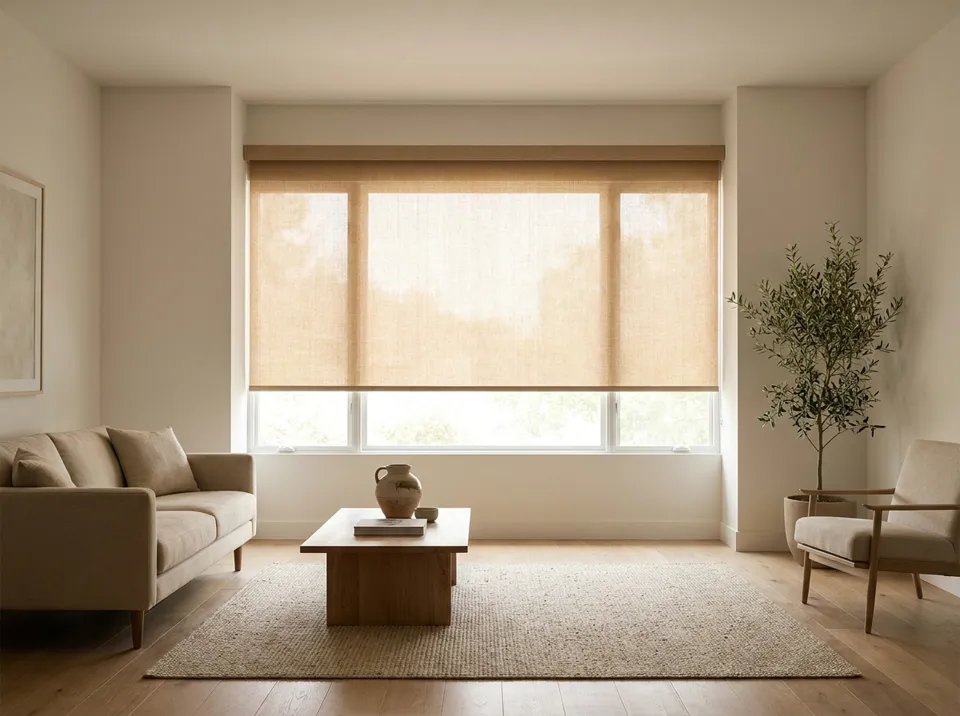
Roller shades in Auburn, WA are the simplest covering you can put on a window — one flat panel of fabric on one roller, one control — and the easiest to get wrong, because the fabric family, the mount, and the edges decide everything. This 2026 guide covers sunscreen vs light-filtering vs blackout fabric, inside vs outside mount, day/night dual rollers, motorized lift, and the trapezoid and arched windows that show up across South King County, plus how a local crew that measures on site, has every shade custom-made to your exact numbers by a wholesale supplier, and installs them keeps the line clean on frames that have settled out of square. Auburn is our home base, so scheduling and coverage details sit on the Auburn service area page.
TL;DR
- Roller shades Auburn WA buyers choose in 2026 for the cleanest line at the window and one-fabric light control.
- Sunscreen fabric keeps the view and cuts glare; light-filtering softens daylight; blackout darkens rooms when the edges are sealed.
- Outside mount beats inside mount on Auburn's settled older frames; inside mount suits newer square casings.
- Dual day/night rollers put two fabrics on one headrail for rooms that need view by day and dark at night.
- Rainier Blinds measures, has shades custom-made by a wholesale supplier, and installs with our own crew.
Key numbers
Why this matters
Auburn light is a moving target. Summer sunrise lands before 5:30 AM, the sky stays light past 9:00 PM in late June, and by November the sun is gone before 4:30 PM. A window covering that has to pick between "protect the room from the sun" and "let the daylight in" picks wrong for half of the day. Roller shades solve that with fabric choice rather than hardware: the same clean roller takes a sunscreen weave for a view window, a light-filtering fabric for a kitchen, and a blackout face for a bedroom.
The second reason this guide exists is fit. A roller shade is a flat panel, which means it shows every measurement error. Older Auburn housing stock — the 1970s ramblers and split-levels on Lea Hill, in Auburn Highlands, and around Lakeland Hills — has settled, and an opening can read a quarter inch different at the top than at the bottom. An inside-mounted shade cut to one width leaves a light wedge down one side, visible every sunny hour of the year. Newer construction along the valley floor runs square, deep casings where an inside mount looks clean. The mount decision is made window by window, on site, before anything is ordered.
One clarification buyers in 2026 still need: Rainier Blinds does not build the shades. We measure your windows with our own crew, the shades are custom-made to your exact measurements by an established wholesale supplier, and the same in-house team that measured installs them. That is what "custom" means here — exact fit and one accountable local crew, not a factory on the premises.
Who this is for
This guide is for Auburn and South King County homeowners who want the cleanest possible line at the window: living rooms with a view worth keeping, kitchens where fabric folds would collect cooking grime, home offices where glare hits a screen, and bedrooms that need dark at 5:00 AM in June. It also fits anyone replacing heavy drapery that never gets opened, or a mismatched pair of sheer-plus-privacy shades that never get operated in the right combination.
It is not for every taste. If you want soft fabric folds at the window, roman shades do that job and roller shades do not. If you want banded view-and-privacy control in one graphic product, zebra shades are the closer match. And for patios and decks, exterior fabric and hardware are a different product family entirely — this page covers interior glass only.
What to look for in roller shades for Auburn homes
Fabric: sunscreen, light-filtering, or blackout
The fabric family is the first decision, and it does more work than brand, color, or price:
- Sunscreen (solar) fabric: a tight woven screen that cuts glare and UV while keeping the view. Openness percentages in the 1-to-10 percent range are typical; lower numbers block more light and see-through less. The pick for view windows, west-facing rooms that take the low afternoon sun from October through April, and any glass where furniture or flooring fade is the concern.
- Light-filtering fabric: softens direct daylight into a diffuse glow and holds daytime privacy. The pick for kitchens, bathrooms, and rooms where you want brightness without the sun landing on you.
- Blackout fabric: a coated or laminated face that blocks roughly 99% of light through the fabric itself. The pick for bedrooms, nurseries, and media rooms — with the edge plan below, because the fabric alone does not close the room.
Ask which family a fabric belongs to during the measure visit, in plain words. A dark gray fabric that "dims nicely" in a showroom is not blackout, and under direct dawn sun on an east-facing window it will glow. There is no fabric that sort of blocks light; there is light-filtering, and there is blackout, and the sleeper room gets the second one.
Inside mount vs outside mount
An inside mount sits the roller inside the window frame. It is the cleanest look on square, deep casings — the newer construction along the valley floor — and it preserves the trim and sill. It also needs casing depth for the roller and brackets, and it does nothing about an out-of-square opening: a frame a quarter inch off shows a light wedge down one side.
An outside mount hangs the shade over the opening, overlapping the casing by an inch or two on each side and at the top. It covers a settled frame, forgives out-of-square openings, and lets the lowered shade overlap the glass so less light rims the edges. On Auburn's older housing stock, outside mount is the default recommendation in 2026 — not a downgrade, and often the more finished look across older trim.
Day/night: dual rollers on one headrail
A dual day/night shade stacks two fabrics in one cassette: typically a sunscreen or light-filtering roller in front and a blackout roller behind. Pull the front one for the daytime state, pull the back one at night, raise both and the window is bare. One cassette, one install, two jobs. It is the right product for a primary bedroom that wants a bright morning and a dark night on the same window, and for living rooms where the afternoon sun and the evening street view fight over the same glass. The blackout layer still needs its edge plan — an outside mount or side channels — because the front fabric does not change where light travels around the back one.
Cordless lift and motorization
Cordless lift is the 2026 baseline for any shade within reach of children or pets; dangling cords on a window are a documented strangulation hazard, and modern cordless rollers remove them entirely. Continuous-loop corded hardware still shows up on very wide or very tall drops — treat it as a skip unless the opening is fully out of reach.
Battery motors fit inside the roller tube, pair with a remote or phone app, and typically run 6 to 12 months per charge depending on daily cycles. Motorize the openings you operate from awkward positions: tall great-room glass, windows behind furniture, stairwell windows, and banks of clerestory windows. Hardwired motors suit new construction where electrical is already planned. Motorized schedules only hold when travel limits are set cleanly on install day, which is what the installing crew does before it leaves.
Measuring and odd shapes
The measurement discipline is three widths and three heights per window, ordered to the tightest usable number, with casing depth, window cranks, alarm sensors, and deep sills all noted before the order sheet is signed. Those obstacles never show up in a photo upload, and they all change bracket placement.
Roller shades also come in shapes most stock programs cannot do: trapezoid windows under cathedral ceilings, arched tops, and angled transoms. These are custom-made to the window's actual geometry by the supplier, which is exactly why a measure visit beats a chart — a stock size does not exist for a trapezoid, and a guess cannot be returned.
Top picks for Auburn and South King County
The view pick: sunscreen roller, outside mount
The living-room pick. A sunscreen roller cuts the glare and the UV while keeping the view of the yard, the valley, or the water. On a west-facing room it handles the low horizontal sun that defines Auburn afternoons from October through April. Buy for view windows and sun-battered living spaces. Custom-made to your exact measurements after an on-site measure, not cut from a stock chart.
The kitchen pick: light-filtering roller
The bright-room pick. Light-filtering fabric gives a kitchen or bathroom soft, private daylight with a flat face that wipes clean — no folds, no vanes, no dust traps. Buy for kitchens, bathrooms, and laundry rooms. Skip it in a room that needs dark; this fabric filters, it does not block.
The bedroom pick: blackout roller with side channels
The dark-room pick. A blackout roller in aluminum side channels is the tightest light seal you can retrofit onto a window, and the slimmest stack of any darkening product — the raised shade nearly disappears into the cassette. Buy for bedrooms, nurseries, and media rooms. Skip bare inside-mount blackout on any sleep-sensitive window in 2026.
The two-jobs pick: dual day/night rollers
The flexible pick. Sheer or sunscreen in front, blackout behind, one cassette, one control each. Buy for primary bedrooms and day/night living rooms instead of buying two separate products a year apart. Confirm casing depth at the measure visit — two fabrics need more stack depth than one.
The reach pick: motorized rollers
The access pick. Battery motors on tall glass, windows behind furniture, and multi-window banks remove the ladder and put the whole house on one remote or app. Consider for any opening you operate daily; motorization is an access and scheduling upgrade, not a light-control requirement. Budget the 6-to-12-month recharge cadence on high-cycle windows.
The shape pick: trapezoid and arched rollers
The hard-window pick. Cathedral-ceiling trapezoids, arched tops, and angled transoms get custom-made roller shades cut to the window's real geometry. Consider where a standard shade cannot cover the shape at all — which is most of the time on these windows.
What to avoid
Sunscreen or light-filtering fabric sold as blackout
A dim room is not a dark room. Under direct dawn sun, any uncoated fabric glows, and a sleeper who ordered darkness gets a gray room instead. Confirm the fabric's actual classification before the order sheet is signed.
Bare inside mounts on out-of-square frames
On a settled Auburn frame, an inside-mounted shade leaves a bright rail down one side and a glow line at the sill that no fabric weight fixes. Outside mount or side channels close the path. Decide it on measure day, not after the first sunrise.
Self-measure orders from online-only sellers
Custom roller fabric cut to uploaded numbers is rarely returnable, and a flat panel shows every measurement error at every daylight hour. Three widths, three heights, a depth check, and the crank and sensor notes are the rules a local crew already follows — which is why the quote includes the measure visit. A local measure costs less than one remake.
Verdict comparison
| Option | Best for | Key detail | Verdict |
|---|---|---|---|
| Sunscreen roller, outside mount | View windows, west sun | Cuts glare, keeps the view | Buy |
| Light-filtering roller | Kitchens, baths, laundry | Bright, private, easy-clean | Buy |
| Blackout roller + side channels | Bedrooms, media rooms | Tightest seal, slimmest stack | Buy |
| Dual day/night rollers | Rooms needing both jobs | Two fabrics, one headrail | Buy |
| Motorized rollers | Tall or behind-furniture glass | 6-12 month battery cycle | Consider |
| Trapezoid and arched rollers | Cathedral and transom shapes | Custom-cut to the geometry | Consider |
| Sunscreen fabric in sleep rooms | Bedrooms, nurseries | Glows at dawn | Skip |
| Self-measure stock shades | Settled older frames | Chart sizes, no remake | Skip |
How local measure, custom-make, and install works
We bring fabric samples to your home and help you choose the weave, opacity, and finish in your own light. Your shades are custom-made to your measurements by a wholesale supplier, and our local crew handles measuring and installation.
- Consult and measure: on-site, room by room — which rooms need dark, which need daylight, three widths and three heights per window, casing depth, and every crank or sensor noted.
- Quote on the spot: real pricing before we leave, on every window in the project, including edge-sealing hardware and any motorization. Standard rectangular windows start from $275, backed by a warranty of up to 5 years depending on package.
- Custom-made by the supplier: fabric and hardware built to your measurements, typically arriving 2 to 4 weeks after the order is confirmed.
- Install: usually one visit. Brackets leveled, side channels aligned, travel limits set on motors, and every shade operated before the crew leaves.
The free quote starts with a measure visit, not a showroom appointment. Coverage and scheduling details for Auburn jobs sit on the Auburn service area page linked above.
FAQ
What are the best roller shades for homes in Auburn, WA in 2026?
What is the difference between sunscreen, light-filtering, and blackout roller shades?
How much do roller shades cost in Auburn, WA?
Should roller shades be inside mount or outside mount?
Are roller shades good for bedrooms?
Can roller shades be motorized?
Does Rainier Blinds make the shades in-house?
How long does it take to get custom roller shades?
One last thing
The detail most homeowners miss is roll direction. On a standard roll, the fabric comes off the back of the tube and sits close to the glass — good for light control, but the roller stays visible and the fabric can rub a deep sill or a crank handle. A reverse roll brings the fabric off the front of the tube, hiding the roller and clearing cranks and handles, at the cost of a small gap between fabric and glass at the top. It is a 30-second question during the measure visit that changes how the shade looks and operates for the next 10 to 15 years — and it is one more reason a flat, simple product still deserves a professional measure in 2026.