
Our available controls: Rainier Blinds offers Roman and woven wood shades with motorized operation only. Available controls and power options for other products are confirmed at your consultation.
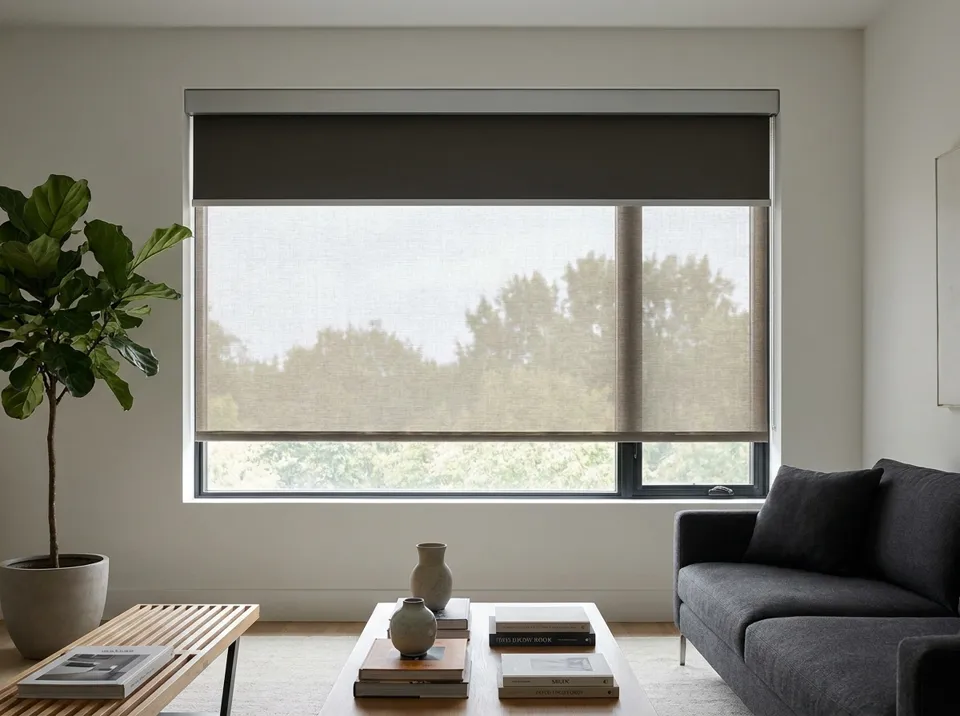
Dual shades in Auburn, WA run two fabrics on one window — a sunscreen roller for daytime glare and a blackout roller for true dark — on a single roller system you control with one lift. This 2026 guide covers how the two-layer setup works, where it beats a day/night cellular or a zebra shade, what cassette depth and mount type to check on South King County frames, and how Rainier Blinds measures, has shades custom-made to your exact measurements, and installs them with our own crew. The full range of roller, cellular, zebra, roman, woven wood, and drapery options sits on the custom window treatments page.
TL;DR
- Dual shades Auburn WA homes buy in 2026 pair sunscreen and blackout fabric on one roller system.
- Best pick for west- and south-facing living rooms that want the view by day and real dark at night.
- Day/night cellular wins when insulation matters most; zebra shades win when budget or casing depth is tight.
- Two fabric layers need cassette depth — shallow or out-of-square Auburn frames usually want an outside mount.
- Rainier Blinds measures on site, provides a quote for the selected options, and installs with our own crew.
Key numbers
Why this matters
Auburn gets both light problems in the same house. Summer sun clears the horizon before 5:30 a.m., and an east- or south-facing bedroom takes it straight through the glass. Then from roughly 4:00 p.m. into dinner, west-facing great rooms in Lea Hill, Lakeland Hills, and West Hill take glare hot enough to wash out a television and fade hardwood. One fabric rarely fixes both ends of that day.
Dual shades end the compromise. The front layer is sunscreen fabric: it cuts glare, holds daytime privacy, and keeps the backyard or street view sharp. Drop the second layer and the room goes genuinely dark for sleep or movie night. One window, one headrail, two fabrics with two separate jobs.
The trade is hardware, not light control. Two fabric rolls share one cassette, so the unit is deeper than a single roller and less forgiving of a bad measurement. On the older, out-of-square frames common across South King County, fit decides whether the system runs clean for fifteen years or binds by the second summer. That is why the measurement notes below matter as much as the fabric choice in 2026.
Who this is for
This guide is for Auburn and South King County homeowners choosing between dual shades and the rest of the lineup — roller, cellular, zebra, roman, or woven wood — for rooms with two distinct light jobs. It fits great rooms and dining rooms on west glass, home offices where the monitor matters, and bedrooms where you want blackout without giving up a bright daytime room.
It also fits buyers replacing a compromise gray fabric that does neither job well, or two separate shades stacked on one window. If a room needs only one state — open or closed — a plain roller shade does the same work for less, and the dual upgrade is wasted spend.
What to look for in dual shades for Auburn homes
How the two layers actually work
A dual shade runs two fabric rolls on one roller system. The front layer is usually a sunscreen or light-filtering fabric; the back layer is room-darkening or blackout. Stop at the first layer for daytime, run to the second for dark, or park anywhere between. Each layer raises independently, which is what separates a dual system from a single shade with two faces.
The details that decide daily satisfaction are the stops. The blackout stop should land flush at the sill, and the daylight stop should park the sunscreen exactly where your afternoon light problem starts. Ask the crew to demonstrate both stops from the room's real seating position during the measure visit, not just fully closed from the doorway.
Dual shades vs. day/night vs. zebra
Three products look similar and do different jobs:
- Dual shade: sunscreen plus blackout fabrics on one roller system. The pick when the daytime job is keeping a view — backyard, corner lot, golf-course window — while cutting glare.
- Day/night shade: sheer plus blackout layers on one headrail. The pick when soft filtered daylight matters more than a sharp view, and when cellular construction can add insulation on the same window. The day/night shades Auburn WA guide covers that pairing in full.
- Zebra shade: alternating sheer and opaque bands provide adjustable light and privacy. Rainier offers blackout zebra options; compare the selected fabric and mounting with a dual shade’s separate layers.
Pick dual when the view job is real and darkness is non-negotiable. Pick day/night when the room also loses winter heat and insulation matters. Pick zebra when casing depth or budget rules out a two-roll system and the room never needs full dark.
Cassette depth and mount type
Two fabric rolls need more casing depth than a single roller. An inside mount has to clear the cassette plus both fabric stacks, and shallow Auburn trim — common in 1970s ramblers and older West Hill homes — often forces an outside mount. Outside mount overlaps the casing by 2 to 3 inches per side and forgives out-of-square openings, which older Auburn frames supply in quantity. Decide mount type at the measure visit, never after the fabric is cut.
Light gaps matter more on a dual system because you run it through daytime positions every day. Side channels or a wider outside-mount overlap close the bright rails at the fabric edges. On street-facing windows, check the closed-state silhouette at night before locking the order.
Lift: cordless, motorized, or smart
Compare the package options for manual, motorized, and smart controls; your measured quote confirms the selected configuration. The final quote confirms the compatible motor, power supply, controller or hub, and supported features for your selected shade and home setup. Battery care and charging intervals depend on the exact equipment and use.
Motorize the openings you would otherwise stop adjusting: two-story great-room glass in newer Lakeland Hills builds, windows behind furniture, and stairwell landings. Set travel limits for both layers on install day so the daylight stop and the blackout stop each land exactly where your day happens.
Match the fabric pair to the room
Do not order one fabric pair house-wide. A sunscreen-plus-blackout dual is the right call for view-facing west rooms. A bedroom may want light-filtering in front and blackout behind instead. A guest bath or hallway may need only a single roller — spending on a second layer there buys nothing. Walk each room at the hour it fails before locking the order.
Top picks for Auburn and South King County
The great-room pick: dual roller on west- and south-facing glass
The view pick. Sunscreen in front keeps the backyard and the valley view sharp while cutting the 4:00 p.m. glare; the blackout back layer handles dinner through movie night. Buy this configuration for living rooms, dining rooms, and great rooms where the daytime view is worth keeping — the job no sheer fabric does as well.
The bedroom pick: dual with blackout back layer
The sleep pick. A dual shade gives a primary bedroom a bright daytime room and a genuinely dark room at night on one window. Choose the blackout back layer with a tight outside mount, and confirm the blackout stop from the bed, not the doorway, on install day. Buy for primary suites and nurseries — a shade that parks one inch short of full dark gets noticed every June morning for the next decade.
The office pick: sunscreen-forward dual on work glass
The workday pick. Home offices on west or south glass need the monitor readable all afternoon without closing the room off. A sunscreen front layer keeps the view during video calls, and the blackout layer handles evening overtime or media nights. Consider this when recurring screen glare is the failure and the room doubles as a living space after hours.
The retrofit pick: outside-mount dual on older Auburn frames
The fit pick. Shallow casing and settled, out-of-square frames are the two reasons dual shades fail on older stock. An outside mount with a proper cassette solves both and hides the light rails at the fabric edges. Buy the outside-mount configuration when the frame cannot accept the cassette depth — forcing a two-roll system inside a shallow frame causes binding and a proud headrail.
What to avoid
Self-measure kits for layered hardware. A dual shade has two chances to be the wrong size, and both show. Order numbers off a phone-app tape job and the front layer can sit clean while the back layer binds or leaves a bright rail. Older South King County frames measure different widths at top, middle, and bottom; a local crew takes three readings and orders to the tightest usable number. Custom-cut layered fabric ordered online is rarely returnable at full value.
One fabric pair for the whole house. Blackout in a noon living room feels cave-like, and sunscreen in a bedroom fights the 5:30 a.m. June sunrise. Match the pair to each room the way you would match opacity on single-fabric shades, and price the mixed package once instead of paying freight twice on a reorder.
Forcing a deep cassette into shallow casing. A two-roll cassette is deeper than a single roller. Shoving it inside a shallow frame causes binding, gaps at the stops, or a headrail that sticks proud of the trim. Outside mount is the correct answer when depth is the constraint; an upgraded shade on a bad mount is not a win.
Motorizing without a service path. A motor behind furniture or above a stairwell needs a reachable battery or reset point and a local crew that can return to set limits or replace it. Confirm labor coverage separately from product coverage before you sign.
Verdict comparison
| Option | Best for | Key spec | Verdict |
|---|---|---|---|
| Dual roller (sunscreen + blackout) | View-facing west rooms | View kept by day, dark by night | Buy |
| Dual with blackout back, bedrooms | Primary suites, nurseries | Bright day room plus true dark | Buy |
| Sunscreen-forward dual | Home offices | Monitor-readable all afternoon | Consider |
| Dual outside-mount retrofit | Older out-of-square frames | Cassette clears shallow casing | Buy when depth fails |
| Dual in a hall or guest bath | Rooms with one light job | Second layer buys nothing | Skip |
| Self-measure kit online | Out-of-square frames | Fixed chart widths | Skip |
How local measure and install works
We bring fabric samples to your home and help you choose the weave, texture, and finish in your own light. Your shades are custom-made to your measurements, and our local crew handles measuring and installation.
- Consult and measure: on-site, room by room, noting cassette depth, mount type, and obstacles such as cranks, locks, and deep sills.
- Quote on the spot: real pricing for the fabric pair, lift, and window count before we leave. Your measured quote confirms the selected product, fabric, controls, and installation scope.
- Our team measures the openings, arranges the custom order, and installs the selected treatments. We confirm the production and installation schedule for your project; motor setup and operation checks are included where applicable.
- Install: usually one visit. Motors get paired and travel limits set for both layers before the crew leaves.
Package warranties run 1 year on Standard, 3 years on Motorized, and up to 5 years on Smart. Scheduling details for home-base jobs sit on the Auburn service area page.
FAQ
What are dual shades and how do they work?
What are the best dual shades for Auburn WA homes in 2026?
How much do dual shades cost in Auburn, WA?
What is the difference between dual shades and day/night shades?
Are dual shades good for bedrooms?
Can dual shades be motorized?
Do dual shades fit shallow window frames?
How long does it take to get custom dual shades installed?
One last thing
The detail most Auburn homeowners miss is the daylight stop, not the blackout stop. Everyone checks full dark; almost nobody checks where the sunscreen layer parks for daily use. A daylight stop that sits half an inch off position leaves a visible fabric band across the window every afternoon for the next ten years.
Book the in-home quote while the afternoon sun is on the window — watching where the glare actually lands answers the dual-versus-single-shade question faster than any spec sheet.
Related guides
In-home consultations are free within 60 driving miles of Auburn. Farther projects are considered individually; any consultation fee is quoted before booking and credited toward your order.