
Our available controls: Rainier Blinds offers Roman and woven wood shades with motorized operation only. Available controls and power options for other products are confirmed at your consultation.
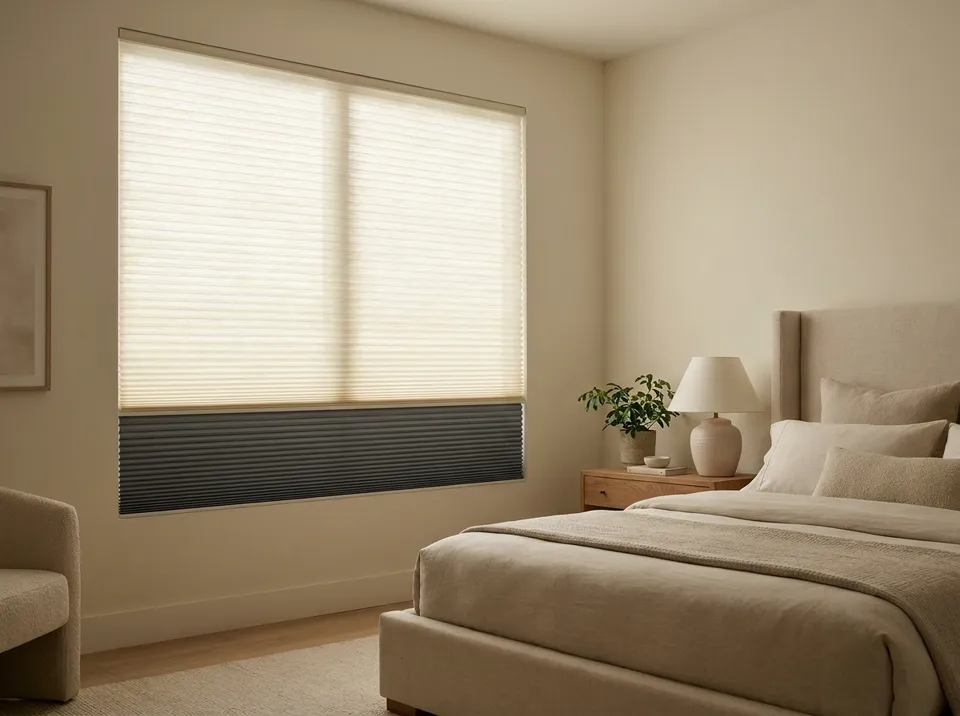
Day/night shades in Auburn, WA stack a sheer layer and a blackout layer on one headrail, so a room flips from bright daytime light to full dark without swapping products or fumbling with a second shade. This 2026 guide covers how the two-layer hardware actually works, where day/night beats a dual roller or a zebra shade, what to check on out-of-square South King County frames, and how Rainier Blinds measures, has shades custom-made to your exact measurements, and installs them with our own crew.
TL;DR
- Day/night shades Auburn WA homes buy in 2026 pair a sheer layer and a blackout layer on one shade.
- Cordless day/night cellular is the Buy for bedrooms; motorize tall great-room glass.
- Dual roller shades win when sunscreen-by-day plus true blackout-by-night is the real job.
- Rainier Blinds measures, has shades custom-made to your exact measurements by a supplier, and installs with our own crew.
Why this matters
Auburn gets both light problems in the same house. Summer sun clears the horizon before 5:30 a.m., and an east- or south-facing bedroom takes it straight through the glass. Winter sun sits low instead, and a west great room takes hard glare from mid-afternoon into dinner. A single-fabric shade forces a choice: blackout fabric that kills the view all day, or sheer fabric that leaves the bedroom bright at dawn.
Day/night shades end that trade-off. The sheer layer handles daylight, glare softening, and view. Drop the second layer and the room goes dark for sleep or movie night. One shade, one headrail, two jobs. Which is why day/night and dual setups have become the 2026 default for Auburn bedrooms and great rooms.
Layered hardware is also deeper hardware. Two fabric rolls need more casing depth than a single roller, and older West Auburn ramblers often run shallower trim than the catalogs assume. Fit decides whether the layers align cleanly or bind at the second stop. For rooms where the first job is insulation rather than light switching, compare the cellular shades Auburn WA guide before you commit to layered hardware.
Who this is for
Day/night shades fit Auburn and South King County homeowners who want one shade to cover two light jobs: a primary bedroom that needs full dark for sleep and daylight for dressing, a great room that needs glare cut at 3 p.m. and privacy after dinner, or a nursery where naps happen at random hours. If you currently run two separate shades on one window, or one compromise fabric that does neither job well. This guide applies.
It also fits buyers comparing day/night against dual roller and zebra hardware before ordering. It is not for renters hunting temporary stick-ons, and it is not a catalog of products outside the shade and drapery range Rainier Blinds measures and installs. Every option below is available manual, motorized, or smart across our package tiers.
What to look for in day/night shades for Auburn homes
How the two layers actually work
A day/night shade runs two fabric rolls in one cassette. The front layer is usually a light-filtering or sheer fabric; the back layer is room-darkening or blackout. You stop the shade at the first layer for daylight, run it to the second layer for dark, or park anywhere between. The mechanics are simple; the fit is not. Both layers share one cassette, so an out-of-square frame shows up twice, once per layer.
Ask to see the shade stopped at each layer during the measure visit, not just fully closed. A shade that aligns cleanly at the blackout stop but gaps at the daylight stop reads sloppy from across the room every single day.
Day/night vs. dual roller vs. zebra
Three products look similar and do different jobs:
- Day/night shade: sheer plus blackout layers on one system. The straightforward two-job pick. Most bedrooms and living rooms land here.
- Dual roller shade: sunscreen plus blackout fabrics on one roller system. The pick when the daytime job is view-keeping glare control on west and south glass, not just soft light.
- Zebra shade: alternating sheer and solid bands on a single fabric roll. Finer light dialing on one layer, but no true blackout fabric in the system.
Pick day/night when the room needs real dark at night and soft light by day on one product. Pick dual roller when the daytime job is preserving a view, a backyard, a corner lot, a golf-course window. Because sunscreen fabric keeps the view sharper than a sheer. Pick zebra when casing depth or budget rules out a two-roll system and the room never needs true blackout.
Full spec ranges for every product family live on the custom window treatments page.
Mount depth, cassette, and light gaps
Two fabric rolls need more casing depth than a single roller. Inside mount requires the cassette plus both fabric stacks to clear the frame; shallow Auburn trim often forces an outside mount. Outside mount overlaps the casing by 2 to 3 inches on each side and forgives out-of-square openings, which older West Auburn frames supply in quantity.
Light gaps matter more on a two-layer system because you run the shade through daylight positions every day. A cassette trims top light; side channels or a wider outside-mount overlap close the bright rails at the edges. Decide mount type at the measure visit, never after the fabric is cut.
Cordless vs. motorized lift
Cordless controls avoid exposed operating pull cords. Follow the product safety instructions and keep beds, furniture, and other climbing objects away from windows. Motorization can help on tall or obstructed windows. Recharge intervals depend on the selected motor, battery, shade size, use, and conditions. We confirm the charging method and access before ordering. App controls, scheduling, solar charging, hardwiring, or other power options must be confirmed for the exact product.
Motorize the openings you would otherwise stop adjusting: two-story great-room glass in newer Lakeland Hills builds, windows behind furniture, and stairwell landings. Set travel limits for both layers on install day. The daylight stop and the blackout stop should each land exactly where you want them.
Match each room's fabric job
Do not order one fabric pair house-wide. A blackout-backed day/night shade is the right call for bedrooms and media rooms. A sunscreen-plus-blackout dual roller is the right call for view-facing great rooms. A guest bath or hallway may need only a single light-filtering roller, spending on a second layer there buys nothing. Walk each room at the hour it fails before locking the order.
Top picks for Auburn and South King County
The safe pick: cordless day/night cellular for bedrooms
A day/night cellular configuration can combine light-filtering and blackout fabrics with insulating cells. Confirm the available configuration, controls, and mounting for your window. Follow product safety instructions and ask for the current order schedule.
Confirm the blackout stop from the bed, not the doorway, on install day. A shade that parks one inch short of full dark gets noticed every June morning for the next decade.
The great-room pick: motorized day/night for tall glass
The access pick. Two-story windows in Lakeland Hills and Lea Hill builds are exactly where a second layer earns its motor, nobody climbs a ladder at 9 p.m. to drop the blackout layer for movie night. Consider motorized day/night on any opening behind furniture or above a stairwell, and hardwire it when the build already has electricians on site. Motorization is an access upgrade; the fabric still does the light work when the shade is manual.
Smart-home support depends on the exact motor, controller, protocol, and hub. We confirm support for your preferred platform and the available features before ordering.
The view pick: dual roller (sunscreen + blackout) for west glass
The two-job pick. When the daytime job is keeping the backyard in view while cutting glare, sunscreen on the front layer beats a sheer. Buy a dual roller for west- and south-facing living rooms, dining rooms with a view, and home offices where the monitor matters. The blackout back layer handles evening. This is the configuration that replaced the compromise gray fabric in most 2026 Auburn quotes.
What to avoid
Self-measure kits for layered hardware
A day/night shade has two chances to be the wrong size, and both show. Order numbers off a phone-app tape job and the front layer can sit clean while the back layer binds or leaves a bright rail. Older South King County frames measure different widths at top, middle, and bottom; a local crew takes three readings and orders to the tightest usable number. Custom-cut layered fabric ordered online is rarely returnable at full value.
One fabric pair for the whole house
Blackout-backed day/night in a noon living room feels cave-like. A sheer-only pair in a street-facing bedroom silhouettes people at night. Match the layer fabrics to the room the way you would match opacity on single-fabric shades. Price the mixed package once instead of paying freight twice on a reorder.
Forcing a deep cassette into shallow casing
A two-roll cassette is deeper than a single roller. Shoving it inside a shallow frame causes binding, a proud headrail, or gaps at the stops. Outside mount is the correct answer when depth is the constraint. An insulated shade on a bad mount is not a win.
Verdict comparison
| Option | Best for | Key spec | Verdict |
|---|---|---|---|
| Cordless day/night cellular | Bedrooms, nurseries | Sheer + blackout + insulation | Buy |
| Motorized day/night | Tall great-room glass | Both layers on remote or schedule | Consider |
| Dual roller (sunscreen + blackout) | View-facing west rooms | View kept by day, dark by night | Buy when the view job is real |
| Zebra shade | Glare + privacy, shallow casing | One roll, no true blackout | Consider |
| Self-measure kit online | Out-of-square frames | Fixed chart widths | Skip |
How local measure, order, and install works
We bring fabric samples to your home and help you choose the weave, texture, and finish in your own light. Your shades are custom-made to your measurements, and our local crew handles measuring and installation.
- Consult and measure: on-site, room by room, noting mount type, casing depth, and obstacles (cranks, locks, deep sills).
- Measured quote: real pricing for fabric pair, layer configuration, lift, and window count. No showroom visit required, and basic installation is included free with every order.
- Production and installation timing depend on the selected fabric, hardware, supplier availability, and project scope. We confirm the current estimate for your order before you plan around a completion date.
- Installation: our team checks mounting and operation, sets motor travel limits where applicable, and shows you the controls. The number and timing of visits depend on the project.
Standard, Motorized, and Smart packages have 1-, 3-, and 5-year warranties respectively.Compare the package options for manual, motorized, and smart controls; your measured quote confirms the selected configuration. Product availability and the exact motor, power, controller, and smart features are confirmed in the quote; Roman and woven wood shades are motorized only.
FAQ
What are day/night shades and how do they work?
What are the best day/night shades for Auburn WA homes in 2026?
How much do day/night shades cost in Auburn, WA?
Are day/night shades good for bedrooms?
Day/night shades vs. zebra shades. Which is better?
What is the difference between a day/night shade and a dual roller shade?
Can day/night shades be motorized?
Does Rainier Blinds make day/night shades in-house?
One last thing
The detail most Auburn homeowners miss in 2026 is the daylight stop, not the blackout stop. Everyone checks full dark; almost nobody checks where the sheer layer parks for daily use. A daylight stop that sits half an inch off the aligned position leaves a visible fabric band across the window every day for ten years.
Have the crew demonstrate both stops from the room's real seating position and save each one as a motor travel limit or a pencil mark on the cassette. Two-layer shades earn their price only when both stops land exactly where your day actually happens.