
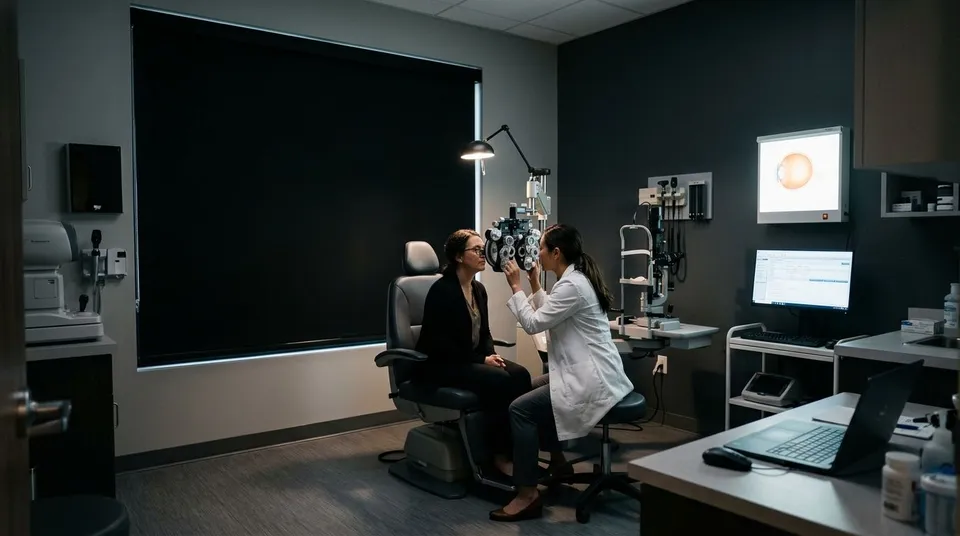
Blackout shades for optometry offices are commercial window treatments engineered to block outside light almost entirely, so retinal photography, OCT scans, and dilated pupil exams produce accurate readings instead of glare-skewed ones. A general medical waiting room can tolerate some ambient light. An exam lane running a slit lamp or fundus camera cannot, and that difference drives every decision below.
- Blackout shades for optometry offices need near-total light block, not just privacy or glare reduction.
- Motorized and smart operation cuts cross-contamination risk between patients compared to manual pull cords.
- Cellular blackout shades add insulation for equipment-heavy rooms; roller shades install faster and cost less to service.
- Rainier Blinds measures and installs blackout shades for South King County optometry and medical practices with an in-house crew.
Why blackout shades matter for optometry offices
An optometrist reading a phoropter or reviewing an OCT scan needs the room dark enough that stray daylight doesn't wash out contrast on the display or interfere with pupil dilation. Standard mini blinds or light-filtering roller shades leave a halo of light around the edges and through slat gaps, which is fine in a reception area and a problem in a diagnostic lane.
The fix is a shade rated for near-total blackout, mounted with side channels or a close-fit headrail so light doesn't leak around the frame. This is a narrower requirement than most commercial window treatment buyers face, and it's why a generic office fit-out often under-specs exam rooms.
Medical and dental office window treatments follow a similar logic: clinical accuracy and infection control drive the spec, not aesthetics. Optometry adds one more layer, since some rooms cycle between full daylight for patient intake and full blackout for imaging, sometimes within the same ten-minute appointment.
Update your light-control checklist per room
Not every room in a practice needs full blackout. Sort rooms into three tiers before you spec anything.
- Full blackout: OCT, fundus photography, visual field testing rooms
- Partial blackout with adjustable opacity: general exam lanes, phoropter rooms
- Standard light filtering: reception, billing, break rooms
Choose the right blackout fabric and mount
Blackout performance comes from the fabric's opacity rating and the mount, not the color alone. A dark charcoal fabric with a loose headrail still leaks light at the edges.
- Specify a true 100% blackout fabric, not "room darkening" or light-filtering
- Add side channels or reveal-fit brackets to close the gap between the shade and window frame
- Confirm the fabric doesn't off-gas or discolor under sustained fluorescent or LED exposure
- Match the headrail color to the wall or trim so the mount reads as built-in
Decide manual, motorized, or smart operation
Every blackout shade Rainier Blinds installs comes in three tiers: manual, motorized, and smart. For optometry, the choice usually comes down to how often staff cycle the shade during a shift and how many hands touch it.
- Manual: lowest upfront cost, fine for rooms used once or twice a day
- Motorized: wall switch or remote control, no cord to grab between patients
- Smart: app or schedule control, useful when the same shade needs to open for intake and close for imaging multiple times an hour
A busy optometry suite running back-to-back OCT appointments sees real value in motorized or smart shades: staff cycle the room without touching a wand or cord between patients, which matters in a clinical setting where hand contact with shared surfaces gets scrutinized.
Coordinate blackout timing with imaging equipment
Some diagnostic equipment has a warm-up or calibration cycle tied to ambient light conditions. Shades that open and close on a schedule reduce the chance a tech forgets to darken the room before a scan.
- Program smart shades to a schedule matched to typical scan block times
- Group all imaging-room shades on one control zone so a single command closes them together
- Keep a manual override switch in every room in case the automated schedule doesn't match a walk-in patient
- Test the full-close position monthly to confirm no light gap has developed
Plan for touchless or low-touch operation
Infection control policy in a clinical setting often prefers fewer shared touchpoints. A pull cord that ten patients grab in a day is a different proposition than a wall switch or app control nobody but staff touches.
- Wall-mounted switches instead of hanging cords in patient-facing rooms
- App control for staff-only operation from a front desk or tablet
- Cordless manual lift as the minimum standard if motorized isn't in scope for every room
Rooms that run comparable equipment cycles, like physical therapy clinics, face the same low-touch preference, and the same operation-tier logic applies there.
Schedule installation around clinic hours
A practice can't shut down for a week to get shades installed. Installation scheduling matters as much as the product spec.
- Book installation for a half-day or full closure day rather than working around patients
- Sequence rooms so imaging rooms go first if they're the priority
- Confirm lead time before booking a closure date, since custom blackout shades are made to order and don't sit on a shelf
Maintain shades to protect exam accuracy
Blackout shades in a clinical setting take more daily cycling than a home shade ever will. Maintenance keeps the seal tight.
- Wipe fabric monthly with a dry or lightly damp cloth, no harsh solvents near motorized components
- Check side channels for dust buildup that can create light gaps
- Test motorized shades quarterly for full-close alignment
- Replace worn brush seals on side channels before they start leaking light
Comparing blackout shade options for optometry offices
| Option | Best for | Key limitation |
|---|---|---|
| Manual blackout roller shades | Single-cycle rooms, tight budgets | Cord or wand touchpoint in patient rooms |
| Motorized blackout roller shades | High-cycle imaging rooms, low-touch policy | Needs power access or battery swaps |
| Smart blackout shades | Multi-room scheduling across a suite | Highest setup complexity of the three |
| Cellular blackout shades | Rooms needing extra insulation or noise dampening | Bulkier profile than a flat roller shade |
Verdict: motorized blackout roller shades are the strongest default for exam and imaging rooms in 2026 because they cut touchpoints without the added scheduling complexity of a full smart system. Practices running several imaging rooms off one workflow get more value from smart control; a single-room practice does fine with manual.
For a side-by-side on blackout performance across a wider range of commercial spaces, commercial screening and media room blackout shades covers the same fabric-and-mount tradeoffs from a different angle.
“If a blackout shade still leaks light at the edges after install, the mount is wrong, not the fabric.”
Common mistakes optometry offices make
- Specifying room-darkening fabric instead of true blackout. The two look similar on a swatch card but perform very differently under an OCT scan.
- Skipping side channels to save on install time. A headrail alone almost never seals a window completely; light creeps in at the jambs.
- Standardizing every room on manual cords. Reception can run manual all day; a room cycling patients every ten minutes needs a switch, not a wand.
- Ignoring equipment heat and glare together. A shade that blocks light but traps heat near a monitor or camera creates a second problem while solving the first.
- Booking installation during business hours. Custom blackout shades for a multi-room suite go in faster and cleaner during a scheduled closure than in stops and starts between patients.
Get exam room shades measured right
Free in-home consultation for South King County optometry practices.
FAQ
What's the best blackout shade for an optometry exam room?
A motorized blackout roller shade with side channels is the strongest default for exam and imaging rooms in 2026, since it seals light fully and removes the shared touchpoint of a pull cord. Single-cycle rooms like reception can use a manual version instead.
Do blackout shades fully block light for OCT and retinal imaging?
A true 100% blackout fabric mounted with side channels or reveal-fit brackets blocks light almost completely. Room-darkening or light-filtering fabrics, even in dark colors, still let light leak through the weave and around the edges.
Should optometry offices choose manual or motorized blackout shades?
Motorized shades make more sense for rooms cycling multiple patients per hour, since staff operate them from a wall switch instead of touching a cord between patients. Manual works fine for rooms used once or twice a day.
How is a clinical blackout shade different from a bedroom blackout shade?
A clinical blackout shade needs a tighter seal at the frame, since even a small light gap can affect imaging equipment accuracy. Bedroom blackout shades prioritize sleep comfort over the near-total seal a diagnostic room requires.
Can one blackout shade work for both patient intake and imaging in the same room?
Yes, as long as it's specified for full blackout with a fast-cycling operation type like motorized or smart control. A shade rated only for partial light filtering won't meet imaging needs even if it's convenient for intake.
How long does it take to install blackout shades in a multi-room practice?
Custom blackout shades are made to order, so lead time depends on the supplier and room count; scheduling installation around a half-day or full closure day keeps the disruption to patient flow minimal.
Do blackout shades need maintenance in a medical office?
Yes. Side channels collect dust that creates light gaps over time, and motorized units benefit from a quarterly full-close alignment check. Manual shades need less upkeep but still require the fabric wiped down periodically.
Are cellular blackout shades better than roller shades for exam rooms?
Cellular blackout shades add insulation and some noise dampening, useful in rooms with sensitive equipment or shared walls, but they carry a bulkier profile than a flat blackout roller shade and cost more to service.
One last thing
The detail practices miss most often isn't the fabric, it's the mount. A blackout shade rated for 100% opacity still fails in the field if it's hung with a standard headrail and no side channel, because light finds the half-inch gap at the window jamb every time. Rainier Blinds' in-house measure crew checks jamb depth and reveal on every optometry consultation specifically because that gap is what separates a shade that photographs well from one that actually blacks out an exam lane in 2026.