
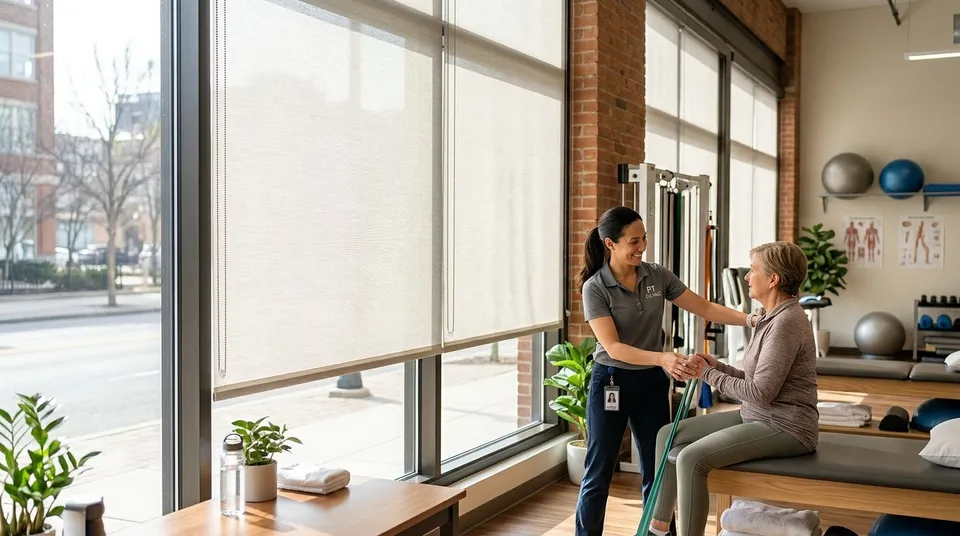
Window treatments for physical therapy clinics need to do three jobs at once: control glare on exam tables and screens, protect patient privacy in treatment bays, and hold up to daily foot traffic without turning into a dust trap. Roller shades, cellular shades, and light filtering shades cover most PT clinic windows better than drapery or open blinds, because they clean easily and don't interfere with equipment or exercise space.
- Cellular shades are the pick for treatment rooms that need quiet and stable temperature during 2026 clinic build-outs.
- Light filtering shades work best for open rehab floors and gyms with west-facing glass.
- Blackout shades belong only in rooms running dim-light modalities, not clinic-wide.
- Drapery is a poor fit for treatment bays because fabric traps dust in a clinical setting.
- Motorized operation removes cord entanglement risk near exercise equipment and treadmills.
Why window treatments matter for physical therapy clinics
A PT clinic isn't a living room. Patients stretch, balance, and lie on tables near the glass, and staff need sightlines that protect privacy without blacking out the whole space. Clinics with street-facing windows or ground-floor suites deal with a different problem than medical and dental offices: PT rooms often have larger open floor plans for gait training and stretching, which means more glass and more glare hitting mirrors and monitors during a session.
Heat gain matters too. A treatment bay running back-to-back sessions all day in 2026 can't afford a west-facing window turning the room into a greenhouse by 2 p.m. Cellular shades and light filtering shades cut solar heat gain without shutting out the daylight patients want during a rehab session.
Zone your clinic before you pick a treatment
The biggest mistake clinics make is choosing one window covering for the whole building. A reception desk, a private treatment room, and an open gym floor each need something different.
Audit each room by function, not by window size
- Reception and waiting area: light filtering shades that soften glare without making the room feel closed
- Private treatment rooms: cellular shades for insulation and quiet, or blackout shades if the room runs dim-light modalities
- Open rehab or gym floor: light filtering or zebra shades that let patients see outside while cutting hot spots
- Staff offices and charting stations: cellular shades for noise control near shared walls
- Covered patio or outdoor rehab space: steel wire or zipper track outdoor shades built for exterior use
Handle glare on screens and mirrors first
Ultrasound machines, e-stim units, and wall-mounted mirrors all wash out under direct sun. Fix this before anything else.
- Measure which windows get direct afternoon sun and flag those rooms first
- Choose a light filtering or solar-leaning fabric for rooms with screens
- Avoid sheer drapery near any screen-based equipment
- Test opacity levels against the actual glare angle, not just the room's general brightness
Match opacity to the treatment happening in the room
A stretching and mobility room needs different light than a room running traction or dry needling.
- Light filtering shades for general movement and stretching rooms
- Blackout shades only for rooms specifically running low-light modalities
- Zebra shades where a room switches between open and private use during the day
- Roller shades in low-traffic hallway windows and transom glass
Solve privacy without losing daylight
Patients on a treatment table near a street-facing window want privacy, not a dark cave.
- Zebra shades give adjustable privacy bands without full blackout
- Cellular shades in a light filtering weave hold privacy while keeping the room bright
- Top-down operation lets staff cover the bottom half of a window while keeping the top open for daylight
Build in noise control for shared treatment bays
Open gym-style rehab floors carry sound. Windows with hard surfaces bounce it right back into the room.
- Cellular shades cut sound transfer better than a bare roller shade, useful in shared bay layouts
- Layer heavier fabric weights on windows near hallways or waiting areas
- Keep noise-focused treatments away from the gym floor where equipment already dominates the acoustics
Pick fabric that survives daily cleaning
A clinic isn't a house. Hands, equipment, and cleaning staff touch these windows constantly.
- Choose wipeable, antimicrobial-friendly fabrics over raw natural weaves
- Skip drapery in any room with direct patient contact
- Confirm the fabric holds up to repeated cleaning without fading or stiffening
Decide between manual, motorized, and smart operation
Rainier Blinds shades come in three operation tiers: manual, motorized, and smart. Clinics benefit from moving past manual in high-traffic rooms.
- Manual works fine for small offices and low-traffic hallway windows
- Motorized shades remove cords near exercise equipment, treadmills, and parallel bars, an actual safety issue in a rehab gym
- Smart shades on a schedule adjust automatically as sun angle shifts through the day, useful for clinics open early morning through evening
Comparison: window treatment options for PT clinics
| Option | Best for | Key limitation |
|---|---|---|
| Roller shades | Reception desks, hallway windows | Less sound and temperature control than cellular |
| Cellular shades | Treatment rooms needing quiet and steady temperature | Costs more than roller shades for large window walls |
| Zebra shades | Rooms that switch between open and private use | Sheer bands still pass some light even fully closed |
| Light filtering shades | Open gym floors, rehab areas with big glass | Not blackout, some rooms still get bright spots |
| Blackout shades | Dim-light modality rooms only | Feels closed off if used clinic-wide |
| Drapery | Reception lobby softening | Harder to keep clean than shades in a clinical setting |
| Outdoor shades (steel wire/zipper track) | Covered patios used for outdoor exercises | Not built for interior treatment rooms |
Get your clinic measured right
On-site consultation and installation by Rainier Blinds' own crew, not a subcontractor.
Common mistakes PT clinics make with window treatments
- Installing drapery in treatment bays. Fabric panels trap dust and are harder to launder than a wipeable shade, a real problem in a room patients touch daily.
- Using corded coverings near exercise equipment. Cords near treadmills, parallel bars, and stretch stations create an entanglement risk that motorized or cordless shades avoid entirely.
- Blacking out the whole clinic. Full blackout in reception and open gym areas makes the space feel clinical in the wrong way. Save blackout for rooms that actually need dim light.
- Ignoring street-level sightlines. Ground-floor clinics near parking lots often skip privacy planning for treatment rooms until a patient complains.
- Treating every window the same. A clinic with five room types needs at least two or three shade specs, not one blanket order.
FAQ
What window treatments work best for physical therapy clinic waiting rooms?
Light filtering shades work best in PT clinic waiting rooms because they cut glare and heat without making the reception area feel dark or closed off. Roller shades are a lower-cost option for smaller waiting room windows.
Should physical therapy clinics use blackout shades in treatment rooms?
Only in rooms running dim-light modalities like dry needling or specific e-stim setups. Most general treatment and stretching rooms do better with light filtering or cellular shades that keep daylight in the room.
Are motorized shades worth it for PT clinics?
Yes, especially in rooms with exercise equipment where cords create a tripping or entanglement risk. Motorized shades also let staff adjust light across a large open gym floor without walking to each window.
How do you keep window treatments clean in a healthcare-adjacent clinic?
Choose wipeable, tightly woven fabrics over raw natural weaves or drapery. Shades hold up better than fabric panels because staff can wipe them down between cleanings.
What is the best window covering for a gym-style rehab floor with big windows?
Light filtering or zebra shades work best on open rehab floors because they cut hot spots and glare while keeping the room bright enough for movement and gait training.
Do physical therapy clinics need window treatments for patient privacy?
Ground-floor and street-facing clinics do, particularly in private treatment rooms. Zebra shades or top-down cellular shades give privacy on the lower half of a window while keeping daylight up top.
Can outdoor shades be used for clinics with covered patio rehab space?
Yes, steel wire or zipper track outdoor shades are built for exterior conditions and work well on covered patios used for outdoor balance or gait training.
How much natural light should a PT treatment room have?
Enough to see clearly during exercises without glare on screens or mirrors, which usually means light filtering rather than full blackout in most treatment rooms.
One last thing
The clinics that get window treatments wrong almost always order one product for the entire building. A PT clinic in 2026 usually needs at least two specs: something with real privacy and quiet for treatment rooms, and something brighter and more open for the gym floor and reception. Zoning the order by room function, not by window count, is the difference between a clinic that looks put together and one that feels randomly assembled.