
Our available controls: Rainier Blinds offers Roman and woven wood shades with motorized operation only. All other shade styles are available with manual, motorized, or smart control. Your consultation confirms the controls and power options for your product.
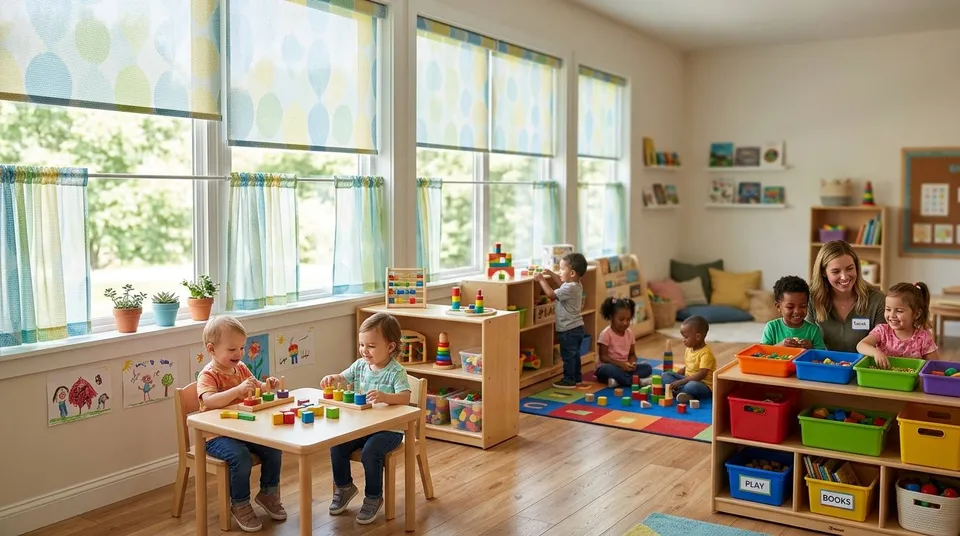
Window treatments for daycare centers are shades and drapery specified for licensed childcare spaces, chosen to eliminate cord and strangulation hazards, control glare during nap time, and hold up to daily wipe-downs from small hands. A daycare's needs differ from a living room: cord safety isn't a preference, it's a licensing checkpoint, and the fabric has to survive juice spills and marker streaks without staining.
- Window treatments for daycare centers should be cordless cellular or roller shades, never corded blinds.
- Blackout cellular or roman shades handle nap rooms; light filtering roller shades suit classrooms and activity spaces.
- Rainier Blinds installs cordless manual and motorized shades in licensed centers across the Greater Seattle Area.
- Vertical blinds, shutters, and corded products fail most childcare cord safety checks before installation is even done.
Why window treatments matter for daycare centers
A licensed childcare room gets more window contact per square foot than almost any residential space. Kids climb toward windows, pull on anything within reach, and staff need to see outside and inside the room at the same time for supervision. That combination rules out a lot of standard window covering, not because it looks wrong, but because it fails on safety and durability the first week.
The window covering industry's own safety standard shifted to cordless as the default for stock products back in December 2018, and licensing inspectors in childcare settings check for exposed cords as a matter of course. A center that installs corded blinds is signing up for a re-inspection. The safe move is cordless from the start, whether that's a cordless lift system on a manual shade or a motorized shade with no cord at all.
Confirm your cord safety requirement first
Before picking a fabric or color, settle the operating system. This is the one decision that can't be undone cheaply after install.
- Rule out any corded lift, chain loop, or wand with an exposed pull
- Check that any looped cords sit fully enclosed or are eliminated entirely
- Ask whether the room serves infants, toddlers, or school-age kids, since inspection scrutiny tightens for younger age groups
- Confirm the same standard for every window in the room, not just the ones kids can currently reach
- Document the cordless spec in writing if a licensing renewal is coming up
Match opacity to each room's function
A daycare rarely needs one opacity level for the whole building. Nap rooms, classrooms, and hallways all want something different.
- Use blackout or near-blackout for dedicated nap rooms so different sleep schedules don't fight the daylight
- Choose light filtering for classrooms and activity rooms so staff keep a clear sightline without full glare
- Reserve sheer or lighter light filtering for hallways and entry areas where supervision matters more than privacy
- Test the fabric against afternoon sun exposure on south and west facing rooms before ordering the whole building
- Avoid full blackout in rooms where staff need to see outside for pickup and drop-off monitoring
Choose fabric that survives daily wipe-downs
A daycare window covering gets touched, sneezed on, and wiped down more in a month than a home window sees in a year. Fabric choice decides whether it still looks clean in year two.
- Pick a wipeable, stain-resistant fabric over anything textured or absorbent
- Skip fabrics that show water spotting, since juice and hand sanitizer both hit windows regularly
- Ask about antimicrobial or easy-clean fabric coatings before committing to a specific shade line
- Confirm the fabric doesn't fray or fade after repeated cleaning with standard disinfectant wipes
Handling this on your own with off-the-shelf shades from a big-box store works for a single small window, but a full center with a dozen or more openings across different room types is where Rainier Blinds earns its keep. The crew measures every window in the building, flags which rooms need blackout versus light filtering, and installs cordless cellular shades, roller shades, or zebra shades room by room instead of one generic product across the whole floor plan.
Decide where motorized operation earns its keep
Motorized shades solve a specific daycare problem: staff shouldn't be reaching over cribs or climbing on furniture to adjust a shade mid-nap.
- Put motorized control on nap room windows so staff adjust light without entering a sleeping room
- Consider motorized for any window above 6 feet or behind furniture that blocks a manual wand
- Group multiple windows on one remote or wall switch in larger classrooms to cut down on staff time
- Skip motorized on small, easily reached windows where manual cordless operation is simpler and cheaper to maintain
Plan for high and hard-to-reach windows
Daycare buildings often have transom windows, skylights, or clerestory glass above eye level, especially in converted commercial spaces.
- Use skylight shades on any overhead glass instead of leaving it uncovered and glare-prone
- Specify motorized lift for any window a step ladder would be needed to reach
- Check egress code on any window marked as a fire exit before covering it with anything that blocks quick opening
- Flag arched or trapezoid windows early since they need custom measurement, not stock sizing
Budget for replacement cycles, not just install day
Childcare centers replace window coverings faster than homes do. Plan the ongoing cost, not just the first invoice.
- Expect fabric shades in high-traffic rooms to need replacement sooner than in a typical home
- Ask your installer what a single-panel replacement costs versus a full room re-order
- Keep one or two spare fabric swatches on file so a replacement matches the rest of the room
- Build a walk-through into your annual facilities budget instead of waiting for a licensing flag
Comparing window treatment options for daycare centers
| Option | Best for | Key limitation |
|---|---|---|
| Cordless cellular shades | Nap rooms and windows needing insulation and blackout | Fabric needs regular wipe-downs in high-touch rooms |
| Cordless roller shades | Classrooms and activity rooms needing light control | Less insulating than cellular shades |
| Zebra (dual layer) shades | Rooms that switch between privacy and open light through the day | Alternating stripes show buildup of dust faster than solid fabric |
| Motorized shades | High or hard-to-reach windows, nap rooms | Higher upfront cost than manual operation |
| Drapery | Common areas and entry lobbies wanting a softer look | Not ideal for rooms needing wipeable, stain-resistant surfaces |
Verdict: cordless cellular shades win for nap rooms in 2026 because they combine blackout capability with no exposed cord, and motorized operation is worth the extra cost anywhere staff would otherwise need a ladder.
“A window treatment that needs a warning label for cord safety already failed the childcare test.”
Common mistakes daycare centers make with window treatments
- Choosing corded blinds because they're cheaper upfront. The re-inspection cost and forced replacement erase the savings fast.
- Installing blackout in every room. Full blackout in classrooms kills the sightline staff need for supervision during the day.
- Picking a textured or absorbent fabric. It looks fine at install and shows permanent stains within a few months of daily wipe-downs.
- Covering egress windows without checking fire code. A shade that blocks quick opening on a marked exit window is a compliance problem waiting to surface.
- Skipping motorized operation on high windows. Staff end up avoiding adjustment altogether, which defeats the purpose of the shade.
Get a childcare shade consultation
Free in-home measure and cordless shade recommendations for your center.
FAQ
What is the best window treatment for a daycare center?
Cordless cellular or roller shades are the best window treatments for daycare centers in 2026 because they eliminate exposed cords and hold up to daily cleaning. Blackout versions work for nap rooms, light filtering versions work for classrooms.
Are corded blinds allowed in licensed daycare centers?
Corded blinds with an exposed pull or loop typically fail childcare licensing inspections and should be avoided. Cordless shades or motorized shades remove that risk entirely.
Do daycare centers need blackout shades in every room?
No, blackout works best in dedicated nap rooms only. Classrooms and activity rooms need light filtering shades so staff keep a clear sightline for supervision.
How often do daycare centers need to replace window shades?
High-traffic rooms wear out fabric shades faster than a typical home, so centers should budget for replacement cycles as part of annual facilities planning rather than waiting for visible damage.
Is motorized operation worth it for a childcare center?
Motorized shades are worth the extra cost on nap room windows and any window above 6 feet, since staff avoid reaching over cribs or using a ladder. Small, easily reached windows do fine with manual cordless operation.
Can window treatments cover egress windows in a daycare?
Any window marked as a fire exit needs to stay quick-opening, so check local egress code before covering it with a shade that could block fast access.
What fabric holds up best in a childcare setting?
A wipeable, stain-resistant fabric outperforms textured or absorbent materials in daycare rooms, since juice spills and hand sanitizer hit windows daily.
One last thing
The detail most centers miss until a licensing visit flags it: cordless doesn't just mean no pull cord, it means no accessible loop anywhere on the shade, including the back of a lift system. Check the full mechanism, not just the front-facing wand, before signing off on any install in 2026.