
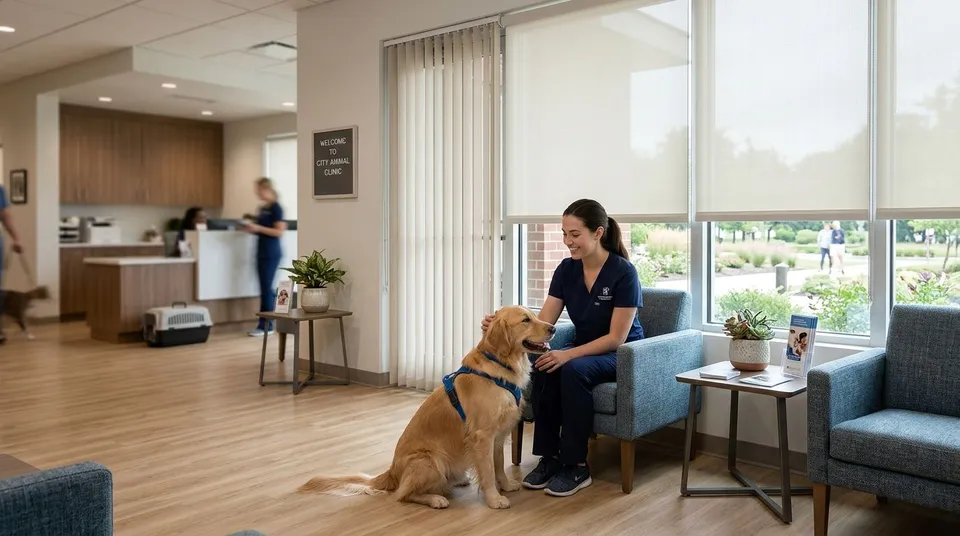
Blinds for veterinary clinics sound like the obvious search term, but slatted blinds trap fur, dander, and disinfectant residue in ways shades never do, and most clinics that install blinds in 2026 end up tearing them out within a year. This guide breaks down which shade types actually hold up in an animal hospital setting, room by room, and how to spec them without guessing.
- Blinds for veterinary clinics trap fur and dander in slat channels; wipeable shades do not.
- Cellular shades cut noise in kennel and boarding rows; blackout shades control glare in surgery suites.
- Rainier Blinds measures and installs custom shades across exam rooms, lobbies, and surgery suites in 2026.
- Zebra shades give lobbies adjustable privacy without the cord loops pets can reach.
- Motorized shades remove pull cords entirely, closing the biggest safety gap in a room with animals.
Why shade choice matters for veterinary clinics
An animal clinic runs a different window covering brief than a house does. Exam rooms get wiped down with disinfectant several times a day, kennel and boarding rows need noise control for anxious animals, and surgery suites need near total light block regardless of the hour. Horizontal slat blinds collect fur and dander in the routing holes and along the top rail, and any exposed cord near a cage or carrier is a chew and strangulation risk for an unrestrained animal.
Shades solve most of that by design. A flat, continuous fabric surface wipes clean in one pass instead of slat by slat, and cordless or motorized lift systems keep operating hardware away from paws and teeth. Rainier Blinds measures and installs custom shades across the Puget Sound area, and animal clinics show up in that work more each year as owners realize blinds are the wrong tool for a room with fur, claws, and constant disinfecting.
Medical clinics wrestle with a similar brief: wipe downs, privacy between patients, and glare control. If you also manage a clinical retail space, the same logic applies in medical and dental office window treatments.
“If slats can trap fur, they do not belong in an exam room.”
Map light and privacy needs room by room
Start with a room by room list before touching fabric samples. Every clinic room has a different job, and the shade spec should follow the job, not a single default.
- Lobby and reception: light filtering for privacy without full blackout
- Exam rooms: quick adjust privacy for owner conversations and procedures
- Surgery and treatment suites: full blackout to control glare on monitors and surgical lighting
- Kennel and boarding rows: daylight control to keep circadian rhythm consistent for boarded animals
- Records and office areas: standard light filtering, no special hardware needed
Rule out anything with slats or exposed cords
This is the step most clinics skip, and it is the one that causes the callback a year later. Slats and loose cords do not survive daily animal contact.
- Skip aluminum and horizontal slat blinds entirely; fur and dander collect in the slat channels
- Skip vertical blinds in exam rooms; the vanes catch on carriers, leashes, and cone collars
- Choose flat panel shade fabric that wipes down without disassembly
- Choose cordless or rear cord lift systems so no loop hangs within reach of a kennel or cage
- Daycare and childcare centers face the same cord safety question with kids instead of pets, covered in daycare and childcare center window treatments
Pick a shade type built for a clinical environment
Once slats and cords are ruled out, the manual research is basically done, and this is where Rainier Blinds' shade lineup becomes the faster path.
- Roller shades in a wipeable, stain resistant fabric for exam rooms and hallways
- Cellular shades for kennel and boarding rooms; the honeycomb structure adds sound dampening
- Zebra shades (dual layered) for the lobby, alternating opaque and sheer bands adjust privacy without full blackout
- Blackout shades for surgery and treatment suites where monitor glare and light spill matter
- Light filtering shades for records and office areas that need daylight but not a fully dark room
Decide on manual, motorized, or smart operation
Operation tier matters as much as fabric in a clinic. Staff hands are often full, gloved, or occupied holding an animal.
- Manual chain or cordless lift for low traffic back offices
- Motorized shades for rooms staff enter with full hands, carriers, or gloves
- Smart shades on a set schedule for boarding rows so light cycles stay consistent overnight
- Motorized units remove the pull cord and chain entirely, which closes the biggest safety gap in a room with animals
Confirm mount type and hardware for clinic walls and frames
Hardware choice determines how the shade survives daily operation, not just how it looks on day one.
- Inside mount for a clean look on standard window frames
- Outside mount when trim is shallow or a window sits inside a kennel run
- Commercial grade brackets rated for repeated daily operation, not residential grade hardware
- Washable or treated fabric options where the supplier offers them
Plan installation around clinic hours
A clinic cannot shut down for a full day the way a house can clear out for an install crew.
- Schedule install during a closed day or a slow afternoon block
- Confirm which rooms need to stay operational for scheduled procedures
- Have staff clear window sills and existing hardware before the crew arrives
- Walk every shade with staff before the crew leaves so lift systems are understood
Set a maintenance routine
A shade that is never maintained fails the same way blinds do, just slower.
- Wipe fabric shades on the same schedule as exam room disinfecting
- Vacuum cellular shade honeycombs monthly to clear dander buildup
- Check motorized shade batteries or wiring on a quarterly rotation
- Replace any remaining residential blinds as they fail, not all at once
Comparison: shade options for veterinary clinics
| Option | Best for | Key limitation |
|---|---|---|
| Roller shades | Exam rooms and hallways, wipeable fabric | Single opacity per shade, no light layering |
| Cellular shades | Kennel and boarding rows needing sound dampening | Honeycomb cells trap dander if not vacuumed |
| Zebra shades | Lobbies needing adjustable privacy | Sheer bands still pass light when fully open |
| Blackout shades | Surgery and treatment suites | No light filtering option, fully dark or fully open |
| Outdoor shades | Covered patios or outdoor runs at the clinic | Not built for interior exam or surgery rooms |
Bottom line: cellular and roller shades cover most clinic rooms, zebra shades belong in the lobby, and blackout shades are the only right call for a surgery suite.
Get clinic shades measured right
Free in-home consultation for exam rooms, lobbies, and kennel areas.
Common mistakes veterinary clinics make with window shades
- Specifying blinds because a contractor's default catalog only shows blinds, not wipeable, cord free shades built for clinical use
- Treating every room the same opacity, leaving surgery suites with light leaks and lobbies fully blacked out
- Skipping motorized options in boarding rows, then having staff adjust two dozen shades by hand on a light cycle schedule
- Ignoring sound dampening in boarding areas, where anxious animals react to hallway noise carried through bare glass
- Choosing residential grade brackets that loosen under daily operation in a high traffic commercial space
FAQ
What's the best window covering for a veterinary clinic in 2026?
Cellular and roller shades in wipeable fabric beat blinds for exam rooms and kennel areas because they have no slats to trap fur and no exposed cords near cages.
Is blackout better than light filtering for a surgery suite?
Blackout wins for surgery and treatment suites because it removes glare on monitors and overhead lighting; light filtering belongs in lobbies and offices instead.
Do motorized shades make sense for a busy clinic?
Yes, motorized shades let staff adjust light with full or gloved hands and remove pull cords and chains from rooms where animals are present.
How often do clinic shades need cleaning?
Wipe fabric shades on the same schedule as exam room disinfecting and vacuum cellular shade honeycombs monthly to clear dander.
Can shades handle kennel and boarding room noise?
Cellular shades add sound dampening through their honeycomb cell structure, which helps quiet reactive animals in boarding rows.
Are vertical or aluminum blinds ever appropriate for a clinic?
No, both trap fur and dander in slats or vanes and expose cords or wands an animal can reach.
How long does installation take for a full clinic?
Installation is typically scheduled around a closed day or a slow block so exam rooms stay usable, and timing depends on room count.
What mount type works for kennel run windows?
Outside mount works best when trim is shallow or a window sits inside a kennel run, since inside mount needs deeper frame depth.
One last thing
The detail clinics miss most: a chain or cord loop at nose height is exactly where a curious dog or cat investigates first. Cordless and motorized shades solve this by removing the loop entirely, not by tucking it out of reach, which is why cord elimination should be the first filter on any clinic shade order in 2026, before fabric or color even enter the conversation.