
Our available controls: Rainier Blinds offers Roman and woven wood shades with motorized operation only. All other shade styles are available with manual, motorized, or smart control. Your consultation confirms the controls and power options for your product.
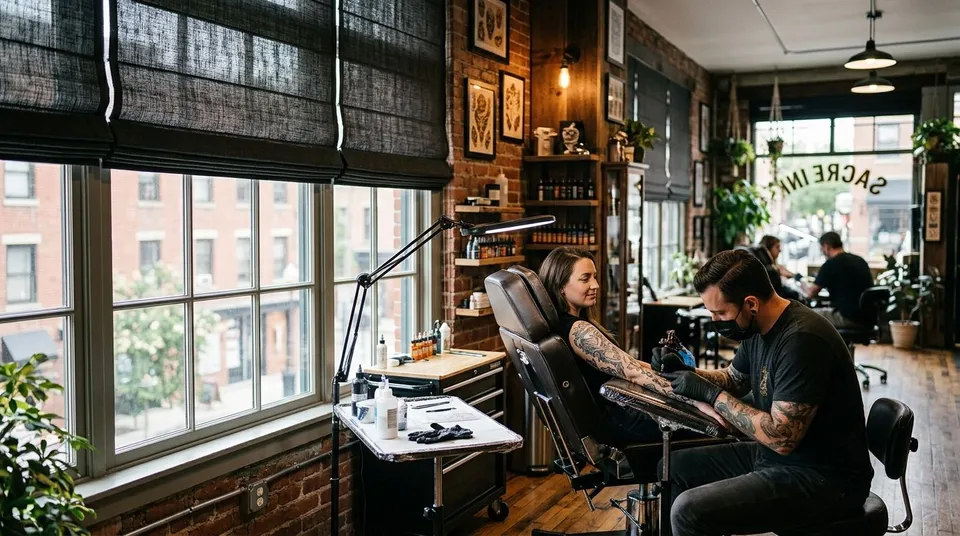
Window treatments for tattoo studios cover the shades and drapery an artist chooses for two different jobs in one shop: a storefront window that still pulls in walk-in clients, and a treatment room where light stays even, ink colors read true, and the client on the table has full privacy. A living room shade list does not solve this. A tattoo studio needs opacity control at the front, blackout or near-blackout at the station, and fabric that wipes clean of ink, stencil fluid, and disinfectant without staining.
- Window treatments for tattoo studios need dual-layer coverage up front and full privacy at the station.
- Vinyl-backed roller shades wipe clean of ink and disinfectant faster than fabric roman shades.
- Cordless or motorized shades matter more here than in retail: gloved hands should not touch a pull cord.
- Rainier Blinds measures and installs custom shades across the Greater Seattle Area, including Auburn, Bellevue, and Tacoma studios.
Why window treatments matter for tattoo studios
A street shop lives or dies on foot traffic seeing activity through the glass, which is the opposite instinct from what a treatment room needs. Studios that treat treatment rooms like spa or salon rooms get this right: visible, welcoming glass at the entry, then a clear opacity step-down as clients move to the chair.
Lighting quality also changes the work itself. Direct sun or hot glare on the skin shifts how saturated ink reads mid-session, which is why artists in daylight-heavy bays end up scheduling more touch-ups than shops with consistent, diffused light. In 2026, more shops are running cellular or zebra shades specifically to flatten that light before it hits the station, not just for privacy.
Assess your storefront window first
Start with the window that sees the most foot traffic, before touching the treatment rooms.
- Note the compass direction: south and west-facing glass gets hot glare in the afternoon and needs light control even if privacy is not the goal yet.
- Check what's visible from the sidewalk right now: reception, flash wall, or a treatment chair.
- Decide if you want the window fully open during business hours or semi-private with light filtering.
- Photograph the window at 9am, 1pm, and 5pm to see how the light actually shifts through the day.
- List anything near the glass that already shows sun fade: flash art, vinyl signage, or retail merchandise.
Set opacity by room, not by shop
One opacity setting for the whole studio almost never works. Matching shade opacity to the room's job instead of picking one fabric for the whole space solves most of the walk-in-versus-privacy conflict.
- Front window and waiting area: light-filtering fabric that lets browsers see activity without seeing faces clearly.
- Consultation rooms: near-blackout, since clients often undress partially for placement discussions.
- Treatment stations with exterior windows: full blackout or a diffusing fabric that kills direct glare on the skin.
- Retail or flash-wall windows: light-filtering with UV protection so printed sheets and merchandise don't bleach out.
- Restroom or private staff areas: full blackout regardless of window size.
Custom motorized and manual shades are the faster route once you know the opacity map for each room. Rainier Blinds measures every window in the shop and matches fabric to that room-by-room list rather than sending one fabric sample for the whole space.
Prioritize wipeable, low-maintenance fabric
Ink, stencil transfer fluid, and green soap end up on more surfaces than most owners plan for.
- Choose vinyl-backed or PVC-coated roller shade fabric over uncoated cotton or linen blends.
- Avoid drapery and fabric roman shades in the actual tattoo bay; cloth panels near ink stains and can't be spot-cleaned the way a flat roller shade can.
- Ask about fabrics rated for commercial wipe-down, not just residential light-cleaning.
- Skip anything with exposed stitching, cording, or fringe near the station; it traps particulate and is harder to disinfect.
- Keep drapery, if you want it at all, for the reception or waiting area only, away from the working chairs.
Cut glare and hot spots at the station
A glare-free window matters as much as a good tattoo lamp once natural light enters the equation.
- Test the window at the time of day the artist works most; morning-only shops have different needs than late-afternoon shops.
- Use a diffusing or blackout fabric directly behind the chair, even if the rest of the room is light-filtering.
- Position the shade to block direct beam without cutting all ambient light, so the room doesn't feel like a cave.
- Pair with the studio's existing lamp setup rather than trying to replace artificial light entirely with shade control.
Go cordless or motorized for hygiene
A pull cord within reach of the chair is a contact point that a corded fabric shade simply doesn't need to have.
- Choose cordless lift for any shade within arm's reach of a client or an artist wearing gloves.
- Consider motorized shades for stations where the artist's hands are occupied and shouldn't touch a wand or cord mid-session.
- Battery-powered motorized options avoid running new wiring through a leased commercial space.
- Pair motorized shades with a wall switch or remote kept away from the immediate work area, not clipped to the window frame.
- Cordless manual shades are the lower-cost middle ground when full motorization isn't in scope yet.
Protect flash art and retail displays from fade
Printed flash sheets, framed portfolio work, and retail merchandise near a window fade faster than most owners expect.
- Use light-filtering or solar fabric with UV protection on any window near a flash wall or retail shelf.
- Openness fabrics in the 1% to 5% range typically block roughly 95% to 99% of UV rays reaching the glass, which matters for anything displayed long-term.
- Rotate flash sheets and posters near the window periodically even with UV-rated fabric installed.
- Keep retail apparel and merchandise racks out of direct beam regardless of shade choice.
Reduce cross-station noise in multi-chair studios
A two- or three-chair studio with open sightlines carries sound between stations more than owners plan for when they're only thinking about light and privacy.
- Cellular shades with a honeycomb structure trap air in sealed pockets, and double-cell versions create two pockets instead of one, which adds a modest sound-dampening effect over a flat roller fabric.
- Combine cellular shades at the window with soft materials elsewhere in the room (rugs, upholstered waiting chairs) for a bigger noise-reduction effect than shades alone.
- Reserve full cellular builds for treatment rooms where a client is likely to be there 60 to 90 minutes, not the reception area.
Comparison: shade options for tattoo and body art studios
| Option | Best for | Key limitation |
|---|---|---|
| Light-filtering roller shades | Storefront windows and reception | Not full blackout; limited privacy once interior lights are on at night |
| Dual-layer zebra shades | Shops that want to toggle between open-for-browsing and private mode | Alternating stripe fabric shows more texture line than a flat roller |
| Blackout roller shades | Private treatment rooms and consultation booths | Blocks all outside light, so the room needs its own supplemental lighting |
| Cellular shades | Multi-chair studios wanting quieter rooms | Honeycomb pleats collect more dust than a flat roller fabric over time |
| Motorized shades (any fabric) | Studios wanting hands-free, cordless operation for hygiene | Needs power or a battery pack, which adds to the install scope |
Verdict: a tattoo studio with a public storefront needs at least two shade types, light-filtering up front and near-blackout at the station, and no single fabric choice covers both jobs well.
Common mistakes tattoo studios make with window treatments
- Blacking out the storefront window entirely. It kills the walk-in visibility that street shops depend on for new client traffic, pushing the studio to rely on Instagram and Google alone.
- Hanging fabric drapery in the tattoo bay. Cloth panels near ink and stencil fluid stain fast and can't be wiped down the way a vinyl-backed roller shade can.
- Leaving corded shades within reach of the chair. A cord near a client or a gloved artist is an avoidable contact point in a room that's otherwise sanitized between sessions.
- Ignoring glare at the actual station window. Direct afternoon sun on the skin changes how ink saturation reads mid-session, which drives more touch-up appointments than a diffused light source would.
- Skipping UV protection on the flash wall or retail window. Unprotected south- or west-facing glass fades printed flash sheets and displayed merchandise faster than owners expect.
Get a shop-specific shade plan
A free in-home or in-shop consultation covers every window, room by room.
FAQ
What's the best window treatment for a tattoo studio storefront?
A light-filtering roller or zebra shade works best for a tattoo studio storefront in 2026 because it keeps the shop visible to walk-in traffic while softening direct glare and blocking a clear view of faces inside. Full blackout at the entry cuts off the foot traffic most street shops depend on.
Should tattoo treatment rooms use blackout shades?
Treatment rooms with exterior windows benefit from near-blackout or full blackout fabric, since it removes direct glare from the station and gives clients full privacy during a session. The room then relies on the studio's own lamp setup rather than shifting daylight.
Are cordless shades better for tattoo studios?
Cordless and motorized shades are the better fit for any window within reach of the chair, since a hanging pull cord is an avoidable contact point in a space an artist works in with gloves. Cordless lift also removes a strangulation hazard near a reclined client.
Can window shades protect flash art and merch from fading?
Yes, light-filtering or solar fabric with UV protection reduces fade on flash sheets, framed portfolio work, and retail apparel near a window. Openness fabrics in the 1% to 5% range typically block roughly 95% to 99% of UV rays reaching the glass.
Do cellular shades help reduce noise between tattoo stations?
Cellular shades add a modest sound-dampening effect because their honeycomb structure traps air in sealed pockets, with double-cell versions trapping air in two pockets instead of one. They work best paired with soft furnishings elsewhere in a multi-chair room, not as a standalone fix.
Is motorized shade control worth it for a tattoo shop?
Motorized shades are worth it for stations where the artist's hands are occupied mid-session and shouldn't touch a cord or wand. Battery-powered motorized options avoid running new wiring through a leased commercial space, which keeps the install simpler.
How do window treatments affect ink color accuracy during a tattoo session?
Direct sun or hot glare on the skin changes how ink saturation appears mid-session, which can lead to more touch-up appointments than a shop with consistent, diffused light. Blackout or diffusing fabric behind the chair keeps the light source predictable regardless of time of day.
What fabric is easiest to clean in a tattoo studio?
Vinyl-backed or PVC-coated roller shade fabric is the easiest to wipe clean of ink, stencil fluid, and disinfectant in a tattoo studio. Uncoated cotton or linen fabrics, and drapery in general, stain and can't be spot-cleaned the same way.
One last thing
Most tattoo studios treat the storefront and the treatment room as one design decision when they're really two separate jobs with opposite goals: one wants to be seen, the other wants to disappear. Solving the front window first, then working backward toward full privacy at the chair, avoids the common trap of blacking out the whole shop and losing walk-in traffic in the process.