
Our available controls: Rainier Blinds offers Roman and woven wood shades with motorized operation only. All other shade styles are available with manual, motorized, or smart control. Your consultation confirms the controls and power options for your product.
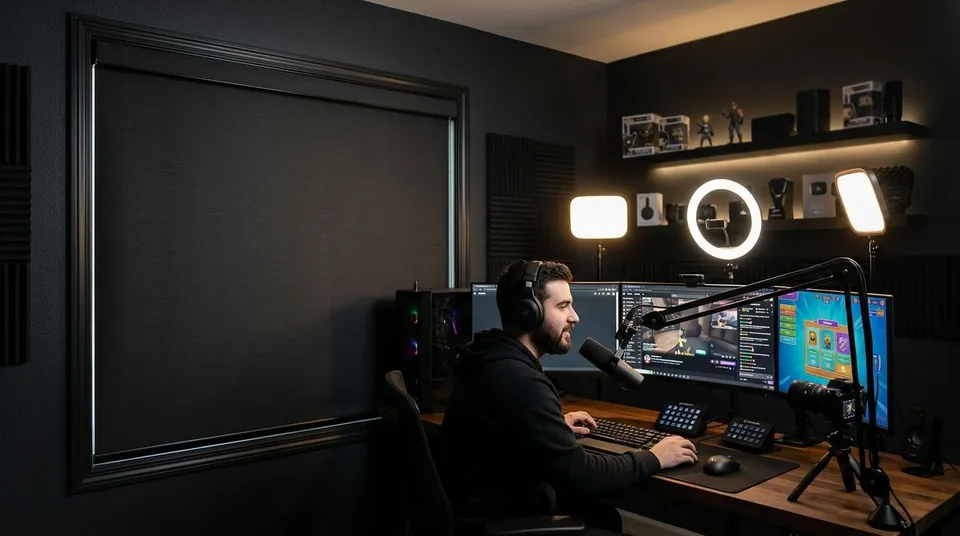
Blackout shades for streaming studios block outside light completely so your camera exposure stays flat and your background doesn't blow out mid-recording, and they do it without the flapping, gapping, or fabric bulk that off-the-shelf blackout curtains bring into frame. A dedicated streaming or content creation space has different demands than a bedroom: consistent light levels take priority over decor, cords need to stay out of the shot, and the shade has to hold its position through hours of continuous recording.
- Blackout shades for streaming studios need side channels or a tight cassette to kill light gaps that ruin exposure on camera.
- Motorized blackout roller shades are the fastest fix for a studio window that changes light through the day.
- Rainier Blinds measures for zero light gap and installs a crew that handles wiring and mount type in one visit.
- Blackout drapery works better than shades for wide backdrop walls where a soft, styled look matters on camera.
- Smart blackout shades let you preset a lighting scene and trigger it before every recording session.
Why blackout shades matter for streaming studios
A camera sensor reacts to light changes that a human eye barely notices. A shaft of afternoon sun sneaking through a gap on the side of a shade will show up as a blown-out highlight on your feed, and a viewer scrolling past will notice before you do. Content creators who record at inconsistent times of day, especially in the Pacific Northwest where daylight swings hard between seasons, need a shade system built to shut that variable down completely, not manage it.
This is different from a bedroom blackout need. A bedroom shade just has to get dark enough to sleep. A studio shade has to hold a flat, repeatable light level across every session, on demand, without you standing up to adjust it. That's why motorized shades for home recording studios come up so often in this category: the ability to trigger the same shade position every single time removes a variable that manual shades leave up to you.
Update your window coverage plan
Before picking a shade, map every light source hitting your recording setup, not just the main window.
- Note any skylights, transom windows, or glass doors in frame or behind the camera
- Check for light leaking around door frames near the recording area
- Identify which window faces get direct sun and at what time of day
- Flag any window with a non-standard shape (arched, trapezoid, bay) that needs a custom-fit shade
- Rule out anything with slats, since venetian-style products always leave light gaps a camera will catch
Choose a mount type that kills light gaps
The single biggest failure point in DIY blackout setups is the mount, not the fabric.
- Use side channels or light-blocking tracks on inside-mount shades to seal the gap at the edges
- Add a fascia or cassette at the headrail to stop light spilling over the top
- Confirm the window frame depth supports a true inside mount before ordering
- Skip stock big-box blackout shades sized to the nearest inch; a quarter-inch gap on either side is enough to show on a wide shot
Layer your material for both privacy and blackout
Single-layer blackout fabric works, but studios recording at odd hours often want a light-filtering option for setup and editing time, then full blackout for recording.
- Pair a blackout roller shade with a sheer or light-filtering layer for non-recording hours
- Consider dual zebra shades with a blackout liner add-on if you want one shade to do both jobs
- Keep the blackout layer closest to the glass for the tightest seal
- Match fabric opacity to your specific recording schedule, not a generic "dark room" standard
The manual version of this setup, tension-mounted rods and static blackout panels, gets you most of the way there for a fixed schedule. Once your recording times shift day to day, a motorized or smart shade earns its keep because you're not climbing on a stool to reposition fabric between takes.
Program your shade for repeatable light
Once shades are motorized, the light-consistency problem becomes a settings problem.
- Set a preset position for "recording mode" so the shade returns to the exact same spot every session
- Pair the shade with a smart home hub if your studio already runs on voice or app control
- Schedule an automatic close 15-20 minutes before your regular recording block starts
- Test the preset at different times of year, since sun angle shifts the light leak point even with the shade fully closed
Reduce glare on video calls and livestream cameras
Blackout isn't only about darkness, it's about controlling reflected light that bounces off monitors and lighting rigs back into the lens.
- Close shades fully during livestreams that run during daylight hours to remove reflected glare off glass
- Position your key light so it doesn't compete with residual light bleeding through a shade edge
- Check monitor and webcam feedback for washed-out spots that trace back to a specific window
- Review how to reduce video call glare with motorized shades if your studio doubles as a meeting room
Measure and install for zero light leak
This is where a DIY blackout kit usually falls short. A window that's off by even a small margin lets light through at the exact spot a camera will pick up.
- Get an exact measurement of frame depth, width, and squareness before ordering
- Confirm whether an inside or outside mount seals the window better for your specific frame
- Have the shade installed level and tight to the frame; a shade hung crooked by a quarter-inch shows up as a bright sliver on camera
- Rainier Blinds measures and installs with its own crew across the Greater Seattle Area, not a subcontractor, which matters when the fit has to be exact for a camera-facing window
Get an exact blackout fit measured
In-home consultation and install across the Greater Seattle Area.
Comparison: blackout options for a streaming or content studio
| Option | Best for | Key limitation |
|---|---|---|
| Blackout roller shades | Fast, clean blackout on standard studio windows | Single flat panel with no light-filtering layer built in |
| Blackout cellular shades | Studios that also want sound dampening and insulation | Adds stack height at the top of tall windows |
| Blackout roman shades | A softer, styled look that still reads well on camera | More fabric bulk visible when raised out of frame |
| Blackout drapery | Wide window walls or full backdrop coverage | Needs floor-to-ceiling space and rod hardware to hang right |
| Dual zebra shades with blackout liner | Switching between daytime light and full blackout on one shade | Not true room-darkening without the liner add-on |
Verdict: blackout roller shades win for most single-window streaming setups in 2026 because they seal tightest with the least fabric in frame; drapery wins when the backdrop itself is part of the shot.
Common mistakes streaming studios make
- Ordering stock sizes instead of custom measurements. A quarter-inch gap at the edge of a big-box blackout shade is invisible to the eye and obvious on camera.
- Skipping the mount type decision. An outside mount on a deep-set window leaves a visible light bar at the top that no fabric fixes.
- Choosing manual shades for a variable recording schedule. If your streaming hours shift, a manual shade means you're adjusting fabric between every session instead of hitting a preset.
- Ignoring reflected glare from monitors and lighting rigs. Blackout at the window doesn't stop light bouncing off a glass desk or a second monitor behind the shot.
- Forgetting secondary light sources. A transom window or a glass door behind the camera undoes an otherwise perfect blackout setup on the main window.
FAQ
What's the best blackout shade for a streaming studio?
Blackout roller shades with side channels or a cassette headrail work best for most streaming setups in 2026 because they seal tightest against the frame with minimal fabric bulk. Drapery is a better fit when the window wall itself is part of the on-camera backdrop.
Do blackout shades actually stop all light from a window?
A properly measured blackout shade with side channels or an inside mount tight to the frame stops nearly all direct light. Gaps happen when the shade is sized loosely or mounted without a light-blocking track, which is the most common failure point in DIY installs.
Are motorized blackout shades worth it for a home studio?
Motorized blackout shades are worth it if your recording or streaming schedule changes day to day, since a saved preset returns the shade to the exact same position every session. Manual shades work fine for a fixed daily schedule.
Can smart shades sync with a streaming setup or smart home hub?
Yes, smart blackout shades can pair with a smart home hub so a preset triggers before a recording block starts. This removes the need to manually check light levels before every session.
What's the difference between blackout and light-filtering shades for a studio?
Blackout shades block essentially all outside light, while light-filtering shades soften light without eliminating it. A studio recording at variable hours often layers both so daytime work happens under filtered light and recording happens under full blackout.
Do zebra shades work for blackout in a content studio?
Standard zebra shades filter light rather than fully block it, so they're not a true blackout solution on their own. A blackout liner add-on is needed to get full room-darkening performance from a zebra shade.
How is a studio blackout shade different from a bedroom blackout shade?
A studio shade has to hold a flat, repeatable light level on demand for a camera, while a bedroom shade just needs to get dark enough to sleep. That difference is why mount precision and motorized presets matter more in a studio setting.
Does Rainier Blinds install blackout shades for studios in the Seattle area?
Rainier Blinds measures and installs blackout shades with its own crew across the Greater Seattle Area, including Bellevue, Tacoma, and Auburn. Every quote happens at a free in-home consultation where the exact mount and fabric are worked out on site.
One last thing
The detail most streaming studios miss isn't the fabric, it's the top of the headrail. A shade can be dead-black fabric and still leak a visible line of light at the ceiling if the cassette or fascia doesn't sit flush against the frame, and that thin bright line is exactly where a viewer's eye lands on a wide shot. Check that spot first before assuming your shade needs replacing.