Our available controls: Rainier Blinds offers Roman and woven wood shades with motorized operation only. Available controls and power options for other products are confirmed at your consultation.
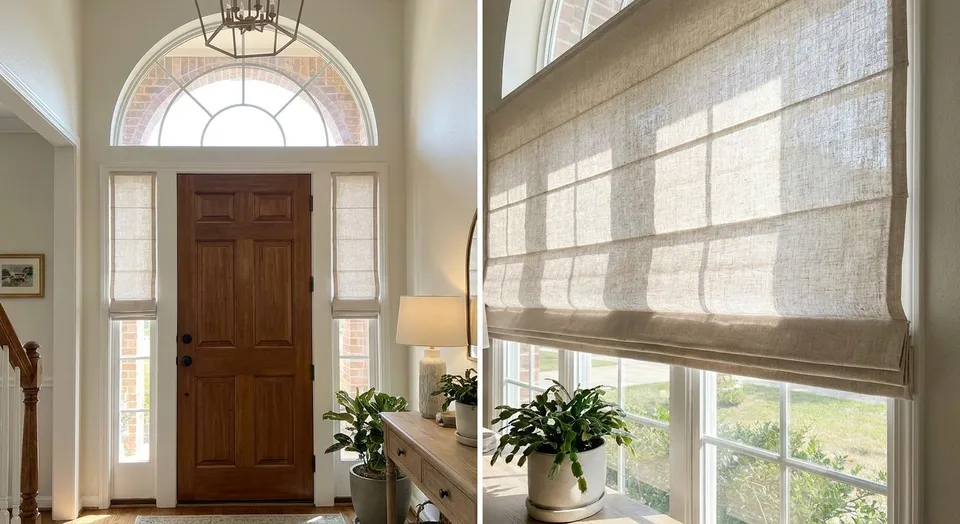
Transom windows above an entry door flood a foyer with light, but they also put anyone standing on your porch at eye level with your living room. Getting privacy right without blacking out the glass is the whole problem transom window shades entryway buyers are trying to solve in 2026.
- Cellular shades win for transom window shades entryway projects in 2026. Light-filtering fabric cuts glare without blacking out the foyer. Buy.
- Skip drapery on transoms under 14 inches tall; panels look bulky and block glass that's already small.
- Motorized lift pays off once the window sits above 7-8 feet. A cord you can't reach isn't privacy, it's decoration.
- Zebra shades toggle privacy fastest for entryways facing the street, switching from sheer to opaque in seconds.
Why this matters
Most transom windows sit above a standard 80-inch door, which puts the bottom rail somewhere between 7 and 9 feet off the floor. That height rules out anything that needs a wand or a pull cord you can actually reach, and it changes which right mount type for custom blinds actually works, inside mount only fits if the frame has real depth, and a lot of entry transoms don't.
Get the mount and the control method wrong on a transom and you end up with a shade that either can't be raised without a ladder or one that's been left in the "down" position since installation. Rainier Blinds sees this in Auburn, Bellevue, and Tacoma entryways constantly: a shade purchased for looks, never actually operated.
Who this is for
This guide is for homeowners with a fixed transom window over an entry door, arched, rectangular, or angled, who want street privacy at night without turning the foyer into a cave during the day. It's for anyone who's already tried a stock blind from a big-box store and found it two inches too short, or a cordless model they can't reach without a step stool.
What to look for in shades for entryway transoms
Mount depth and frame clearance
Transom frames are often shallow, sometimes under 2 inches, which knocks inside mount off the table before you even pick a fabric. Measure the frame depth first. Outside mount adds visible hardware but solves the clearance problem on nearly every transom Rainier Blinds measures.
Light control without blackout
For an entryway, decide how much glare control and after-dark privacy you need. Compare actual fabrics from inside and outside; a solar openness number alone does not establish nighttime privacy.
Motorization for hard-to-reach transoms
Anything mounted above 7 feet is a candidate for motorized lift, full stop. A battery-powered or hardwired motor removes the ladder from the equation entirely and lets you tie the shade to a schedule so it opens at sunrise without anyone touching it.
Shape-matching for arched or angled glass
Arched transoms need a shade built to the actual curve, not a rectangle trimmed to fit. If your entryway has an arched or angled specialty window, the fabric and headrail both have to be custom-cut. Stock sizing doesn't bend.
Fabric durability near drafty entry doors
Entry doors open and close, letting in temperature swings and moisture that a bedroom window never sees. Polyester and vinyl-coated fabrics hold their shape better than natural woven materials in that kind of daily draft exposure.
Top picks for transom window shades in entryways
Cellular shades, the light diffuser. Cell sizes as small as 3/8 inch fit narrow transom openings without looking like an afterthought, and the honeycomb structure filters light evenly across the whole pane. They hold their shape in a drafty entry better than flat fabrics and come in light-filtering or blackout versions. Verdict: Buy.
Light-filtering roller shades, the clean line. A single flat panel of fabric with a 5% openness factor cuts glare at the door without going dark. Roller shades mount fast on rectangular transoms and cost less than cellular in most cases. Verdict: Consider.
Zebra shades. The privacy toggle. Alternating sheer and opaque bands let you dial privacy up or down in seconds by sliding the fabric, which matters on a transom facing a sidewalk. The tradeoff is a slightly bulkier headrail than a plain roller shade. Verdict: Consider.
Motorized lift upgrade. The reach fix. Any of the shade types above can be built with a motorized lift, and on a transom mounted 8 feet up, this stops being a luxury and starts being the only way the shade gets used. Battery packs typically run a season or more between charges depending on how often the shade cycles. Verdict: Buy if the bottom rail sits above 7 feet.
Woven wood roman shades. The texture pick, skipped here. They look sharp on a wide living-room window, but the folded stack height on a roman shade eats into the small glass area a transom already has, and moisture near an entry door isn't kind to woven wood over time. Verdict: Skip for transoms specifically, even though they're a strong choice elsewhere in the house.
What to avoid
- Full drapery panels on a transom under 14 inches tall. The proportions look wrong and the fabric stack blocks more glass than it should.
- Cordless-only shades mounted above 7 feet with no motorization option. You'll operate it twice and then stop.
- Blackout fabric for a foyer that gets most of its natural light from that one window. You'll trade a bright entryway for total darkness with no middle setting.
Verdict comparison
| Shade type | Mount fit | Light control | Reach above 7ft | Verdict |
|---|---|---|---|---|
| Cellular shades | Outside mount, shallow frame OK | Light-filtering to blackout | Motorized option | Buy |
| Light-filtering roller | Outside mount, rectangular only | Soft glow, ~5% openness | Motorized option | Consider |
| Zebra shades | Outside mount, rectangular | Adjustable sheer/opaque | Motorized option | Consider |
| Woven wood roman | Outside mount | Light-filtering | Rainier woven wood is motorized only | Skip |
“A shade you can't reach isn't privacy. It's decoration.”
Get transom shades measured right
Rainier Blinds measures entry transoms in Auburn, Bellevue, and Tacoma and installs with our own crew.
FAQ
What's the best shade for a transom window entryway?
Cellular shades are the best fit for most entry transoms in 2026 because their honeycomb structure filters light evenly and holds shape in shallow, drafty frames. Light-filtering roller shades are a close second on a budget.
Can transom windows above a door be motorized?
Yes, cellular, roller, and zebra shades on transoms can all be built with motorized lift. It's the practical choice once the bottom rail sits above 7 feet, which most entry transoms do.
Do transom shades need to be blackout?
An entryway may suit light-filtering fabric, solar screen, or a darker fabric depending on the sun and privacy needs. Compare samples after dark as well as during the day; choose blackout where reducing light is the actual goal.
Are drapery panels a good option for entry transoms?
Drapery works poorly on transoms under 14 inches tall because the fabric stack blocks a disproportionate share of the small glass area. A flat cellular or roller shade keeps more of the window usable.
How much clearance does an entry transom need for inside mount?
Inside mount typically needs at least 2 to 2.5 inches of frame depth, and many entry transoms fall short of that. Outside mount solves the problem and is the more common choice on transoms.
Is zebra shade better than roller shade for street-facing transoms?
Zebra shades give faster privacy control because you slide between sheer and opaque bands without lowering the whole shade. Roller shades are simpler and slightly cheaper but offer only one fabric setting.
What happens if I install a cordless shade too high to reach?
You'll end up leaving it in one position permanently because there's no way to adjust it without a ladder. That defeats the point of buying an adjustable shade in the first place.
Can arched transom windows get custom shades?
Yes, arched or angled transoms need a shade cut to the actual curve rather than a trimmed rectangle. Both the fabric and headrail are built to the specific shape during measurement.
One last thing
The detail most people miss on a transom project isn't the fabric, it's the headrail color. A white headrail against a dark entry door frame reads as a visible stripe from the street, while a headrail color-matched to the trim disappears, worth asking about before the 2026 install date gets locked in.