
Our available controls: Rainier Blinds offers Roman and woven wood shades with motorized operation only. Available controls and power options for other products are confirmed at your consultation.
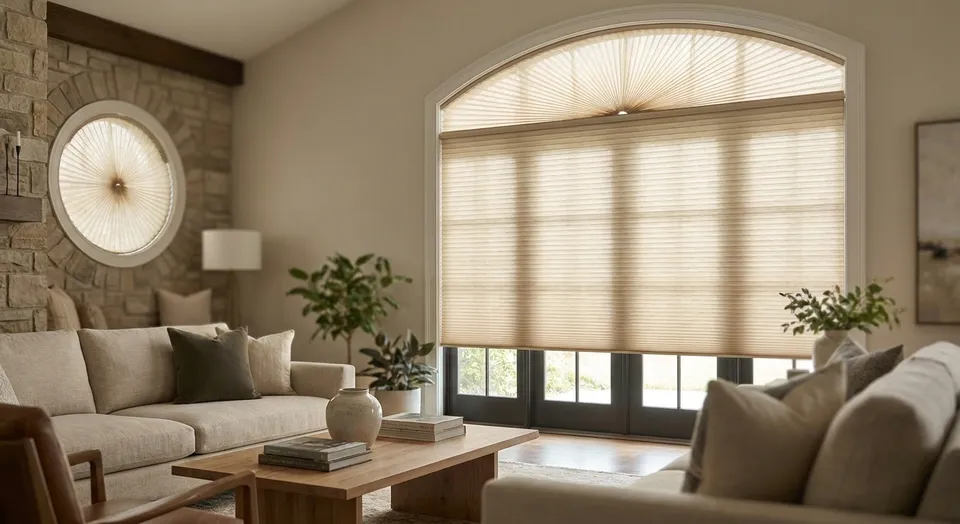
Arched transoms, half-moons over French doors, and canted bay windows don't take a standard headrail. The frame is either curved, angled, or fixed in place, and most off-the-shelf shades simply won't sit flat against that opening. Pleated shades for specialty windows solve that problem with fabric that's cut, pleated, and mounted to match the exact geometry of the frame, not a rectangle that gets forced to fit.
- Cellular shades are the safest pick for pleated shades specialty windows because the honeycomb structure holds its shape on fixed arch-top frames.
- Skylight shades handle angled and overhead glass that cellular shades can't reach without a custom track in 2026.
- Woven wood roman shades add texture to arched picture windows but lose full blackout capability.
- Skip any 'universal fit' pleated kit sold online. Arch measurements need a template pull, not a tape measure guess.
Why this matters
A specialty window that's measured wrong doesn't just look off. It doesn't operate, or it doesn't mount at all. Arch-tops are usually treated as a stationary panel because there's no headrail geometry that lets fabric retract around a curve. Rainier Blinds installs cellular shades cut and pleated specifically for arch-top and skylight openings across Auburn, Bellevue, and Tacoma, and the honeycomb pleat construction is what makes a fixed-panel arch shade hold a clean, straight fold line instead of sagging in the middle within a year.
The stakes are cost, not just aesthetics. A specialty-shaped shade built wrong can run $300 to $600 more than a standard rectangle for the same window, and there's no return window once the fabric is cut to a curve. Getting the criteria right before you order matters more here than it does on a standard double-hung window.
Who this is for
This guide is for homeowners with at least one non-rectangular window, arch-top, half-round, trapezoid, skylight, or a deep bay, who want a fabric treatment that isn't a plantation shutter or a static decorative panel. It's for anyone who's already been told by a big-box measuring service that their arch "can't be done" in a moving shade, and for anyone budgeting a 2026 remodel that includes at least one specialty-shaped opening.
What to look for in pleated shades for specialty windows
Fixed vs. operable mounting
Most arch-tops over 90 degrees of a circle get mounted as a stationary panel, full stop, there's no mechanism that retracts fabric around a true curve without a custom curved track, which adds real cost. Confirm with your installer whether your arch is getting a moving shade or a fixed decorative panel before you pick fabric, because that decision changes the pleat depth you want.
Pleat depth and fabric stiffness
A 3/8-inch single-cell pleat holds a crisp fold on a fixed arch panel; anything softer or wider tends to bow in the middle within months, especially on openings wider than 36 inches. Stiffer fabrics with a resin or laminate backing hold the curve better than sheers.
Light control layering
Skylights and south-facing arches in the Puget Sound area take direct glare for a longer window in summer 2026 than most homeowners expect, even with regular cloud cover. Decide upfront whether the specialty window needs full blackout, light-filtering, or a sheer layer, retrofitting light control after a fixed panel is installed usually means a full remake, not an add-on.
Frame profile and headrail concealment
On an arch, there's often no wall depth to hide a headrail, so the mounting hardware has to sit inside the curve itself. A shallow-profile mount matters more on specialty shapes than on standard windows, where a deeper headrail can hide behind trim.
Motorization compatibility
High arch-tops and skylights are frequently out of reach for a manual wand, which makes motorization less of a luxury add-on and more of a functional requirement. Confirm the motor and remote or hub work with the mount depth of the specialty shape before ordering. Not every low-profile mount has room for a battery pack.
Top picks for pleated shades specialty windows
Cellular shades. The safe pick. Honeycomb cells hold a 3/8-inch pleat depth without sagging on fixed arch panels, and the same fabric line runs light-filtering to full blackout. Buy for arch-tops, half-moons, and trapezoid windows where the shade will be stationary.
Skylight shades, the specialist pick. Built for angled and overhead glass rather than vertical frames, skylight shades use a track-mounted or crank system designed for the pitch of the roofline instead of a wall. Buy for actual skylights and sloped ceiling windows; skip for vertical arch-tops, where the mounting hardware doesn't apply.
Woven wood roman shades. The texture pick. Natural reed and bamboo weaves add warmth to a large arched picture window, but the weave doesn't hit true room-darkening levels the way cellular blackout fabric does. Consider for farmhouse or coastal-style homes where light control is secondary to look; skip for bedrooms needing full blackout.
Motorized shades on large picture-window arches, the automation pick. For arched openings paired with an oversized picture window below, a synced motorized system lets both sections operate on one remote or schedule instead of two separate manual pulls. Buy if the window is out of easy reach; hold if budget is the deciding factor, since motorization adds cost on top of the custom cut.
Get an arch-window measurement
A crew measures the exact curve on-site before anything gets cut.
What to avoid
"Universal fit" pleated shade kits sold online. These ship pre-cut to standard arch radii and almost never match a real-world opening. Most residential arches are custom-built and don't follow a stock curve. A kit that's off by even a half-inch on a fixed panel shows a visible gap at the frame edge.
Skipping the mount-type conversation. Arch and skylight openings need a different mounting approach than a standard window, and getting this wrong means a redo. Review how to choose the right mount type for custom blinds before finalizing any specialty-shape order, because the wrong mount is the single most common reason a custom arch panel gets sent back.
Treating fabric choice as purely decorative. Homeowners layering trim work or a panel grid layout on a feature wall near an arched window often make the mistake of matching the shade fabric to the wall paneling purely on color, when pleat depth and fold direction matter just as much for the finished look. If the wall paneling runs horizontal lines, a vertical pleat in the shade fabric competes with it instead of complementing it.
If the arch is more than 90 degrees of a circle, a fixed decorative panel is the only realistic option, a moving shade on that curve isn't a stock product.
Verdict comparison
| Pick | Best for | Pleat/fabric | Mount type | Verdict |
|---|---|---|---|---|
| Cellular shades | Arch-tops, half-moons, trapezoids | 3/8-inch honeycomb cell | Fixed panel, inside mount | Buy |
| Skylight shades | True skylights, sloped ceilings | Track or crank system | Roof-pitch mount | Buy for skylights |
| Woven wood roman shades | Large arched picture windows | Natural reed/bamboo weave | Fixed or operable | Consider |
| Motorized picture-window arch shades | Oversized combined openings | Cellular or roller fabric | Synced motor mount | Buy/Hold on budget |
FAQ
What are pleated shades and how do they work on arched windows?
Pleated shades use fabric folded into fixed creases, and on arched windows they're almost always mounted as a stationary panel cut to the exact curve of the frame. Cellular (honeycomb) shades are the version most commonly used for this because the pleat structure holds shape without a moving headrail.
Can cellular shades be shaped for an arch-top window?
Yes, cellular shades can be cut and mounted as a fixed panel that follows the exact radius of an arch-top opening. They won't retract like a standard cellular shade does on a rectangular window; the panel stays in place once installed.
Are skylight shades the same as pleated shades?
No, skylight shades are a separate mounting system built for angled or overhead glass, while pleated construction refers to the fold pattern in the fabric itself. A skylight shade can use pleated fabric, but the track and mounting hardware are different from an arch-top panel.
How much do custom shades for specialty windows cost in 2026?
Specialty-shaped shades typically run $300 to $600 more than a standard rectangular shade of the same size in 2026, mainly due to custom cutting and template measurement. Motorization on top of a custom cut adds further cost depending on the mount.
Can pleated shades be motorized on arched windows?
Fixed arch panels generally aren't motorized since they don't move, but any operable section paired with the arch, like a picture window below it, can run on a synced motor. That's the more common way motorization gets used on specialty-shaped combinations.
What's the best window treatment for a half-moon window?
A fixed cellular shade panel is the most common answer for a half-moon window because the honeycomb pleat holds a clean curve without sagging. Decorative fixed fabric panels are the alternative when light control isn't a priority.
Do pleated shades block light as well as blackout shades?
Pleated cellular shades come in light-filtering and full blackout fabric options, so light control depends on which fabric line you choose, not the pleat structure itself. Woven wood weaves, by comparison, filter light but don't reach true blackout levels.
How do you clean pleated fabric shades on hard-to-reach specialty windows?
A soft brush attachment on a vacuum handles most dust buildup in the pleats without pressing the fabric out of shape. For skylights or high arches, this usually requires a pole attachment or a scheduled service visit rather than a stepladder.
One last thing
Most homeowners assume the arch is the hard part of the measurement. It's actually the wall depth around it that trips up more installs, since there's rarely enough return depth to hide hardware the way a standard window allows. Ask for that measurement specifically before you commit to a mount type.